







Deciding to embark on the journey of writing a novel can be overwhelming and even terrifying. There’s so much advice out there, and it’s hard to choose who to listen to. Well, fear not, this week at Bookstr, we’re not offering opinions that you have to decide if you want to agree with. We’re laying out the nuts and bolts of three prevalent story structures, as well as one additional method you can combine with these three structures if you choose to! Warning! Spoilers ahead for The Hobbit, The Hunger Games, Immortal Longings, and A Court of Thorns and Roses.
We’ll be discussing:
- The Hero’s Journey
- The Three Act Structure
- Save the Cat
- The Snowflake Method
The Hero’s Journey
The Hero’s Journey involves your main character, or hero, departing from the world they know (perhaps unwillingly), facing trials, accomplishing a task or completing a lofty quest, and returning home changed. There are 12 classic touchpoints in this structure, as well as distinctions between when the hero is in their ordinary world versus the new, strange one. Let’s get into it.
The Ordinary World
In the story’s opening, we see the main character living the life they’ve always known. Maybe they’re happy, maybe they’re not, but either way, they are familiar with their surroundings, and their familiarity allows readers to feel a sense of normalcy.
The Call To Adventure
The call can come in almost unlimited forms. Maybe your hero receives a knock on their door telling them they’re the long-lost heir to a dying kingdom. Maybe they discover that they have magical abilities they want nothing to do with. Or maybe someone directly asks them for help on a mission they don’t care to go on. However the call presents itself, it will be a request to the hero to do something they aren’t keen on.

Refusal of the Call
The hero’s refusal or reluctance to answer the call is a pivotal point in their journey and adds a sense of characterization to your hero. They often do not dream of glory or riches and may be perfectly content living life just as they have been. But inevitably, something will happen after the refusal that causes them to change their mind.
Meeting the Mentor
Whether the mentor is a person, a creature, a book, or even a vision, this meeting will equip the hero with the knowledge, supplies, and just enough confidence to convince them to continue on the journey.
Crossing the Threshold
This pivotal step is when the hero wholeheartedly commits to the adventure. Crossing the threshold also means the hero will be leaving behind the world they know and stepping into a new realm, where they must think fast and learn faster.

Tests, Allies, Enemies
In this new world, the hero will encounter many new people, places, and things. They will be challenged in new ways, make unlikely friends, and make themselves a few enemies. This is also when they will often encounter the forces of the main antagonist directly or see firsthand the consequences that will be wrought should they fail in their mission. The stakes are rising.
Approach the Inmost Cave
Tensions ramp up as the hero approaches the main conflict, armed with new knowledge and confidence and bolstered by allies. They are nearing the center of the external conflict and their own internal battle. Whether it is the same discrepancy that made them refuse the call (like cowardice or fear) or a new conflict they have not yet been able to resolve, the hero’s conscience is approaching a pivotal turning point.
The Ordeal
In the thematic and physical climax of the story, the hero faces their greatest challenge yet. This moment is the culmination of all they’ve learned, everyone they’ve met, and everything they’ve lost along the way. Their morals and abilities will be put to the test, and readers will be able to see the effect of the journey on the hero. They will likely do things differently than they would have at the beginning of the story.

Reward
Usually, the hero succeeds, but at a great cost. The reward is often bittersweet, and the hero has had to sacrifice much in order to reap the reward. Whether it was the death of a friend or an ally, or that the circumstances forced them to give up their innocence and see the world for what it really is, there is always a price. They begin to experience the consequences of their success.
The Road Back
Now the hero begins their journey home, returning to the world they once knew, but it feels different to them, as they are the ones who are forever changed. If they are not returning home, they are continuing on in their journey in a world that they now know much better and perhaps feel more accustomed to than their original world.
Resurrection
The hero experiences a final challenge, question, or event that purifies their conscience, galvanizes their mindset, and reminds them of all they’ve accomplished. They can now return to the ordinary world with an (at least partially) healed soul.

Return With the Elixir
They return with knowledge, power, or a boon that will solve a problem, prevent a disaster, or benefit the world from which they came in some other way.
This structure correlates with a larger tri-phase setup, with steps 1-5 being the Departure from the world they once knew, 6-9 being the Initiation into their new role as the hero, and 10-12 being the Return where they let their experience sink in and deal with the consequences and rewards of their actions.
Example
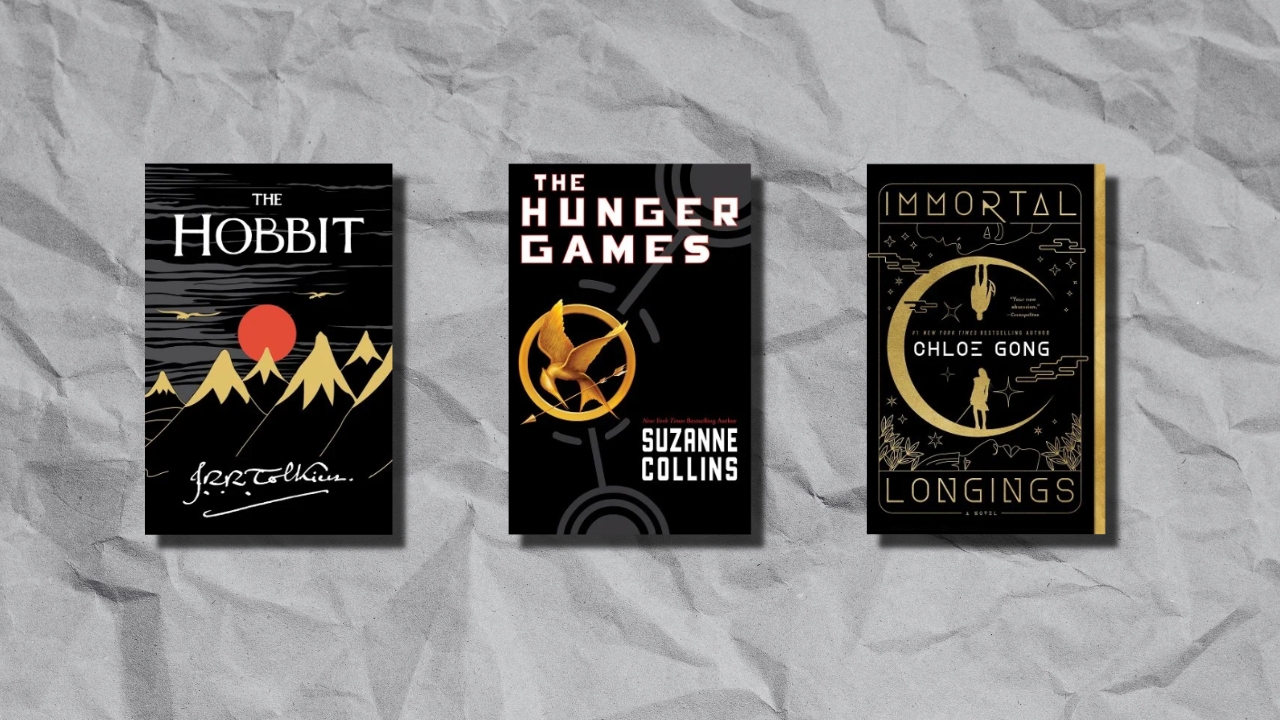
One example of a novel that utilizes this structure is The Hobbit by J.R.R. Tolkien. In this story, Bilbo, the MC, wants nothing to do with the dwarves and Gandalf when they arrive and urge him to come on their perilous mission with them. After much convincing and a bit of wounded pride, Bilbo decides to join them. Gandalf is their legendary mentor, and Bilbo crosses the threshold into the unknown when he decides to leave the Shire.
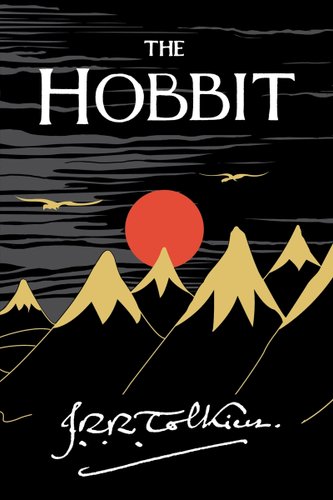
Along the way, trolls capture them, they make friends with the elves, are attacked by goblins, and grapple with gigantic spiders, among other trials and tribulations. When the dwarves are captured, timid and sneaky, Bilbo must brace himself to endeavor to rescue them alone. When he succeeds, he gains new confidence to equip him for the next part of his journey.
Once they reach the Lonely Mountain, Bilbo must play his role as the burglar and enter the dragon Smaug’s lair alone. He succeeds in stealing his treasure, but Smaug is enraged, and the team must collaborate with many allies to find his weakness and take him down. Bilbo utilizes his newfound wit and cunning to help solve the argument over who gets the treasure and how it will be allotted. He then spends time with his new friends and allies before returning to his peaceful life in the Shire.
The Three Act Structure
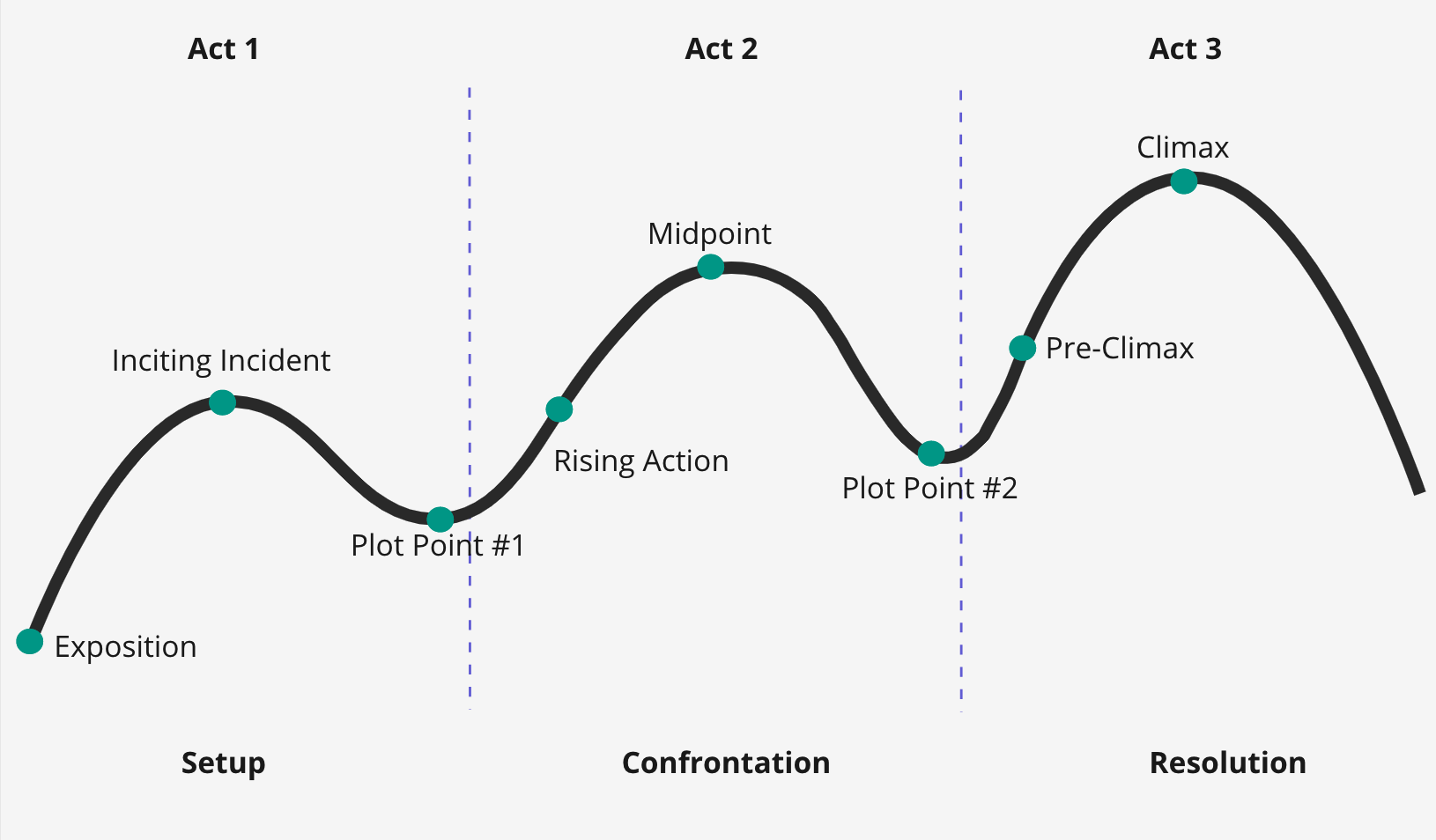
The Three Act structure divides the story into, as the title suggests, three main acts: Setup, Confrontation, and Resolution. Each act is then broken down into smaller, specific beats that power the plot forward.
Act 1: Setup
The first act introduces your characters and their world and establishes relationships, societal standards, and norms. This beat is called the exposition. Shortly after, the main character will experience an inciting incident. Something will happen to them, or they will receive information that pushes them off on their journey. Once they’re off, your MC and their team will encounter their first challenge. This is plot point one that gets the ball rolling for Act Two.
Act 2: Confrontation
This act is when tensions begin to rise and characters begin to face the challenges laid out in Act 1. Events or information raise the stakes, and your MC begins to better understand what they’re up against during the rising action. At the midpoint, everything changes. This mini-climax gives the characters the rest of the information they need to form a complete picture of the challenges they face, and this information spurs on the second plot point. At this point, readers and characters alike begin to doubt whether the team will prevail in the conflict.
Act 3: Resolution
The third and final act is the culmination of all the characters have learned and experienced along their journey. During the pre-climax, the team prepares for the final challenge. Whether that’s a college entrance exam or a battle of kingdoms, things are now heating up. The climax brings everything to a head, and things start to wind down after the outcome. Whether they succeeded or not, the resolution will usually bring some sort of peace to the characters. Even if they didn’t win the main war, they may have won a spiritual or emotional one.
This structure is quite open-ended and allows for much creativity and variation as you write through the beats.
Example
The Hunger Games by Suzanne Collins is a prominent example of a book that utilizes the Three Act Structure. During the setup, readers are introduced to Panem, the way of life in District 12, and Katniss, along with her family and friends. Katniss navigates her ordinary world for some time before the Reaping, and readers become familiar with the societal norms and the world she lives in.
During the confrontation, which begins when Katniss volunteers in place of her sister Prim, Katniss leaves the world she knows and is thrust into the world of the Capitol. She meets her mentor Haymitch, her ally Peeta, and the other competitors she will later be forced to fight to the death. And she faces seemingly impossible trials when the games begin and is subjected to the Gamemaker’s will. Everything changes when they decide that two victors can now win instead of just one, and Katniss finds herself reunited with a dying Peeta.
To save him, Katniss must face the deadliest challenge yet, and nearly loses her life in the process. With the numbers dwindling, the Gamemakers force all remaining candidates into one location, where their final and most dangerous opponent tries to kill Peeta for revenge. Katniss realizes in this terrifying and sickening moment that although Cato is her current enemy, they are all simply products of the cruelty of the nation that raised them. She succeeds in killing Cato mercifully and saves Peeta.
When the Capitol announces that only one person can win, Katniss takes a stand. After experiencing the games, she is full of rage. She decides that she and Peeta can use this moment to rebel, eating the poisonous Nightlock berries and killing themselves instead of allowing the Capitol to manipulate them further. They immediately announce that the games are over and Katniss and Peeta have won, but this rebellion sets the events of the second and third books in motion.
Save the Cat
Perhaps the most detailed and granular structure we’ll explore, Save the Cat, is divided into four main acts, further sectioned into specific beats. Adapted for novel writing from screenplays, Save the Cat offers specificity and clear descriptions of each beat for writers to adapt to their plots.
Act 1
Opening Image:
The first page — or few pages — of your story should launch your reader right into the world you’re creating or portraying. Opening with clear, vivid imagery gives your reader a sense of your story’s setting. However, you’ll want to be careful not to engage in the dreaded info dump. “Show, don’t tell” is a general rule to follow to show your readers a glimpse of the world without getting into lengthy ramblings about the history and culture of your story and its inner machinations.
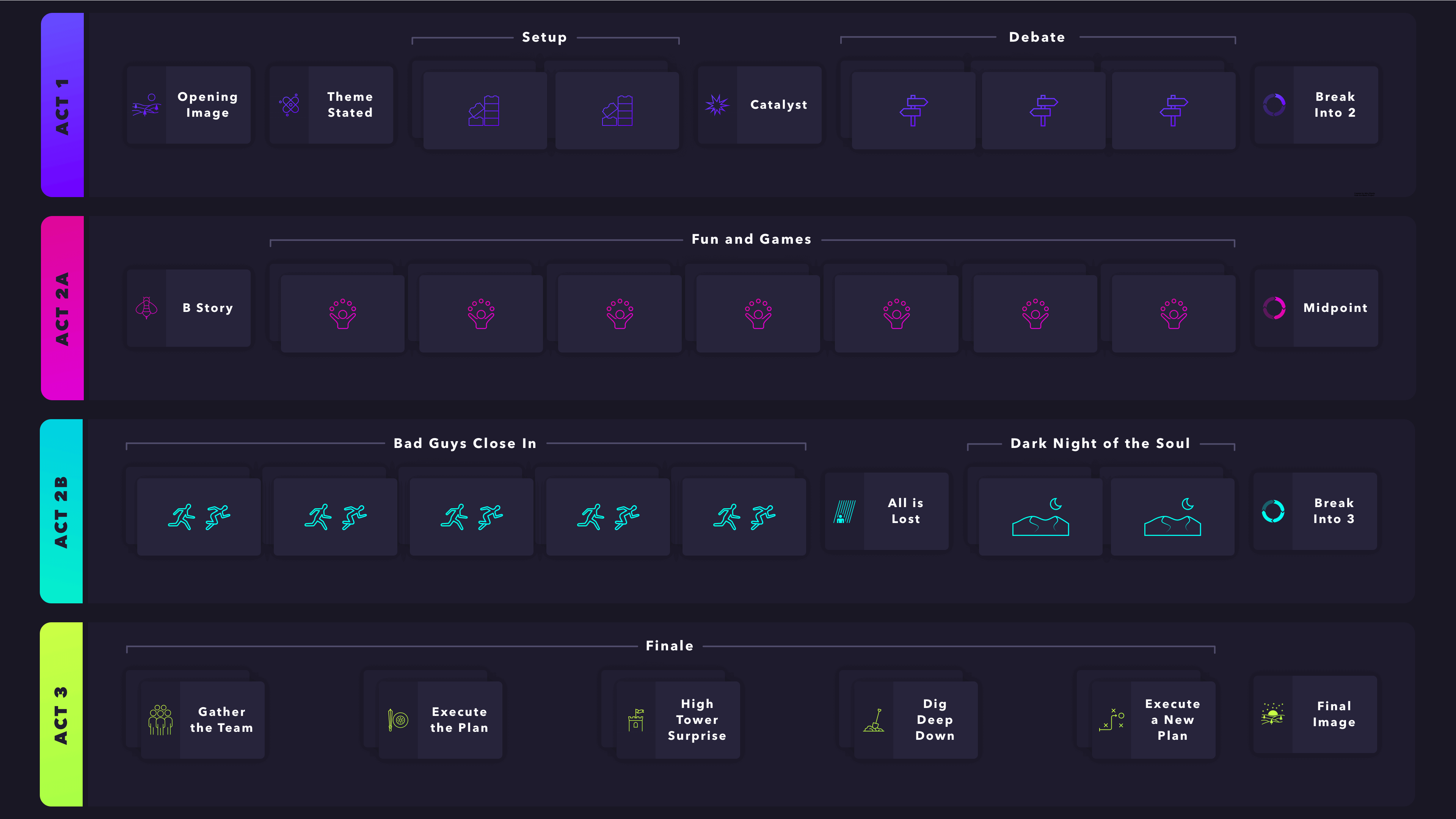
Theme Stated:
In film, a narrator or character must verbally state or suggest the theme since movies do not allow for the same nuances as novels. In your writing, the theme can be noted to the character — usually in a way that they do not yet understand — and will require the journey and the growth it provides to have the context to grasp the true meaning of the theme later.
Setup:
Within your first chapter, you want to establish (in some way) your main cast of characters. Sometimes, due to story structure, you have to mention or hint at the existence of these characters. You also want to show your protagonist inhabiting the world they’re familiar with, or the “old world.” This is your chance to hook your audience by making them curious. You want them to want to know more, so you have to walk the line between offering too little information, leaving readers confused, and offering too much and boring them into a DNF.
Catalyst:
This is also known as the inciting event, and it changes your protagonist’s daily life. It can take many forms, and your protagonist generally will not be willing or ready to handle the problem head-on.
Debate:
The protagonist must decide. They often fight an internal battle that reflects the version of themselves that they currently are, and their choice sparks the journey of growth and change that they will inevitably embark on as the plot progresses.

Break into two:
Whether by choice or external prodding, your protagonist decides to face the challenge and set out on the adventure. This is the moment when the ball begins rolling, and the plot is set into motion.
Act 2A:
B story:
The A story follows your protagonist and the main journey. The B story is the subplot that inevitably weaves into the A story as your plot advances. This is often a love story and also serves to emphasize the main theme of your novel.
Fun and games:
This extended section of the second act is the time when your character learns and decides what to do with their new knowledge. They may meet mentors, make allies, find unexpected information, or uncover secrets that aid on their journey, and usually make enemies that will resurface later. Often, a mistake or accident that occurs in this phase will circle back around to haunt your protagonist and their team later.

Midpoint:
At the midpoint, your protagonist will face a challenge and either succeed or fail. Either way, the outcome sets the story in a different direction.
Act 2B:
Bad guys close in:
After the events of the midpoint, whether your protagonist succeeds or not, there will be consequences. External forces — perhaps the antagonist — will grow in power, your protagonist will become disheartened, and the stakes will be raised. Sometimes, the literary “bad guys” can be as intangible as infighting in the group or a flood that sets the team back weeks on their long journey.
All is lost:
In this beat, the protagonist loses something important and valuable. Often, this is a character, like the death of a mentor or a close ally. Whatever your character loses, it rocks them deeply because this person or knowledge offered them solace, wisdom, or bearing in their ever-changing world. This loss, too, sets the plot in a different direction, perhaps changing the mentality of your protagonist to something darker or setting them on a path of revenge instead of that of a savior.
Dark Night of the Soul
There will come a time in your story when your protagonist is so downtrodden after all they’ve lost that they lose hope. This is their lowest moment when they feel that all is lost.

Break into 3
In this beat, while your character is at their most miserable, they will learn, discover, or remember something useful that rejuvenates them enough to keep going. It can be information, advice, an object, or any missing piece of a puzzle that allows them the resources and grit to continue forward. Maybe they remembered an offhand comment that a mentor made that didn’t click with them at first, but in the depths of their despair, they had the clarity to put it together.
Act 3:
Finale:
The finale can be addressed simply, but you can also dive into the nitty gritty of this beat with five more elements.
Gather the team:
This is when your protagonist puts all the pieces of what they’ve learned together. The culmination of who they’ve met, what they’ve learned, and how they’ve changed.

Execute the Plan:
With the team assembled, your protagonist has a wholly new assembly of skills, values, and wisdom, and they come up with and execute a plan that they would never have been capable of before going on the journey — or as individuals.
High Tower Surprise:
While the team is executing their plan, the antagonist pulls a new trick out of their hat that the protagonist (and the readers) was not expecting. This should not come from absolutely nowhere, though, and readers should feel a sense of “how did I not see that coming?” more than pure shock and confusion that something like that could happen. Sometimes, this is a betrayal, and other times, it is a loophole in the rules or an event that has been previously foreshadowed.
Dig Down Deep:
After their initial failure, the team must regroup, integrate the new information that has been revealed, and put their minds together to come up with yet another solution.
Execute the New Plan
In this last effort to succeed, the team gives it their all. Whether they succeed or fail, their efforts are the culmination of everything they’ve learned and achieved so far. There is often a sacrifice or hard-hitting loss in this beat.

Final Image:
The final image is the last event or scene that depicts the sum of the journey on which your characters have gone. This leaves readers with a last image and should reinforce the main theme and showcase the growth that have occurred both within your characters and within the world they inhabit.
Example
A novel that, for the most part, utilizes this structure is Immortal Longings by Chloe Gong. The story is told from multiple perspectives, allowing readers a glimpse into various versions of the same world. Prince August and Princess-in-hiding Calla start their stories from opposite sides of luxury. August is heir to the throne but hates the way the country is run. Calla murdered her entire side of the royal family and has been in hiding ever since.
When the royal games begin, August approaches Calla with a deal: He’ll do everything he can to make sure she wins if she promises to kill the current King Kasa when she does. She agrees, and the games begin. Calla and another player, Anton, quickly rise to the top in this fight to the death. They’re playing for wildly different reasons, but when they eventually decide to team up, everything changes.
The pair start to fall in love and wonder what they’re going to do when it gets down to just the two of them. They’re hoping it doesn’t come to that, but as they eliminate enemy after enemy, it becomes clear that that very well may be what happens. Calla wants Anton to run away with her, but he refuses, urging her to quit the games so he can win and she can live. Neither of them will back down. Calla is devastated that her relationship with Anton is over and angry at their whole situation.
But with all of her strength, Calla remembers her mission — the mission she killed her parents for. Unexpectedly, Calla is ushered into a giant stadium, and Anton wakes up with a bag over his head, only to realize once it’s removed that he’s been forced into the same stadium for the final battle. They fight, and Calla tries once again to get Anton to withdraw from the games. He does the same; neither of them budges. Having failed in saving the person she has come to love and hating herself every second of the process, she musters up her grit and kills Anton.
After winning the final battle, Calla completes her mission and kills King Kasa. She is expecting to be executed immediately and is relieved that she can be free of her guilt and join Anton when she dies. But to her surprise, Prince August strangely pardons her. Everything is not as it seems, and though success came at a great cost, it may not have been the one Calla thought she signed up for.
Bonus: The Snowflake Method
The Snowflake Method involves starting small and using each step of the process as the building block to expand into the next step and can be combined with any of the previous story structures or used entirely on its own. Visually, it can be described as a triangle that expands infinitely as you add additional points and information between two already-formed points. These five steps may seem obvious, but they break down into methodic, manageable portions.

Step One
Create your one-sentence tagline. This will be the premise and the starting point for your entire novel.
Step Two
Take your sentence and turn it into a paragraph. You should summarize the main plot of your story, identifying any main characters and major side plots. You should note any relevant plot points and get a sense of your story’s beginning, middle, and end. If you combine with another structure, you want to consider how the major beats fit into your plot. Each beat becomes a shard on your growing snowflake.
Step Three
Use the narrative you’ve just created and write a character summary for all the major players. Who are they? What is their experience like in your world? What do they desire? What role will they play in your overall story? Where do they start and end (in other words, do they have a notable character arc, or are they static)?

Step Four
Take the summaries you’ve just written and build full character profiles. You should utilize this step to deeply acquaint yourself with each and every relevant character. What are their names? Who is the main character, and who are their enemies and allies? Why is that the case? How will each character’s experiences, desires, fears, and biases contribute to your main plot? What are their main traits? What are their flaws? It’s often helpful to conduct character interviews where you “ask” your characters a series of questions to see how they answer, which will help you as the writer position them in your world and plot.
Step Five
When you get to this step, you have your core story and your main characters down. It’s time to expand these into a multiple-page synopsis. Between three and five pages is a solid goal. While you’re writing your full summary, be sure to include your major scenes (which will correlate with any beats in another story structure if you’re combining), how the main characters fit into the story, any relevant side plots, disasters, or other events that contribute towards the climax.
Once you’ve completed these five steps, you’re ready to start writing your manuscript. Don’t forget to refer back to any story structures you’ve decided to combine to keep you on track and motivated throughout your writing!
Example
Though it is hard to tell what books may have been written using this guide, we will use A Court of Thorns and Roses by Sarah J. Maas as an example. The first sentence of this book may have been: “Human Feyre is kidnapped by faeries, and after growing fond of their world, she must be its savior.”
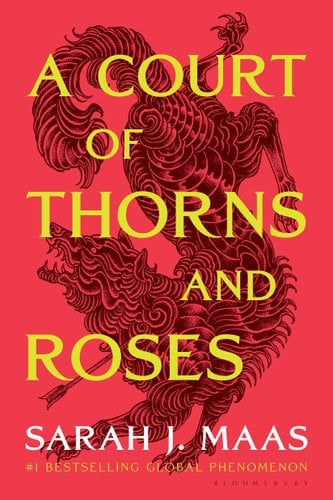
You would then take this sentence and turn it into a paragraph. For example, Feyre enters the faerie realm, Prythian, by force but begins to grow fond of Tamlin and almost enjoys their world. She returns home to find her family’s wealth returned but decides to return to Prythian to fight for Tamlin. She discovers that Amarantha has kidnapped him and must complete deadly challenges if she wants to save him and the rest of Prythian from Amarantha’s wrath. She barely succeeds, and, in the aftermath of the challenges, her life is forever changed.
The main characters in this book are Feyre, the human who will save Prythian; Tamlin, the faerie who captured Feyre and fell in love with her; Lucien, Tamlin’s best friend and advisor; Amarantha, the main villain; and Rhysand, Feyre’s mysterious ally and High Lord of the Night Court.
To elaborate on all of them you could begin with Feyre. She is the youngest of three daughters, loves to paint, and is headstrong and clever. She was born wealthy but lived her teenage years in poverty after her father lost all their wealth. She learned to hunt and trade in town in order to keep her family alive. You could keep going in this style for each of the characters and flesh them out into full paragraphs and personalities.

Now that you’ve got your character profiles and one-paragraph summary, you can start to flesh this out into a four-page plot synopsis, going into detail on Feyre’s adventures, her life at home and in Prythian, the specifics of what happened under the mountain, and how each character fits into her journey.
There is a whole wide world of conversation about the best way to plan your novel. Depending on what genre of story you want to write and how specific you would like to be in your planning, some of these may suit your writing style better than others. What do you think? Are you a plotter or a pantser? Would you try any of these methods to outline your next novel? Let us know on our socials!
Looking for more writing advice as you dive into your next draft? Click here to read about the nine best podcasts for writers!
Click here to view Bookstr’s resources to utilize as you promote your next book!