






When it comes to novel planning, there’s no shortage of tools designed to help writers like you plot a compelling story. However, one strategy, in particular, has garnered massive popularity since its inception: Save the Cat!. Save the Cat! is a variation of the classic three-act story structure that breaks a narrative into 15 key beats. Countless writers swear by this outlining technique above all others. But what’s so special about the Save the Cat! method?
Today, we’re here to find out what separates Save the Cat! from the rest of the novel-planning methods on the market! We’ll discuss everything you need to know about this technique, including:
- What is the Save the Cat! method?
- A Step-by-Step Breakdown of Save the Cat!
- Deconstructing The Hunger Games Using Save the Cat!
- Pros and Cons of Save the Cat!
- Further Resources
What is the Save the Cat! method?
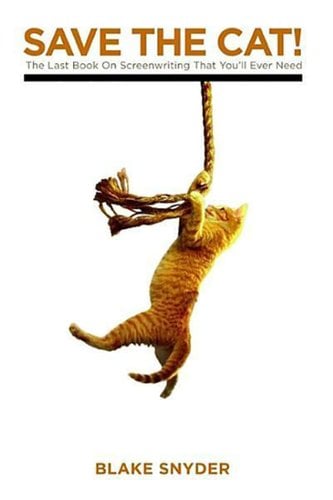
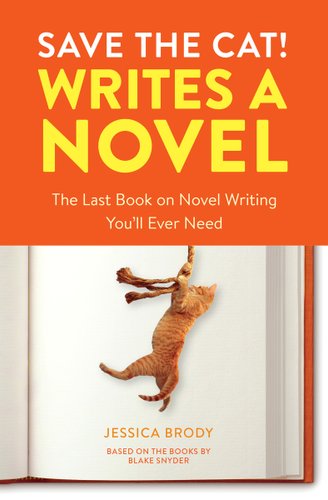
Save the Cat! is a story-structure method originated by screenwriter Blake Snyder in his bestselling book Save The Cat! The Last Book on Screenwriting You’ll Ever Need. While Snyder’s guide was designed for screenwriters, it has since been adapted for novelists by author Jessica Brody, who penned the hit craft book Save the Cat! Writes a Novel: The Last Book on Novel Writing You’ll Ever Need. In her bestseller, Brody instructs writers on how to write a captivating story that’s as compulsively consumable as a blockbuster film. With helpful charts, checklists, and templates, she breaks down the technique step by step in illuminating detail. So what makes up the Save the Cat! outline?
As mentioned above, Save the Cat! is a riff on the ever-popular three-act structure, which was also propagated by the screenwriting community. The three acts that comprise the Save the Cat! outline are further divided into a total of 15 critical story beats (aka, plot points), which come together to form a riveting adventure from beginning to end. But as Snyder and Brody both stress, you can’t have an engaging narrative without a memorable hero to headline it. That being said, let’s explore what makes a story-worthy protagonist.
The Basis of Strong Characters
When most people think of outlining, they probably think of developing a plot more than anything else, and rest assured, we’ll get there. However, the importance of your main character cannot be understated. Your plot idea could be the most groundbreaking, intriguing premise the world has ever seen. But if your protagonist is dull and unlikable, who cares what happens to them? Fortunately, concocting fascinating characters isn’t as challenging as it might seem. In fact, the foundation of a strong character only involves a few simple details.
To get readers rooting for them, your hero needs the following:
A Problem
Your hero’s problem is a character flaw to be fixed throughout the story. Nobody is perfect, so your characters can’t be either. It’s entirely unrealistic for your protagonist to have everything together at the beginning of their story — not to mention boring. Hence, they need at least one major problem (if not several!) that they can work to overcome as the story progresses.
A Want
Your hero’s want is the goal they’re trying to achieve. Everyone wants something. Whether it’s a promotion, a fancy sports car, or a fulfilling relationship, we all have something we desire — a dream we’re working toward. Your hero needs one, too.
Be as specific about this goal as possible. It’s not enough to say your character wants to be happy. We all want happiness, but our individual ideas of what happiness is are bound to differ. For some, it might be winning the lottery; for others, it might be buying a house or marrying their childhood sweetheart. Whatever the case, it must be something tangible the reader can relate to and root for.
A Need
Your hero’s need is the life lesson they must learn. The hard truth is, whatever your character thinks they want most in life isn’t the real path to happiness. Remember, they’ve got a big problem that needs fixing, and no amount of money, popularity, or success can solve it.
Ask yourself: what does my hero truly need? In other words, what is your story really about? What’s the moral both readers and your hero should be taking away? This moral should be universal: redemption, forgiveness, responsibility, trust, acceptance, etc. The more relatable it is for your readers, the more they connect with your story and characters.
Now that you know what makes an interesting hero, it’s time to decide what kind of story your character will inhabit. Every successful story falls into one of 10 story genres, according to Save the Cat!. Before diving into the 15 beats, let’s break these genres down.
The 10 Essential Story Genres
While Save the Cat! employs the word “genre” to describe these story categories; its usage here is a bit misleading. The “genres” mentioned below aren’t romance, mystery, science fiction, and the like. They have nothing to do with the tone, style, or subject matter of your story. Instead, they act as templates that describe the kind of story you’re trying to tell in terms of the hero’s transformation and the narrative’s central themes.
Unfortunately, we don’t have time to discuss the full depth of these categories in today’s blog. But for those interested in learning more, Brody dedicates an entire chapter to each one in Save the Cat! Writes a Novel. For now, here’s a brief overview of each of the ten story genres:
- Whydunit: A hero must solve a mystery. Their investigation reveals a dark truth about human nature.
- Rites of Passage: A hero must persevere through the pain of coming of age, death, addiction, or any number of life’s common challenges.
- Institutionalized: A hero becomes involved in (or is already a part of) an organization and must decide whether to join, escape, or destroy it.
- Superhero: An extraordinary hero must come to terms with what it means to be special in an ordinary world.
- Dude With a Problem: An ordinary hero must rise to the challenge when faced with extraordinary circumstances.
- Fool Triumphant: An underdog hero must prove their unrecognized worth when pitted against an institution.
- Buddy Love: A hero meets someone new and is transformed by the love, friendship, or mentorship they receive through this bond.
- Out of the Bottle: An ordinary hero must learn to appreciate the mundane after a brief encounter with magic.
- Golden Fleece: A hero goes on a journey in search of something and finds themself along the way.
- Monster in the House: A hero must defeat some kind of monster in an enclosed setting. They may or may not be responsible for bringing the monster into existence.
With that out of the way, let’s finally get into the Save the Cat! beat sheet.
A Step-by-Step Breakdown of Save the Cat!
Once you have a hero and genre in mind for your novel, it’s time to decide what to do with them. Put differently, what exactly is going to happen in your story? That’s what the Save the Cat! beat sheet is here to help you figure out. Regardless of whether you’re a pantser or a plotter, jumping into a novel without the slightest idea of where your story is going can be daunting. The Save the Cat! beat sheet is your outline — or your roadmap, if you will — designed to guide you from the beginning of your story to the end. To learn why Save the Cat! remains a popular plotting method nearly 20 years after its invention, let’s break it down act by act and beat by beat.
Act One
Act One introduces the hero and their status quo world, revealing who they are and where they’ve been before everything changes. The beats in this act include:
- Opening Image: A “before” image of the hero and their world.
- Theme Stated: A statement that hints at the hero’s arc, typically made by a character other than the hero. It foreshadows the life lesson the hero must learn.
- Setup: An introduction of the hero’s status quo life, including supporting characters, the hero’s main goal, and the hero’s reluctance to change despite the risk of staying the same presents.
- Catalyst: An inciting incident that launches the hero into a new world and prevents them from returning to their status quo world.
- Debate: A reaction to the catalyst in which the hero debates what to do next. This beat reinforces the hero’s unwillingness to change.
Act Two
Act Two is the antithesis of Act One, demonstrating how the character flounders or thrives in this upside-down world. The beats in this act include:
- Break Into Two: A decisive beat that shows the hero accepting the call to action and venturing outside their comfort zone, effectively separating the status quo world of Act 1 from the inverted world of Act 2.
- B Story: The introduction of a new character (or several new characters) who will help the hero learn the theme. This could be a friend, mentor, nemesis, love interest, or family member.
- Fun and Games: A look at the hero either succeeding or failing in the new world that delivers on the story’s hook.
- Midpoint: The culmination of the Fun and Games. Here, the stakes are raised by a false victory (if the hero has been succeeding so far) or a false defeat (if the hero has been failing so far).
- Bad Guys Close In: As the hero’s flaws come to a head, they experience a downward path where things get gradually worse (if the Midpoint was a false victory) or an upward path where things get gradually better (if the Midpoint was a false defeat).
- All Is Lost: An action beat where the hero’s internal flaws and external enemies push them to their lowest moment — the hero’s rock bottom.
- Dark Night of the Soul: A reaction beat where the hero takes a moment to process everything that has happened to them.
Act Three
Act Three is a fusion of the prior two acts, showing how who the hero was in Act One and what they learned in Act Two combine to create their final form. The beats in this act include:
- Break Into Three: The moment the hero realizes what they need to do to solve all their problems and become a better person.
- Finale: The hero executes the plan they created in the Break Into Three, conquering both their flaws and their enemies and proving they’ve learned their life lesson.
- Final Image: An “after” image of the hero and their world that mirrors the opening beat and displays the hero’s epic transformation.
So there you have it! A complete breakdown of each act and plot point in the Save the Cat! beat sheet. This outline gives you everything you need to start planning your novel, but first, let’s take an example. Here’s a look at the Save the Cat! beat sheet in action using one of the most iconic dystopian YA series of all time: The Hunger Games.
Deconstructing The Hunger Games Using Save the Cat!
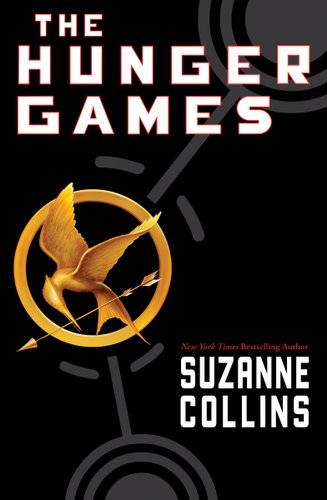
If you need any evidence that three-act structure is just as effective a tool for novelists as it is for screenwriters, Suzanne Collins’s Hunger Games trilogy is a shining example of the model’s merits. Before she became a bestselling author, Collins studied playwriting. During this time, she learned to use a three-act structure, and the habit stuck when she turned to novel writing. Thus, her books are an ideal match for the Save the Cat! format.
Let’s break down the eponymous first novel in Collins’s Hunger Games series to see how it fits into the Save the Cat! beat sheet.
Act One
1. Opening Image
The reader is introduced to Katniss, her little sister Prim, her mother, and her bleak life in District 12, where every day is a fight for survival.
2. Theme Stated
Katniss’s friend Gale suggests they run away together and escape District 12, but Katniss rejects the idea as preposterous. This moment hints at the theme of the novel and the Hunger Games series in its entirety: It’s not enough for Katniss to survive the Capitol; to protect herself and her family, she has to burn it down.
3. Setup
Katniss sneaks into the woods to hunt for food. It’s illegal, but it’s the only way she can feed her family — though she’s only a teenager, Katniss is her family’s main provider. She and Gale resent the Capitol for their circumstances, but they only voice this when they’re in the privacy of the woods. After she returns home, Katniss prepares for the reaping.
4. Catalyst
Prim is selected as the girl tribute for District 12, so Katniss volunteers to take her place. Peeta Mellark is chosen as the boy tribute. Because Peeta showed her kindness in the past, Katniss feels like she’s indebted to him. However, she knows she’ll have to kill him to survive the Hunger Games.
5. Debate
Katniss faces a harrowing debate: Is she capable of winning the Hunger Games? And if so, what’s her strategy? As she ponders these questions, Katniss says goodbye to her family, receives the Mockingjay pin (a symbol of rebellion), and boards the train to the Capitol.
Act Two
6. Break Into Two
When Katniss arrives at the Capitol, it’s the complete opposite of District 12: luxurious, colorful, and indulgent. She’s given a makeover to better fit into this new world.
7. B Story
The love story between Katniss and Peeta begins when Peeta confesses his love for Katniss during an interview with Cesar Flickerman. Katniss is angry, believing this star-crossed-lovers image will make her look weak. However, her mentor, Haymitch, and her stylist, Cinna, assure her the façade will only benefit her. Katniss is confused about her feelings for Peeta, but her primary goal is still to make it out alive. Ironically, Peeta will eventually teach her the theme: life is more than just survival.
8. Fun and Games
After training for the Games concludes, the tributes are thrust into the arena. Katniss manages to snag some supplies and escape into the woods, where she hides out in a tree. She realizes Peeta has joined a group of Careers (tributes who have trained since childhood to compete in the Games) and questions his motivations. After escaping a fire, Katniss encounters a young tribute from District 11 named Rue, who helps her drop a nest of deadly mutant wasps (aka, Tracker Jackers) on the Careers, killing two of them.
9. Midpoint
As Katniss hallucinates from the Tracker Jacker venom, Peeta saves her life, making her question whether his feelings for her are real after all. In a moment of false defeat, Katniss realizes the futility of their love when only one of them can win the Games.
10. Bad Guys Close In
Katniss teams up with Rue, and together, they create a plan to destroy the Career’s food supply. Katniss successfully blows up the supplies but later finds a boy tribute stabbing Rue with a spear.
11. All Is Lost
As Rue dies in her arms, Katniss promises to win the games for both of them.
12. Dark Night of the Soul
Katniss lays Rue to rest on a bed of flowers and receives a gift from District 11 as a token of their gratitude.
Act Three
13. Break Into Three
After the announcement that two tributes from the same district can win the Games together, Katniss immediately seeks out Peeta. She finds him on the brink of death but manages to get him to a cave, where she nurses him back to health. She kisses Peeta, caught between her true budding feelings for him and the act she must put on to survive.
14. Finale
When it’s announced that an item each tribute desperately needs is available to them in the center of the arena, Katniss decides to go get medicine for Peeta. He objects, not wanting her to risk her life, so she drugs him and slips out while he’s sleeping. Although it’s a guaranteed bloodbath, Katniss won’t let Peeta die.
When she reaches the center of the arena, Katniss is nearly killed but is spared by the other District 11 tribute because of how she treated Rue. She returns to the cave safely, and Peeta recovers quickly after taking the medicine. Later, Peeta gathers berries, only realizing they’re poisonous when another tribute dies after stealing and eating them.
The final three tributes — Katniss, Peeta, and Cato — are driven to the center of the arena by nightmarish monsters. When Cato is seized by the monsters, Katniss shoots him in an act of mercy. Just as they’re about to celebrate their win, Katniss and Peeta are informed that the dual-winner rule has been revoked, meaning they must fight to the death. Instead, they prepare to ingest the poisonous berries in an act of rebellion, forcing the Capitol to name them both victors.
Katniss remains conflicted about her feelings for Peeta after the Games, especially because she is forced to continue playing up their romance to appease the furious Capitol. She wants to figure it out, but for now, she’s still in survival mode.
15. Final Image
Katniss and Peeta prepare to return home together as victors instead of tributes. Despite all the uncertainties still swirling in Katniss’s mind, one thing is for sure: She’s no longer playing by the Capitol’s rules. Now, she’s a rebel.
Pros and Cons of Save the Cat!
As popular as Save the Cat! is, every plotting method has its ups and downs. Whether or not Save the Cat! will work for you depends on what you’re looking for in an outline. To help you determine the criteria that best fit your needs, here are some pros and cons of the Save the Cat! method.

Pros of Save the Cat!
Since its first introduction by Snyder, Save the Cat! has been a widely known and respected plotting technique within the writing community. For those who need an outline to begin writing but aren’t sure how to create one, this method is the perfect guide. Furthermore, it’s a valuable tool for newbie writers looking to learn about the basics of plot structure. Additional pros of Save the Cat! include:
It’s straightforward.
Save the Cat! is an easy method to grasp, even for those who have never written a novel before or who don’t have much knowledge of plot and character arcs. In just 15 simple beats, Save the Cat! gets you from the beginning of your story to the end in a captivating way.
It has broad applications.
While many novel-planning strategies only instruct users on how to write a stand-alone story with a single protagonist, Save the Cat! offers much more. This method can be easily adapted for stories with multiple POVs as well as book series, giving you the freedom to tell whatever kind of narrative you’re interested in.
It helps create compelling protagonists.
In the Save the Cat! methodology, the relationship between plot and character is essential. In other words, this technique is equally as concerned with crafting layered characters as it is with constructing a thrilling plot. Hence, by using Save the Cat! to plan your book, you’ll kill two birds with one stone!
Cons of Save the Cat!
Every outlining strategy has strengths and weaknesses, and that includes Save the Cat!. Despite its popularity, this method has been criticized for promoting an overly simplistic view of plot structure. Plus, some argue it’s a creativity killer rather than an imagination booster. Additional cons of Save the Cat! include:
It’s formulaic.
As is true of all plotting techniques, the Save the Cat! beat sheet is formulaic by nature. This model in particular was built to mirror the structure of hit films and novels so users could replicate their success. Thus, following this method too closely means your story might turn out to be generic and predictable, which will turn readers away more than attract them.
It’s restrictive.
The basis of Save the Cat! was to aid readers in crafting high-concept, marketable stories quickly and painlessly. As a methodology, it’s less interested in helping users create high-quality art than in teaching them to write to the market. Whether Save the Cat! is a good fit for you depends on your goals: do you want to write for the mainstream, or are you more interested in pursuing a niche idea?
That isn’t to say that Save the Cat! has no value for writers who don’t want to be the next James Patterson or Nora Roberts. It’s a fantastic tool, especially for novice writers looking to understand what makes stories satisfying and fun to read. But if you’re looking for guidance on more experimental forms and techniques, this method has none to offer.
It doesn’t work for every kind of story.
Save the Cat! follows the traditional Hero’s Journey template: a naive, flawed protagonist leaves the comfort of their ordinary world to go on a daring adventure in unfamiliar territory and returns home transformed. It facilitates a positive character arc, in which the hero changes for the better by the end of the story. If your narrative features a neutral or negative character arc, or if it doesn’t involve a high-stakes conflict against some sort of antagonist, Save the Cat! might not be the right fit for you.
Further Resources
Despite the comprehensiveness of this blog, we’ve only scratched the surface of the Save the Cat! methodology today. To learn more, check out these helpful resources:
- Save the Cat! The Last Book on Screenwriting You’ll Ever Need by Blake Snyder — the first iteration of the Save the Cat! technique. While this guide isn’t tailored for novelists, the main tenets of the theory are still the same. Plus, it’s a fascinating read if you want to understand the origins of this iconic outlining method.
- Save the Cat! Writes a Novel: The Last Book on Novel Writing You’ll Ever Need by Jessica Brody — the original Save the Cat! methodology adapted for novel writers. A valuable read for aspiring authors.
- Save the Cat! Writes a Young Adult Novel: The Ultimate Guide to Writing a YA Bestseller by Jessica Brody — Brody’s latest novel-writing guide. A useful read made specifically for YA authors.
- Save the Cat! Beat Sheet Workbook: How Writers Turn Ideas Into Stories by Jamie Nash — a guided workbook filled with exercises and prompts to get your ideas flowing. Although intended as a companion to Snyder’s first Save the Cat! book, this guide is still a beneficial read for novelists who need help transitioning their premise into a full-fledged novel.
- SavetheCat.com — a hub for all things Save the Cat!, including storytelling classes, story-structuring software, and tons of free resources.
Save the Cat! simplifies the vexing process of planning a novel so you can get on with what you do best: writing! If you want to know what all the hype is about, try the Save the Cat! method out for yourself. If it works half as well for you as it has for so many others, you’ll be one step closer to achieving your literary dreams.
No one story-planning method works for everyone. Check out our blog on the 27-Chapter Method for an alternative technique!
Check out our Author Services to see how Bookstr can help promote you and your book!