
















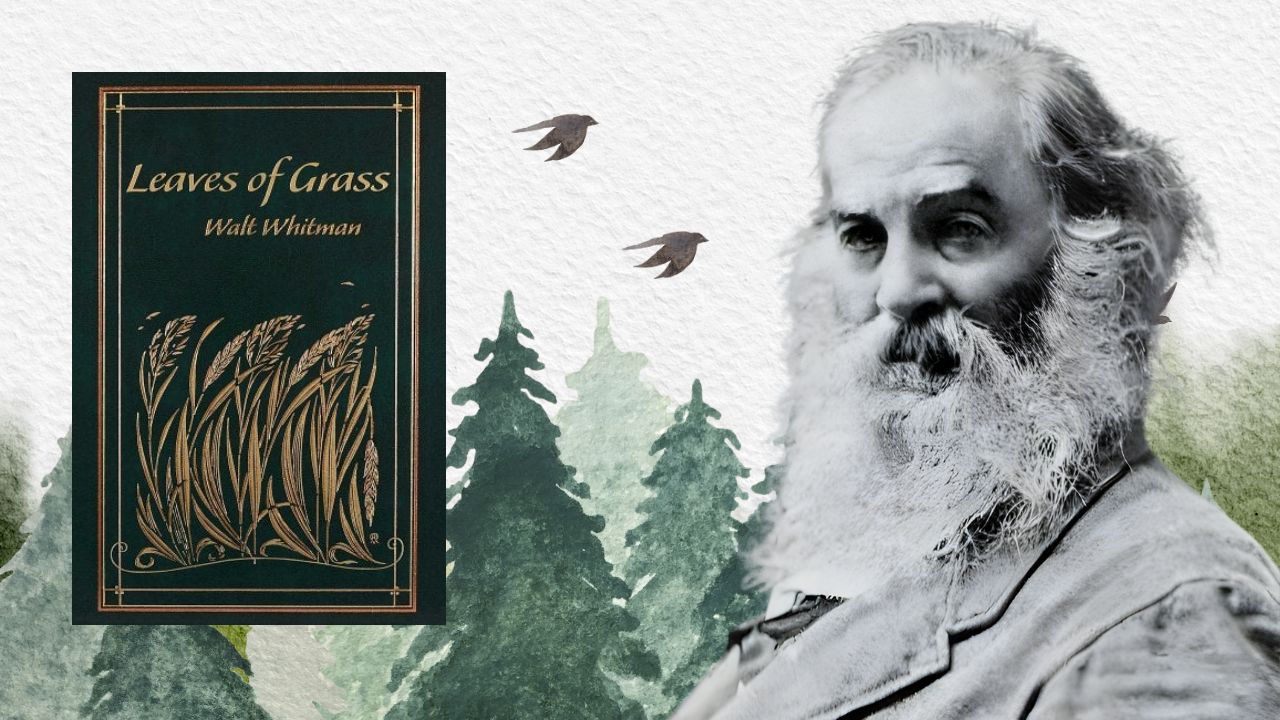
Regarded alongside Emily Dickinson as one of America’s greatest 19th-century poets, Walt Whitman’s legacy is rich and celebrated. His most notable work, Leaves of Grass, is a self-published collection of poetry exploring the nuances of humanity in an elegant and poignant style. Inspired and later revered by acclaimed writer Ralph Waldo Emerson, Leaves of Grass was based on when Whitman traveled the American frontier. His affecting style, voice, and poetic depictions rightly earned Whitman his legacy as a deeply cherished poet.
One of the most regarded poems in the collection is Song of Myself, an exquisitely layered work of literature. This article will unravel the magic behind the most talked about sections of Song of Myself and why it is continuously referenced and loved centuries later.
Emblematic Title
Initially published in 1855, with its final edition in 1892, Leaves of Grass was edited, revised, and rewritten multiple times. The evolution of the Song of Myself’s title partly contributes to the poem’s more profound meaning. Finalized in 1881, the emblematic title shows Walt Whitman’s personal transformations from the poem’s start to finish.
In some ways a biography, Song of Myself touches upon permanence and abstractive existences and the intertwined identities of society. The first three lines of the poem introduce this theme distinctly, stating, “I celebrate myself, and sing myself, / And what I assume you shall assume, / For every atom belonging to me as good belongs to you.” This celebration of self gives a whimsical, uplifting tone to the poem’s start, connecting with readers from the beginning.
Rich Form
During his time, Whitman’s critics and readers were disturbed by his innovative style and form. Instead of mimicking his fellow poets’ contemporary methodical rhythm and rhyme, Whitman’s lengthy inflections and rhetoric use reflected that of Biblical verses. Song of Myself spans multiple pages, and its audio narration is almost an hour long. Nonetheless, each line, stanza, and section wields a potent power. Though a single poem, Song of Myself reads almost like a story, bringing readers a fascinating adventure.

A Literary Masterpiece
Song of Myself is told by multiple narrators across different moments in their lives, analyzing concepts of perception, perspective, and the mind’s inner workings. It is affluent in symbolism and messages, with individual themes embedded in the sections. Most notable are the themes of mortality, sexuality, emotion, and fluidity. When the child in section six inquires about grass, the narrator ponders the question, the truth in the existence of grass and of themselves, and considers grass concerning death. Grass, like death, is experienced by all humans, and the essence of grass, which grows from bodies in a grave, is rooted in immortality. Whitman spreads the universal message that no one truly dies because new life is born from our bodies.

The pioneering discussion on sexuality is found in section 11 as the narrator, a woman, recounts her observation of 28 bathing men. She yearns to join them, her life filled with loneliness, and imagines herself communing with them. Yet, in this dream, she remains invisible to the men, inferring that to experience life to its fullest, truthful, rawest extent, one must walk a fine line between presence and an overseeing absence. One must be part of the Earth but distinct from it to gain a detached perspective rather than soil the truth of it.
The woman describes the men in striking detail, Whitman’s voice emerging in the descriptions, overlaying the explicit erotism with implicit homoerotism. Whitman’s hunger for communion created that unnerving experience for his readers, but it is, in part, what makes him vivid and soulful as a poet. The transparency of the narrator in this section reflects the fluidity of agency and human sexuality that, while impermissible during Whitman’s time, still wields and has wielded significant meaning.

Throughout the rest of the poem, Whitman ends with contentment for humankind’s paradoxical and intricate nature. The famous stanza “Do I contradict myself? / Very well then I contradict myself, / (I am large, I contain multitudes.)” has a theme representative of many stanzas throughout, in that philosophical answers do not come easy and one must be patient with the multitudes they contain. Whitman declares, “I will never translate myself at all” unless he is with someone private and intimate. A soul and a body are an all-encompassing web of many things; one must approach that with sincere sympathy.
Walt Whitman’s Song of Myself is a lavish expression of the comprehensiveness of humanity, nature, the transcendent, and the inexplicable links that connect it all. It continues to resonate deeply with readers, touching the hearts and souls of many. Whitman will forever be justly known as a legendary poet, and his writing will continue to carry monumental significance for centuries.
Click here to discover more featured authors!
Click here to browse more poetry collections!