
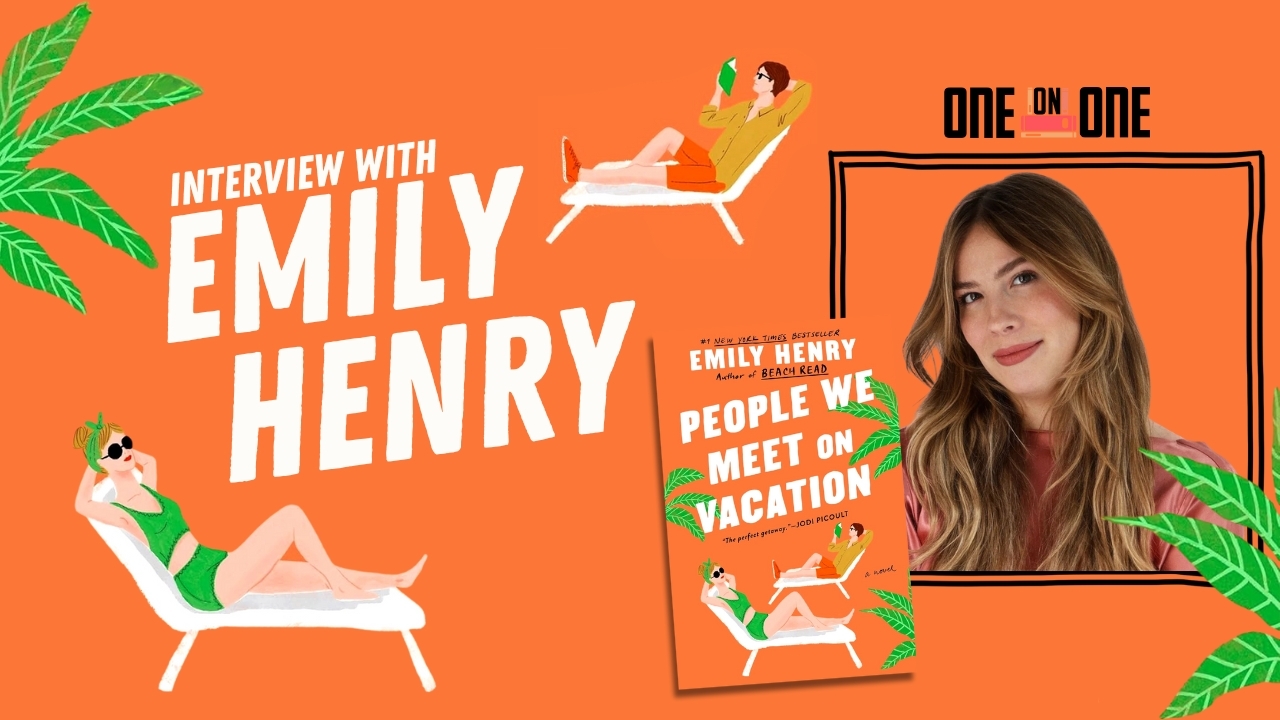
Today, we are thrilled to welcome the phenomenal New York Times bestselling author, Emily Henry, to our virtual couch! Known for her razor-sharp wit, deeply empathetic characters, and the ability to craft stories that are as heart-warming as they are heartbreaking, Emily has captivated millions of readers. From the bookish charm of Book Lovers to the summer nostalgia of Beach Read, her novels define the modern romance landscape.
Now, her beloved novel, People We Meet on Vacation, is headed for the big screen, bringing Poppy and Alex’s epic, decade-long love story to life. As she steps into this new chapter, we want to look beyond the usual questions and dive into the heart of her creative process, her connection with the reader, and the exciting future ahead.
About Emily Henry

Emily Henry is the #1 New York Times and #1 Sunday Times bestselling author of Great Big Beautiful Life, Funny Story, Happy Place, Book Lovers, People We Meet on Vacation, and Beach Read.
Be sure to follow Emily on her Instagram or check out her Website for fun extras and updates.
Thanks for joining us, Emily. Let’s get started.
People We Meet on Vacation hinges on the friends-to-lovers trope and the anxiety of risking a perfect friendship for romance. For readers who see their own friendships in Poppy and Alex, what is one surprising or underlying theme you discovered during the writing process that you hope translates into a sense of courage or validation when they see the movie adaptation?
For me, I think the thing (I don’t know that it actually surprised me, but I do think it’s an important theme), is this idea that you’re not too much and you’re not too little. I think most of us feel like we are one of those two things. I have a lot of group chats with my friends, and it’s pretty common to leave a party and for everyone to go around and be like, “Okay, did I offend anyone? Was I rude? Was I monopolizing conversation?” We’re all so afraid of taking up too much space. And also, sometimes you leave a party or an interview, and you’re like, I’m the most boring person on the planet. Like, I have nothing to say. I have nothing to offer. And I think that those fears are really limiting. What drives Alex and Poppy’s story so much is that she’s so afraid that she’s too much. He’s so afraid that he’s not enough. And you’re not. You might be too much for the wrong person. You might be too little for the wrong person. But you are right exactly as you are.

Many authors feel a sense of loss or separation when relinquishing their characters to new actors and a screenwriter. What is one specific quiet moment in the novel that you are most eager to see given a fresh, perhaps unexpected emotional weight by the actors on screen?
There are so many for that. Having seen the movie three times now and once quite recently, there was one moment that really stood out to me, and it did make it into the trailer. But in the full context of the movie, I’m really excited for the readers to see the moment when Poppy sprains her ankle. The dialogue in that portion of the movie is like almost directly from the book, which is really special. A lot of the movie is sort of Frankensteined little bits of the book to fit in new places, but that happens even in a different setting, but it [the ankle sprain] happens largely exactly as it happens in the book. There is such humor in it, but it’s also really, really sweet and really romantic. I think it feels a lot more important in the movie than it even did to me in the book. It feels like a very significant moment in their relationship. And I’m so excited for readers to get to see that come to life.
If you could take us back to the moment you finished the very first draft of People We Meet on Vacation, knowing everything you know now about its success and its imminent adaptation, what single non-revisionary encouraging sentence would you whisper to that past self?
I love this question, but my answer is that I wouldn’t. I wouldn’t, I don’t, I’m glad I didn’t know. I had such a joyful experience writing People We Meet on Vacation. I had kind of pitched it to my editor, but it wasn’t formally accepted as my next book. I just went off, and I was like, I should write a little bit of this and make sure I can find my way into the story, and I’m excited by it in practice. And I wrote the whole book. I loved it so much. And by the time I resurfaced, my editor was like, “So, what did you decide? Is that the book you’re going to do?” And I was like, “I did it, and I think it works. Let’s see what you think.” I think if I had known everything that was to come for this book, it would have been really terrifying to me. No matter how helpful or encouraging my future self was trying to be, I think it’s good that I didn’t know. I think it’s good that I just wrote the book that I wanted to write, and I didn’t know that it was going to be this thing ever. I think it’s good that I just trusted my gut in that moment.
When you step away from writing about writing, as you did with Happy Place, what unique challenge or freedom do you find in creating protagonists whose professional lives are entirely separate from your own world?
I was surprised how challenging that was for me. I’m very much immersed in the book world. Most of my friends are in the arts. We actually all talk about how it’s a problem, and we need a friend who’s like an electrician, or can do something if there’s an apocalypse. If we’re going to be sitting around writing each other sonnets, we will die first. So, it’s easiest for me to write about artists and people who love the arts and work in the arts in some form, as well as people who are bookish.
In writing Harriet for Happy Place, I had to do a lot of message board reading because, again, I do not know or have a doctor as a friend. She’s a doctor and writer. But at the time, I didn’t know doctors other than my actual doctors. So I was on message boards reading about what it’s like to be a resident and reading about what they complained about. I was really gratified to hear from doctors the fact that it rang true to them, even though it was such a small part of the book. Those little details are so important because you don’t want someone to be pulled out of the story by the fact that you didn’t do your research.

Now that you’ve navigated the full complex process of adapting People We Meet on Vacation for the screen, has that experience given you a new lens, a sense of clarity, or perhaps even a feeling of inevitability for upcoming adaptations?
Yeah, this process has been a huge education. It was like a trial by fire at times, but having Brett let me look over his shoulder every step of the way, every piece of the puzzle taught me so much about how things work. It taught me about the technical challenges of writing a good script. It taught me so much, and it made me excited, and like I said, I’m still nervous about the other adaptations, but I’m really excited for some of the ones that I’m more involved in that I’m writing on. I’m excited to try something new and to stretch myself, and to get to be a part of this process again, hopefully.
Do you find yourself considering the visual language or pacing of a scene differently now, knowing your future characters could also be destined for the big screen?
That’s such a great question, and I actually was just telling someone I do not want to change the way that I write novels. I love novel writing and that medium offers something different than what film writing offers, and what films offer in general. So, I want to keep approaching novels as if they’re only ever going to be novels, and I’ll let the filmmakers figure out how to adapt that if they want to.
I will also say that I was already hugely influenced, even as a novelist, by films. The sensibility of the romcoms that I’m writing was hugely inspired and influenced by Norah Efron, Nancy Meyers, Cameron Crowe, and all these people who were writing for the screen. I am a very visual person, and there’s a lot of detail in my scenes. I think about the choreography of a scene, where people are standing in space, how they touch, and all of that. It’s already kind of the way that I write. So that’s not that different. I don’t want to change the process with the novels because I want the novels to just get to live in that world. I want them to do what only a novel can do and let movies do what only movies can do.
What classic, perhaps lightly dated romance trope do you find the most challenging yet exciting to modernize?
Well, I do think the most challenging thing I’ve done so far has been the friends-to-lovers trope because you don’t have that built-in tension or conflict, and you have to figure out and explain to your audience why these two people can’t be together or believe they can’t be together… and that’s hard! But for the future, I’m a big historical romance reader, and I love a marriage of convenience in a historical romance. And obviously, that happened a lot more frequently back in the Regency Era, but I someday want to try to write a modern marriage of convenience and find a way to make that feel really grounded, realistic, and possible while still playing with this situation that’s quite heightened.
How do you decide where to leave your character stories’ happily ever after, and what feeling do you most want to leave readers with?
Well, the feeling that I strive to leave the reader with is hope. I want them to feel filled up with optimism and that everything isn’t quite so grim as it was before they started the book. I want to bolster people and bring them a little bit of joy that will enable them to move through the world more easily.
How do you decide where to leave your character stories?
I want it to be in a moment of hope and growth. I think the thing that drew me to writing romance originally was that it felt like a really natural way to do a coming-of-age story for an adult. Coming-of-age for teens is also very interesting to me, and I used to do that. When I started writing about adults, people in their 30s, and seeing, you know, the kind of transformation that you go through at that age, I loved that falling in love was a natural trigger for people to have to face their issues because when you fall in love with someone, everything you are stuffing down kind of comes to the surface. All of your fears can get tripped. I just love that it’s an opportunity to take someone through this process of growing and healing. So, when I leave my characters behind, it’s because they have broken through something and realized something about themselves, hopefully, and healed a bit in this place of hope.
If you had to create a three-song playlist for your next book, what vibe would it convey?
Ooh, I mean, I couldn’t answer it. Not even legally speaking, I couldn’t answer it because I’m about to start writing that book, and it’s all still up in the air! So, we’ll see. That’s TBD.
What new non-traditional form of storytelling might you pursue next?
To explore romance. I will say, I love graphic novels. In college, I took a comics class and kind of wanted to do that. I don’t know if I’m drawn to doing that for romance or not at this time, but that’d be fun to play with, and I would love to figure out how to do a stage show of some kind. I would love to see a musical adaptation of one of my existing books. I think Funny Story or Book Lovers could be really, really fun. I would not be able to write those songs, but I would love to work on that in some capacity. That’s really exciting to me.
Thank you so much for an amazing interview, Emily! Be sure to watch People We Meet in Vacation, now available on Netflix.
Want to check out more author interviews? Click here.
You can find People We Meet on Vacation and all of Emily’s other books on our RomCom bookshelf on Bookshop!