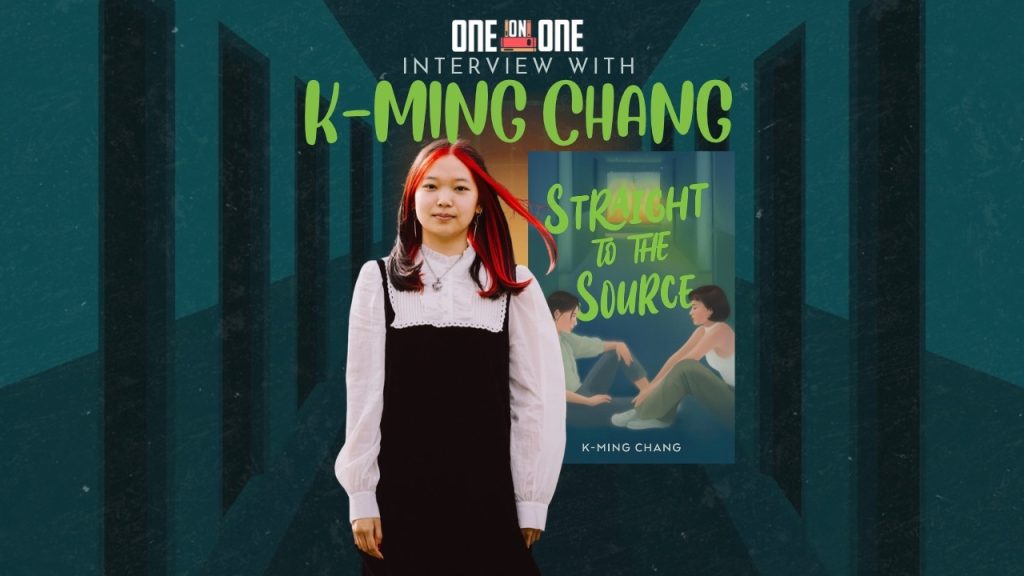


K-Ming Chang has a particular interest in lineage. With over 70 digital publications and five published adult books, the author has hand-crafted a literary legacy spanning genres, formats, and now, age groups. With her first foray into young adult literature, Chang explores what it means to look at the past, present, and future of a community and individual queer identity.
Profound, complex, and even a bit romantic, Straight to the Source has gone straight to the top of Bookstr’s YA autumn reading list!
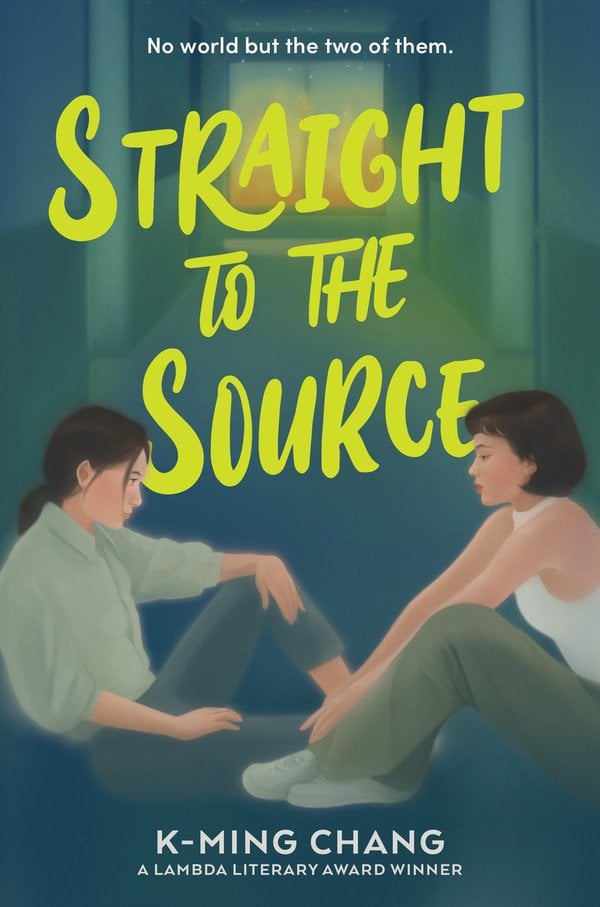
About Straight to the Source
Taiwanese American teen and aspiring journalist Wendy Lin wants nothing more than to witness the downfall of her personal nemesis, the annoyingly perfect high achiever Helen Ouyang.
Yep, Helen Ouyang. As in, Wendy’s childhood best friend. Now most-decidedly-ex-best-friend. Perhaps, maybe, still her unrequited-crush-friend. After a falling out that may or may not have involved some simmering romantic feelings, the two haven’t spoken in years, and Wendy has had to witness Helen’s meteoric rise to high school success from the sidelines. But not for long.
Chasing up a lead for the school paper, Wendy soon turns up a major story with Helen at its center—one involving a mysterious fire that destroyed a building and tore apart an immigrant community a decade earlier. Wendy investigates, certain she finally has the dirt she needs to bring Helen down. But when the girls reconnect, old feelings come rushing to the surface… and with them, long-buried skeletons in both girls’ family closets.
Thanks for joining us, K-Ming. Let’s get started!
Congratulations on your YA debut! What inspired you to leap into a new age group right now? Did you always want to write for both adults and teens?
Thank you so much! I’ve always wanted to write YA; it was the genre that made me a devout and voracious reader. In both adult and YA, I love to write about young narrators, and girlhood remains a theme in all my works. For some reason, I felt a bit intimidated to enter the YA space, but when I was a teenager, YA was all I ever wanted to write.
The very first book I ever wrote was a YA fantasy about a girl who could shapeshift into a tiger, which I started and abandoned in eighth grade. My close friend, who grew up with me, encouraged me to confront my fear of failure and to write something for the sheer joy of it. I’ll admit that I dismissed her advice at first, but shortly afterward I had a dream about the two of us in our high school journalism class, where we first bonded, and the scene was so real and lucid, the dialogue so alive, that I woke up and immediately started to write. I gave her the first draft of the manuscript shortly afterward, and she sent me text messages as she was reading it, which was the most thrilling form of correspondence and immediate gratification that I’ve ever experienced in my writing life. Usually, the writing life is all about waiting for someone to care, to be willing to spend time with your characters, but I’d written this just for us. It’s a love letter to and a reckoning with our younger selves, my ode to friendship, and my gift to a very specific person, which makes it so different from my other books, and particularly special!
Your stories are widely lauded for their surreal, transformative, and genre-bending qualities. Beyond writing for a new age group, what was it like stepping into a more grounded, contemporary setting for this novel?
I love this question, because it really should have been difficult! Since writing this book, I haven’t written a single other thing that isn’t supernatural or fantastical in some way, so this book is my outlier, and yet it felt entirely natural, almost as if I was channeling another self (maybe a version of my younger self?) So many of the details about high school journalism and the hunger to be a storyteller were plucked from my own experiences and desire to write, but beyond that, being grounded in interiority, in the emotional journey of these characters, felt endlessly generative and exciting, no matter the genre or the setting. What has always compelled me to write is interiority, and particularly the interior worlds of girls and women, so that common thread guided me through the process, even amidst some temptation to add a creature or ghost or two, which is always present for me. There are definitely ghosts of the figurative kind here!
The genre elements I’m interested in are usually tied to internal transformation or a form of haunting, and I could dramatize and heighten that for the main character as she wrestled with the warped and disorienting nature of memory and perspective. And I’m of the belief that nothing is more surreal, surprising, and frightening than your own unknown self!
Looking back ten years to your own high school experience, what gap in representation do you hope this book fills that your teenage self would have appreciated? How does it honor that desire?
I think that the characters in this book reckon with things that took me many more years to truly confront, so there is an element of wish fulfillment in writing YA. I get to visit my characters from their own futures, and imbue them with a sense of a greater horizon, a place they can grow into and build for themselves, which is tremendously cathartic.
I also think it allows me to be kinder to my past self. It’s often terrifying and mortifying for me to linger too much on that self, because it’s painfully intimate, and because I tend to look at myself unkindly, but because I love and empathize with my characters so deeply, I’m finally able to not only accept but to embrace our shared messiness and chaos. (Though I think Wendy is a lot less chaotic than I was!) Ironically, I don’t think my teenage self would have appreciated Wendy, maybe because we have too many similarities, but she would have been compelled by Wendy’s unabashed queerness and longing, all while figuring out how to write her own story.
Building off that, which of your two main characters do you feel are most reflective of your high school self? Why?
I always joke that Wendy is who I was as a teenager, and Helen is who I wished I could be. Now, though, I think I have a bit of Helen in me, so maybe Helen represents a future self. But Wendy is an eternal part of me, because of her sense of inferiority, which often muddles her ability to see others, and her endless and hungry desire to prove herself. I also love her curiosity and her sincerity, which I try to nurture and preserve in myself. Helen’s apparent confidence is a little more aspirational, but I do think her sheer intensity is something I relate to deeply.
Do you feel there is a difference in how queer stories should be approached for teens versus adults, and, if so, why?
I think that stories for teens present a really unique opportunity to return to the freshness and newness of self-discovery, searching for community or connection, and confronting desire and the self. Even when I write in the adult space, I’m very interested in the sensation of experiencing something new and foundational for the first time, and inventing your own language and mythology for it. So maybe it’s more accurate to say that I approach queer stories for adults the way most people approach queer stories for teens. To me, formative experiences are some of the most alive, fascinating, and fraught relationships to probe, especially in how they shape your selfhood and your desired world.
Why was it important for you to touch on themes of family and community when romance is a focal point of this story?
I tend to always gravitate toward intergenerational relationships no matter what I write, and this book was no exception, which surprised even me. I remember some of the feedback I received was about the intergenerational element of the story, and how some people found it a bit slow or less interesting than the girls’ stories. But I was adamant about not changing it, and had faith that there would be someone out there who loved that element of the story, who understood that it was necessary (and luckily, I did!)
I’m interested in lineage, whether in more literal ways or in the lineages and ancestry we construct for ourselves, and to me, every story is a collective story. I wanted these girls to be formed by and connected to their histories, and to challenge the idea that a coming-of-age story means separating oneself from the space of the domestic. I was more interested in how the girls could transform and intervene in their lineage, how it’s never too late for communal and collective change, and how sometimes, it’s about the older generation learning to transform and subvert their fates, not necessarily about the younger generation trying to conform or fulfill expectations.
Whether through speaking engagements at Stanford or featured flash fiction and short stories in publications like The Rumpus or The Los Angeles Review, you have a long-standing relationship with the literary community. What’s one thing you’ve learned about writing that’s shaped how you approach both writing novels and teaching others about how to craft them?
I think that often we’re very focused on critique, on “fixing” a story to make it more consumable, legible, or easy to understand. But I always try to encourage others, and myself, to embrace your idiosyncrasies and obsessions, and to worry less about conforming to the idea of an audience. I remind myself to make work that I’m proud of or that excites me, and that’s the only thing I can control. It’s important to liberate yourself from the idea of an audience while you’re writing so that you can take risks and be uncompromising. Then, when the time comes, in a terrifying act of faith, you can let the work go and hope that it finds whoever needs to find it, like sending a message in a bottle.
On your blog, you once gave book recommendations based on The Handbook of Chinese Horoscopes. If you could assign each of your novels a zodiac animal, which ones would you choose and why?
I love this question! Seriously, one of my favorite questions I’ve ever received. Thank you!
- Bestiary: Tiger (for obvious reasons; the YA fantasy novel I wrote about a girl shapeshifting into a tiger eventually became this book!)
- Gods of Want: Horse (just feels right!)
- Organ Meats: Dog (again, for obvious reasons.)
- Cecilia: Snake (I was always told that snakes were baby dragons, and this book is definitely about being in a gestational or transformational state.)
- Needlemouth: Rat (Because this is a book about survivors, I can’t help but think of the resourcefulness of rats.)
- Straight to the Source: Ox (stubbornness and persistence!)
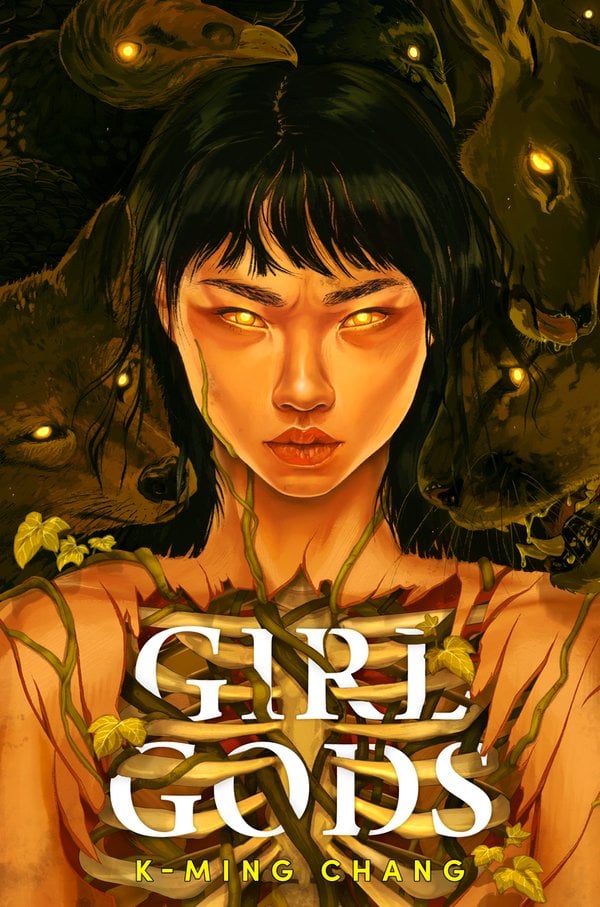
- Girl Gods: Dragon (The snake is all grown up and becomes its most ferocious self!)
This question has made me realize that I’d like to write a monkey book—something for the trickster!
Finally, you have one other exciting young adult book on the way! What can readers look forward to in that next novel and beyond?
My next YA book, Girl Gods, is a novel-in-verse, so I’m going back to my roots as a poet! I think of this novel as the bridge and union between my adult books and my YA books, sharing a lot of thematic resonances and a love for animals and animal transformations, but also a little more grounded, too. It’s a very special book to me because it’s about finding a friend who’s also a fellow warrior, someone who will fight alongside you for a different and better world.
Thank you, K-Ming, for such a reflective and passionate interview! If you haven’t picked up Straight to the Source or any of her other books, be sure to stop in at your favorite local indie bookshop or use any of the links above!
About K-Ming Chang
K-Ming Chang is a Lambda Literary Award winner, a National Book Foundation 5 Under 35 honoree, a Kundiman Fellow, and an O. Henry Prize Winner. She is the author of the novel Bestiary (One World/Random House, 2020), which was shortlisted for the Faulkner Award and longlisted for the Center for Fiction First Novel Prize, the VCU Cabell First Novelist Award, and the Otherwise Award. In 2021, her chapbook Bone House was published by Bull City Press. Her story collection Gods of Want (One World/Random House) won a Lambda Literary Award, and her books have been translated into Spanish, Chinese, Korean, German, Turkish, and other languages. Her most recent books are Organ Meats (One World, 2023) and a novella titled Cecilia (Coffee House Press, 2024).
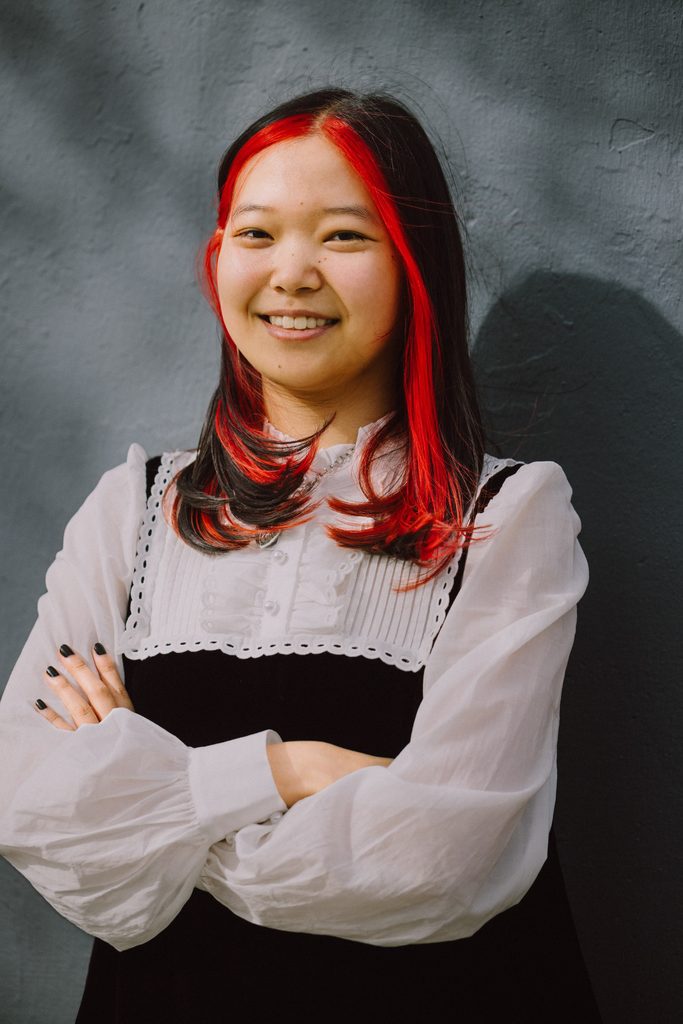
In 2026, she will be making her YA debut with Straight to the Source, a romance forthcoming from Holiday House, and her second YA project, a novel-in-verse titled Girl Gods, will be forthcoming from Kokila (Penguin Random House) in 2027. Her next novel for adults, Needlemouth, is forthcoming from Simon & Schuster on October 20, 2026. Her writing is most frequently described as “not for everybody” and occasionally described as “for the freaks.”
Learn more about K-Ming from her website and follow her on Instagram and Substack.
Looking for more author interviews? Check out our Author’s Corner to see who we’re chatting with!
Pick up K-Ming’s books from our YA Romances Bookshop shelves today!