

















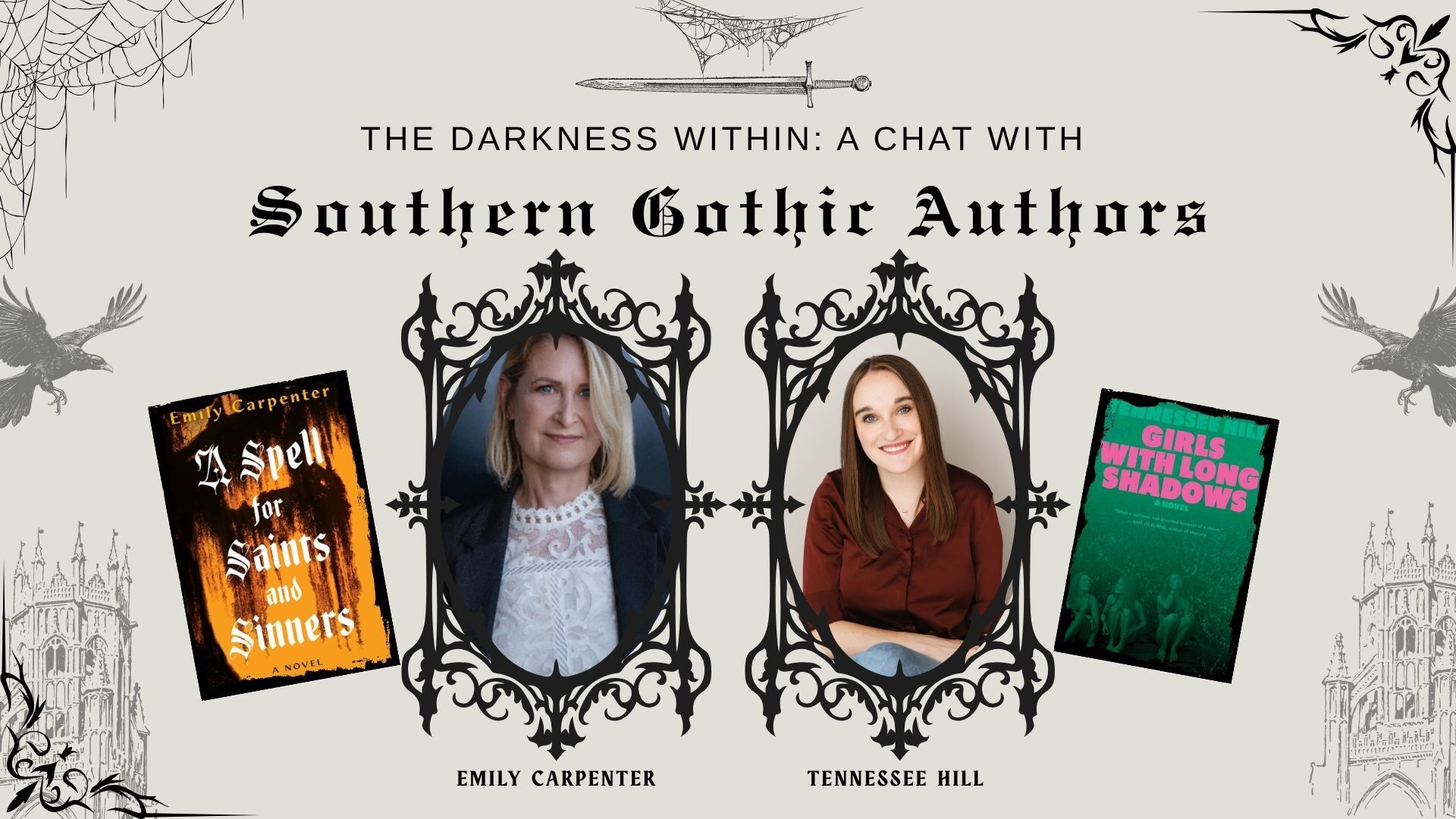
Gothic fiction can reflect the peculiarities, anxieties, and historical traumas that loom large over particular time periods or regions. Perhaps the definitive example of a regional Gothic literary tradition is Southern Gothic literature. Writers from Flannery O’Connor to Zora Neale Hurston have explored the darkness lurking beneath the American South’s unassuming, idealized facade. Characters living in privilege and poverty alike grapple with personal vices, unspeakable desires, and pasts they can’t seem to escape. The landscape itself often seems to bear the weight of these struggles, marked with the remnants of plantation slavery’s violent oppression.
Today, we’re speaking with two writers whose work proves the Southern Gothic is just as relevant and powerful as ever. Read on as they discuss what draws them to the genre and what makes a novel Southern Gothic.
The Authors
Emily Carpenter
Emily Carpenter is a bestselling author of novels of suspense. Her previous novels include Gothictown, Burying the Honeysuckle Girls, The Weight of Lies (which received starred reviews by both Kirkus and Publishers Weekly), Every Single Secret, Until the Day I Die, and Reviving the Hawthorn Sisters, which Publishers Weekly called a “refreshingly modern gothic tale” and Kirkus called “an exciting, gothic-tinged quest.” A Spell for Saints and Sinners will be published March 2026.
After graduating from Auburn University in Alabama with a Bachelor of Arts in Speech Communication, Emily moved to New York City. She’s worked as an actor, producer, screenwriter, and behind-the-scenes soap opera assistant for the CBS shows As the World Turns and Guiding Light.
Emily is a member of International Thriller Writers, Mystery Writers of America, and Sisters in Crime.
Born and raised in Birmingham, Alabama, she now lives in Atlanta, Georgia with her family.

Tennessee Hill
Tennessee Hill holds an MFA from North Carolina State University. She has been featured in Best New Poets, POETRY, Adroit Journal, Southern Humanities Review, Arkansas International, and elsewhere. Her debut novel, Girls with Long Shadows, was published by Harper in May 2025. She lives and teaches in Houston.

The Questions
Southern Gothic often explores moral decay and societal rot. How do you navigate the macabre and grotesque elements of the genre while ensuring the human stories at their core remain resonant and not just sensational?
Emily: I always want my books to be about capital-S Something. Something universal that we all feel, that we all understand. Something that is relevant, emotionally, to the human experience. So that is where I start, in a hopefully grounded place that feels familiar and real to readers. So then, when I add in those grotesque and macabre elements, which are part of the human experience too, as we all know, I endeavor to use subtlety and put those elements in a place where it will have the most impact. It’s like seasoning a dish with a distinct spice, or that Coco Chanel thing about taking off one accessory. The grotesque, to me, is so necessary but you need to use it wisely. In Gothictown, I have some distinct horror elements, but the book isn’t cover-to-cover horror.

Tennessee: This can be a slippery slope. I just tried to hold myself accountable to not including violence as “plot points”, but rather to implement moments of violence — emotional and/or physical — only when it served a larger conversation in the text aiming to hold the groups and people being violent accountable. I think Southern Gothic as a genre is evolving and I don’t think that in order to participate in it, the macabre or grotesque has to rule the text. The Gothic can be subtle, too.
The Black experience is a foundational, yet often underrepresented, part of Southern history. How do you integrate this perspective into your work, and what specific focal points of the Black experience do you feel are most crucial to explore within the Southern Gothic framework?
Emily: It’s difficult. The history of the South is not history, to paraphrase Faulkner. It’s everywhere down here, in the water, in the air, in the statues and buildings. You feel it in your bones day and night. However, as a White woman, I have basically nothing to say about the Black experience — all I have is my perspective on the often biased world I come from. Which, in itself, is an experience, I suppose, just not necessarily a new one. And as much as Southern stories tend to include racial issues or stories about slavery, I really wanted Gothictown to be about something else. Another great sin from the past.
But the history of the treatment of Black people down South is always at the top of my mind when writing my books. Back to Gothictown, my main character Billie is a White woman who’s from New York and used to being in a very diverse world. So as she’s thinking about moving down to this small Southern town to raise a six-year-old daughter, she was going to have questions about how diverse the town is. Do they welcome people of different faiths, cultures, races, identities, etc.? Is her daughter going to be too sheltered? This felt like the truth of this situation to me.
Tennessee: My love of Southern Gothic is built on the works of Randall Kenan, Zora Neale Hurston, Jesmyn Ward, Brandon Jacobs-Jenkins, and many more. To understand the Southern Gothic as a genre, you absolutely must prioritize reading works by Black authors, classic and contemporary. As a White writer, when I read literature that centers the Black experience, I am reveling and listening. Being intentionally in communion with these writers, their characters, and the hearts of their stories. Instead of focusing on focal points the genre can explore, we can uplift and empower our Black writers to challenge the genre in ways they feel are important.
When depicting your main characters, do you find they are often based on/inspired by people you know in your real life, or are they entirely fictional beings to you?
Emily: My main characters are entirely fictional, but if they’re based on anyone, they are in small ways, and maybe big ways, always me. Or who I would like to be, who I want to pretend to be for a couple of months.
Althea in Burying the Honeysuckle Girls was the part of me that wanted to strengthen my own trust in myself, my gut instinct. Meg Ashley in The Weight of Lies was writing a tell-all memoir about her mother, so she was the part of me that wanted to spill the beans on some past hurts I had. Daphne Amos in Every Single Secret was the part of me that wanted to trust myself in the context of my relationship. (Not implying that my husband is anything like her fiance in any way!) Billie Hope in Gothictown basically takes down a whole corrupt community. All of my protagonists are so much braver than me!
Tennessee: When writing Girls with Long Shadows, I tried to resist any pull toward autofiction. Some of the elements of the novel were inspired by my life — for example, the main characters are a set of identical triplet sisters, and I am a triplet, though I have two brothers. I wanted to really explore what it might be like to have sisters, and found that there wasn’t much about my own triplet-experience that crept into the book because I was so captivated by the sister experience, which I’ve never had. Of course, you live as a human in the chaotic world and sometimes think, “Ooo that’d be a fun sentence or image or scenario for my story,” and those things might creep in. But I try to create as much as I can from scratch!

Southern Gothic often overlaps with genres like classic horror and the Gothic Western. What, in your view, is the single most crucial element — be it a theme, a type of character, or a sense of place — that uniquely defines Southern Gothic and sets it apart?
Emily: Remember that court case decades ago where they classified pornography as impossible to define but “I know it when I see it”? Honestly, that’s Southern Gothic to me. There are definitely the same odd people and family secrets in every pocket of our country and in other countries, but to me, the actual geography of the South absolutely has this mystical alchemy on the characters and plot that makes it distinct. Also, I heard recently from a fellow author (quoting another author) that the definition of gothic is a romance between a girl and a house. Which absolutely killed me. It’s so simple, but also so true. So just add “Southern” into the mix — Southern Gothic is a romance between a girl and a Southern house! That’s literally the starting point of almost all my books to some degree or another.
Tennessee: The eeriness of the pastoral landscape and its creatures feels, to me, like the distinction of Southern Gothic from other Gothic genres. This could just be my biases speaking because setting is the element I’m most drawn to in novels, but I do think Southern Gothic texts usually think about the volatility between people, nature, and animals. Someone once told me that all Southern Gothic writers have a short story in their repertoire about a dead hog — that’s been my marker for Southern Gothic since. There’s got to be a hog!
How do you balance the traditional archetypes of Southern Gothic — like the decaying mansion, the tormented family, or the haunted landscape — with fresh, contemporary themes to make the genre feel new and relevant for today’s readers?
Emily: I write about the things that bother me, it’s as simple as that. The things I wrestle with in my own life like misogyny, belonging, motherhood, fighting for love, independence, justice, spirituality. The issues of today’s world always end up in my books, and I think part of writing for me is taking an opportunity to hash out how I truly feel about a particular issue. For instance, I was raised traditionally Christian, and I have these never-ending questions about God and if he/she/they exist, what level of control or influence do they actually have in our day-to-day lives? Are miracles real? Is the veil thin? I tackled that in Reviving the Hawthorn Sisters, not that I came to any sort of definitive conclusion. It’s important to me to write a book that people can enjoy on just a plot level. Like, I want to tell a cracking good story that you fly though. But if you’re looking for a little something deeper, something more resonant, I’ve got that for you, too.
Tennessee: I’m not sure I have a very self-aware answer because I wrote and revised in such a flurry. When I step back, I see some of the things my characters are able to speak about openly as people waddling around the 2000s might be what pulls it toward the contemporary. Truthfully, I struggle with balancing elements of plot when writing. My writing process is messy and impulsive, not at all planned or elegant like I wish it was. Luckily, I have never felt too pressured to include archetypes, or to focus on being particularly contemporary. I feel quite free to create and see where things go!
Bonus Questions
Everyone has their favorite trope that is an automatic buy when we see it as part of a promo about the book. What is your favorite sub-trope to write in the Southern Gothic genre?
Emily: I love an emotional, and occasionally steamy, romance and most of my books have a dollop of that. I especially loved that aspect in Burying the Honeysuckle Girls, with Althea and Jay, and Reviving the Hawthorn Sisters, with Ruth/Dove and Dell.
And I don’t know if “dark” is a trope, but I’m definitely going to write something dark, no matter what!
Tennessee: Hurricanes. Mostly because the communities I’ve lived in have been so irreparably and repeatedly upended by them, and they feel like one of the scarier parts of the Coastal South experience. We’re always waiting for one, or running from one. But every time I want to write about a hurricane, I remember that Salvage the Bones exists, and there’s probably not much I can say about a hurricane that Jesmyn Ward hasn’t!
It’s well known that authors read what they write to better align with their audience’s expectations and the genre’s specific style. What other books do you find yourself gravitating to outside of the genre that you might take inspiration from?
Emily: I love a good literary read. I aspire to write beautiful sentences and things that are not only commercial and exciting to read, but also well written. I am drawn to books that are odd in some way, either in its genre mashing or in structure. Horror or science fiction or anything that is speculative. I love the freedom that I feel when I read something that is completely unique. I want to be daring that way too, within the borders of what is a commercial suspense novel, to shake things up and give something new and delightful to readers. I actually self-published a contemporary romance series, the Thornhill, Georgia series (under the name of Isla Moore) where I have the main character of each book interact with a person who is either someone in their life who had passed away or was an imaginary character. In the first book, The Jennifer Files, the main character is writing a romance novel and has this funny ongoing conversation with her protagonist, Jennifer. It was such a blast to write.
Tennessee: I’m a poet first. I read so much poetry, every single day. It’s the best way to live! For that reason, I gravitate toward lyrical writing more than anything. I love books about strange women, like The Rabbit Hutch by Tess Gunty and The Safekeep by Yael van der Wouden. I revel in super-short stories, like in Lorrie Moore’s Self-Help and anything by Amy Hempel. I adore suburban creep, perfectly exemplified in Stephen Millhauser’s novella Enchanted Night or anything by Kevin Wilson. I had an Irish Literature summer and was delightfully entrenched in the works of Claire Keegan, Louise Kennedy, Lucy Caldwell, and Tana French, with a huge stack of Irish Lit still waiting to be read.
Thanks to our lovely authors for speaking with us! If the eerie atmosphere and riveting drama of Southern Gothic speak to you, consider giving them a read.
Find Emily Carpenter here.
Find Tennessee Hill here.
Want more recommendations to kickstart your Southern Gothic journey? Click here.
Find more eerie Gothic fiction at our Bookshop.
