












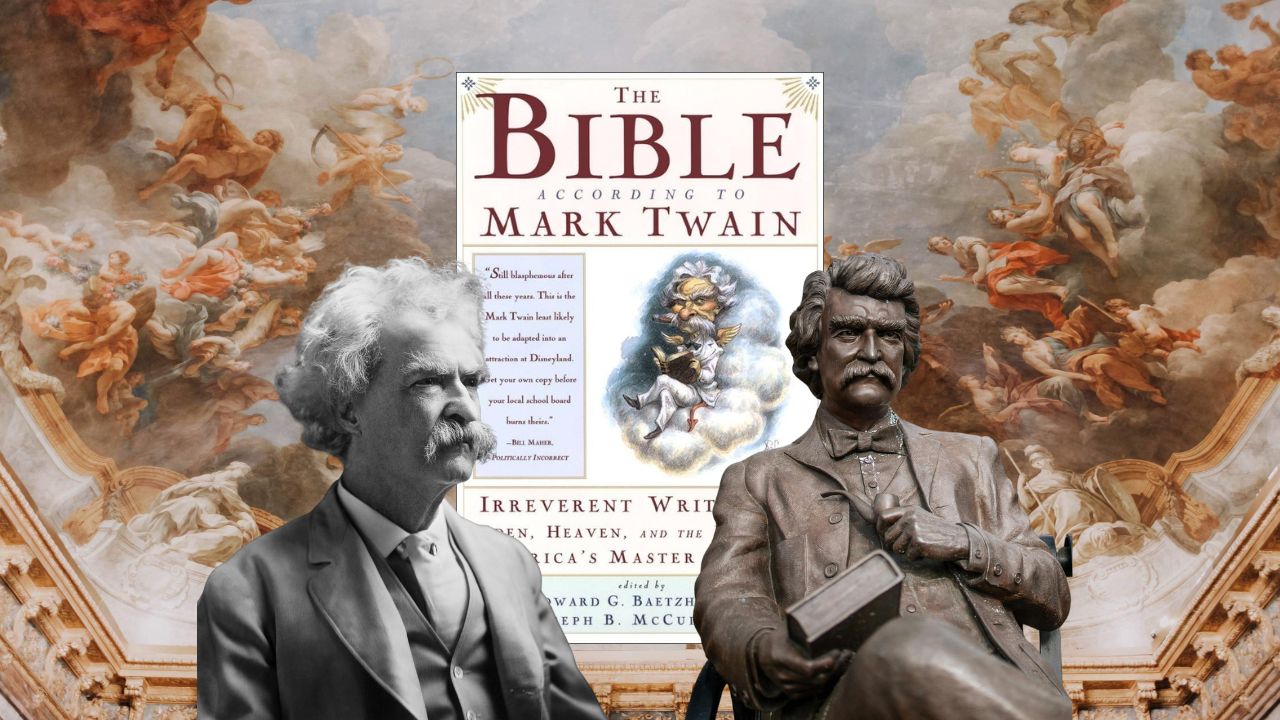
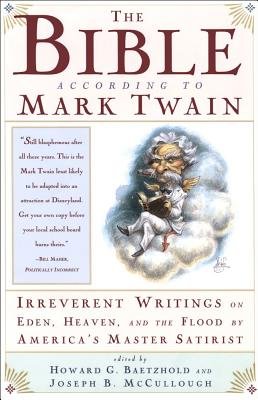
Mark Twain — aka Samuel Clemens — has had his fair share of accolades. He’s been hailed as “America’s master satirist” and even “the father of American literature” altogether. The Adventures of Huckleberry Finn and The Adventures of Tom Sawyer have never gone out of print. But as for his lesser-known The Diaries of Adam and Eve, in some ways, it’s a wonder they even went to print when they did. On the surface, The Diaries is a light-hearted comedy retelling of the biblical Creation story from the perspective of the Bible’s first humans. Extracts From Adam’s Diary, Eve’s Diary, and Autobiography of Eve, first published across the early 1900s and found in Twain’s posthumous collection, The Bible According to Mark Twain, document the couple’s unlikely hobbies, Eve’s insatiable curiosity, and Adam’s irritation and gradual warming towards his new partner.
Bubbling under the surface, however, is Twain’s scathing anti-Creationist stance — and there are more than a few clues hidden about his Eden.
Comedy
“I am very busy, then, naming and classifying the creatures and plants and trees and flowers and things, from eight until noon, and from two till six, for these are my office hours. And when I please — which is somewhat often — I take a little holiday, and play with the animals…”
Mark Twain, Autobiography of Eve
Okay, so there are moments of genuine, innocuous humor. Plenty of them, in fact. “I get no chance to name anything myself,” Adam complains. Eve spends her first days naming all species of flora and fauna. And some of their names, Adam is none too pleased about. “Dodo! It looks no more like a dodo than I do.” Eve makes a day job of naming the animals. And it sounds more like a modern-day corporate job than anything. She works “from eight until noon, and from two until six, for these are my office hours,” and takes “holiday” breaks. Who would’ve thought holiday and office hours would find their way into Eve’s prehistoric lingo?
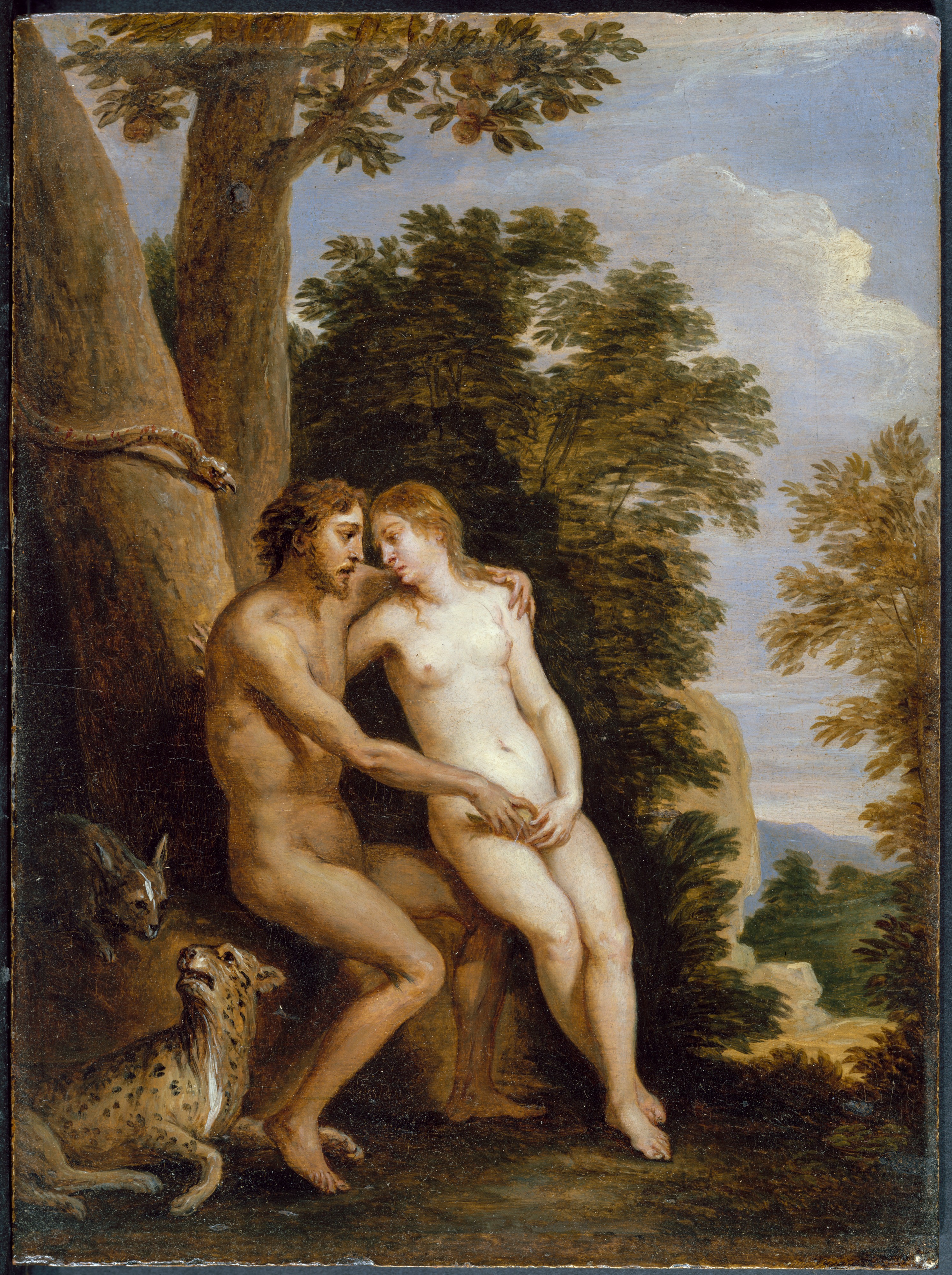
Twain dishes out plenty of dramatic irony. Eve, easily amused, is delighted to learn that the moon returns night after night. Later, outside the garden, she “catches” a new creature, which they name Cain. But as to its species, Adam is beyond baffled. It’s a fish, he thinks at first — “though when I put it in the water to see, it sank, and she plunged in and snatched it out before there was an opportunity for the experiment to determine the matter.” Seeing Cain’s long hind legs grow, he names it Kangaroorum Adamiensis, before deciding it’s a bear. Finally, when Cain and Abel are grown, Adam settles the matter — “they are boys.” It’s easy to picture Twain winking over the heads of his clueless first humans.
Pre-Fall Veganism
“She engages herself in many foolish things: among others, trying to study out why the animals called lions and tigers live on grass and flowers, when, as she says, the sort of teeth they wear would indicate that they were intended to eat each other”.
Mark Twain, Extracts From Adam’s Diary
More often than not, however, the punchline for Twain’s jokes is the logical fallacies he perceives in the literally understood Creation story. For the most part, Christianity in the 19th century, in which Twain had grown up, had been slow to accept a more nuanced, metaphorical interpretation of Genesis’s Creation story. It wasn’t until 1950 that Pope Pius XII publicly taught that there was no conflict between evolution and a figurative understanding of Creation. Eve, in this account, is one step ahead. As Adam complains, she wastes her time investigating how it can be that Eden’s clawed, sharp-eyed beasts are resigned to a plant-based diet, when “the sort of teeth they wear would indicate that they were intended to eat each other.” Nudge, nudge.

In fact, Twain’s prelapsarian Eden is full of vegan predators. “The lion eats turnips; the tiger eats tomatoes; the hyena lives on strawberries, the fox eats apples…” You get the point. On a darker note, Eve becomes concerned for the poor buzzard, which she finds isn’t satisfied by its mild diet of grass. She thinks it was meant to live on flesh. In a more profane twist, it’s actually the idea that the forbidden fruit would introduce death into the world that entices Eve to eat it — she just wants to save the sick buzzard. Twain told a friend that, around the time of writing The Diaries, he’d been reading commentaries defending a literal interpretation of Genesis — for example, that the meat-eating animals became vegetarians on Noah’s Ark. Twain, it becomes clear, was a staunch supporter of evolution in its early days of recognition, before Evolutionist Christianity had the popularity it does today.
Dinosaurs
“I am the only one that is alone. There are two leopards, two mastodons, two megatheriums, two pterodactyls, two tigers, two lions, two elephants, two of everything — and I am by myself.”
Mark Twain, Autobiography of Eve
Twain’s Eden is nothing if not anachronistic — laughably so. Before she meets Adam, Eve believes she’s a solitary creature. Every other animal has a mate, she laments. Even the mastodon, megatherium, and pterodactyl. Twain provocatively defies the typical Noah’s Ark play set. It’s worth noting, too, that scientists estimate a gap of over 60 million years between the pterodactyl and the megatherium. Tucked away in a list as they are, Twain’s creatures rear their incongruous heads in more than a gentle poke at the discourse between Creationism and the emerging evolutionary discoveries of his time. In Adam’s Diary, Adam and Eve are interrupted by a “mighty brontosaurus” striding through camp. On one occasion, a dinosaur distracts Adam from eating the forbidden fruit — and the Fall is thus postponed.

Twain’s lifetime until this point had seen the first introduction of the term dinosaur, Charles Darwin’s On the Origin of Species, which introduced the theory of natural selection, and a wealth of other discoveries that threw the largely unchallenged idea of a Six-Day Creation into question. It also saw several less likely arguments attempting to reconcile Creationism with the discovery of fossils — namely, that God had planted the fossil record in the earth during creation, to add nuance to the planet (see Andrew Dickson White’s History of the Warfare of Science With Theology in Christendom). Twain, as he makes no attempt to hide, was less than convinced.
Fossil Planting
“I have put up a hydrocephalous plantigrade with fused reptilian and molluscous characters and an evolutionary disposition toward feathers, which will attract attention in the remote by and by when they find it.”
Mark Twain, Autobiography of Eve
Speaking of anachronisms, the first family has some less-than-common hobbies. When they’re not naming animals and discovering fruits, they’re keen fossil crafters. Eve is especially proud of Cain’s skills: “he is really an expert at making the simpler kinds of fossils”; in fact, “he has even invented one fossil, all by himself.” At one point, Eve herself creates what is most likely a platypus fossil — “a hydrocephalus plantigrade with fused reptilian and molluscous characters and an evolutionary disposition toward feathers.” If you thought office hours and holiday sounded jarring in Eve’s cavewoman vocabulary, how about hydrocephalus plantigrade and evolutionary disposition? Eve has a lexicon to rival Darwin himself.

For the most part, Twain’s satire is tongue-in-cheek. As The Diaries progress, it becomes increasingly tongue-out-of-cheek. That is, the veil of innocent comedy gradually wears thin; Twain, really, is sticking his tongue out at Creationism, and the more unconvincing arguments he’d read. As Eve writes on her most impressive fossil, “it may turn out a help in reconciling Science and the Scriptures, but the more I look at it the more I am persuaded that there will have to be considerable concessions on both sides before that happens.” At this point, we can’t help but wonder — who is “I”? Is this still the Autobiography of Eve — or of Twain, writing to the 1900s readers he found so resistant to changing views?
Romance
“Wheresoever she was, there was Eden.”
Mark Twain, Eve’s Diary
Pterodactyls and plantigrades aside, The Diaries aren’t all bitter satire and theological critique. The relationship between Adam and Eve — at first begrudging on Adam’s part — develops into true affectionate companionship. After their expulsion from Eden, Adam comes to love his partner. He concedes, “it is better to live outside the Garden with her than inside it without her.” It’s sounding less like Twainian parody here and more like Milton’s Paradise Lost. And, 40 years later, standing at Eve’s grave, Adam ends Eve’s Diary with his own touchingly poetic eulogy: “wheresoever she was, there was Eden.”
Twain’s own wife of 34 years, Olivia Clemens, died a year before Eve’s Diary, and it’s widely considered to be his eulogy to her. After her death, Twain wrote to his brother-in-law, “I am a man without a country. Wherever Livy was, that was my country.” For all its scathing satire, The Diaries are surprisingly sentimental.
The Diaries of Adam and Eve have come a long way since their early 1900s publication, with directors like David Birney adapting the extracts for the stage. The intersection between Christianity and evolution has also since evolved. Although beliefs vary across countries, cultures, and churches, Evolutionist Christianity has grown massively in the century since Twain’s death. Today, Twain would have had his hands full with books like Genesis Unbound: A Provocative New Look at the Creation Account by John Sailhamer and Quarks, Chaos & Christianity: Questions to Science And Religion by John Polkinghorne, which offer answers to the many questions he raised through his Diaries. He also would have loved today’s natural history museums.
For more of Mark Twain’s best under-discussed works, read our other roundups here and here.
Or to expand your reading list, check out the Bookstr team’s latest recommendations here.