
















As a pioneering Black intellectual, W.E.B. Du Bois left a lasting impact on United States history. In addition to co-founding the National Association for the Advancement of Colored People (NAACP), he was a prolific writer whose work redefined conversations around race relations and the experience of being Black in America.
What you may not know is that Du Bois was also a novelist — and a poet! On top of that, he edited four journals and worked full-time as an academic and advocate for Black Americans.
Join us as we take a look at the incredible career of one of the United States’ most influential Black writers.
Scholarship and Essays
From a young age, Du Bois demonstrated a sharp mind and a talent for writing. As a high schooler in Massachusetts, he wrote articles for the Republican and the Globe, two regional newspapers. He went on to earn degrees from Fisk University and Harvard College, becoming the first Black Harvard student to earn a PhD.
In 1896, the University of Pennsylvania hired Du Bois to conduct a study of the Seventh Ward, a predominantly Black Philadelphia neighborhood. The Philadelphia Negro shone a light on the systemic racial discrimination driving poverty among Black urban communities, whose implications are still felt to this day.

In 1897, Du Bois’s essay Strivings of the Negro People was published in The Atlantic Monthly. That essay introduced the phrase “double consciousness,” which Du Bois adopted to describe how Black Americans perceived themselves under white supremacy:
Du Bois’s words have resonated with many who have felt Othered or pressured to assimilate as they navigate the feeling of being caught between two opposing cultures. They helped set the foundation for Du Bois’s most famous work, The Souls of Black Folk, an essay collection published in 1903. The Souls of Black Folk combined Du Bois’s academic background in history and sociology with anecdotes from his own life experience. It quickly became a foundational work in Black American literature, one that urged Black Americans to challenge the racial hierarchy and demand better for themselves.
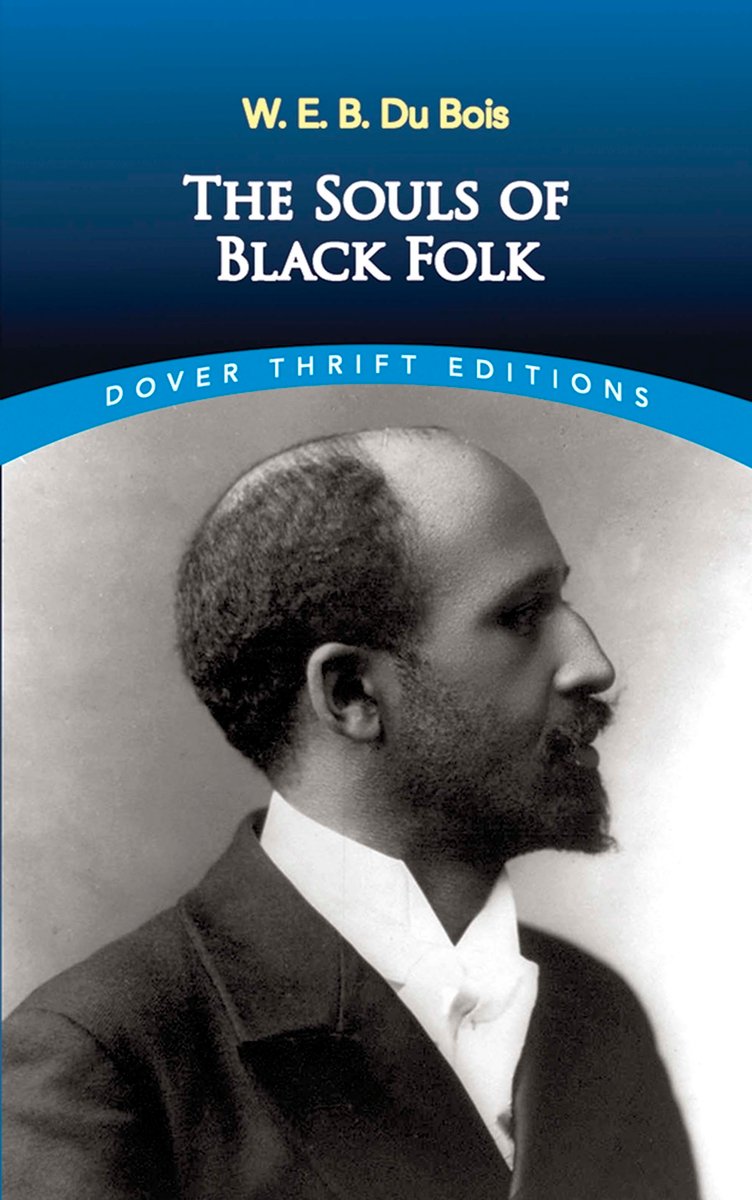
As his academic and activist career progressed, Du Bois continued to write extensively. Some of his works, such as Black Reconstruction in America (1935), documented aspects of African-American history. Others were more autobiographical, analyzing the intersecting effects of racism and capitalism on Du Bois’s own life as well as society at large. These personal accounts included Darkwater: Voices from Within the Veil (1920) and Dusk of Dawn (1940).
Fiction
Less well-known than his scholarship and nonfiction works are Du Bois’s novels. Du Bois often used fiction as an additional lens to examine and critique race relations. His first novel, The Quest of the Silver Fleece, was published in 1911. It uses the romance between Southern field worker Zora and Northern-educated teacher Bles to explore the relationship between race and economy in the South.

His next novel, 1928’s Dark Princess, was also a romance, one between disillusioned medical student Mathew Towns and Kautilya, the princess of a fictitious Tibetan kingdom. While Dark Princess, which imagined possibilities for global racial solidarity, was a favorite of Du Bois’s, it received mixed reviews from critics. Modern scholars have drawn attention to some of the novel’s more problematic aspects, namely its Orientalist portrayal of Kautilya.

Du Bois’s final three novels, released between 1957 and 1961, are collectively known as the Black Flame Trilogy. They follow Manuel Mansart, a character similar to Du Bois himself, through his early life and developing academic career.
Poems
Du Bois wrote a number of poems, some of which were included in his autobiography Darkwater. Though many of them were not published during his lifetime, they have been archived online by the W.E.B. Du Bois Center at the University of Massachusetts. In his poems, Du Bois captures a wide range of emotions, from despair and anger to wonder and hope. Ghana Calls, one of Du Bois’s last writings, reflects on his life journey and eventual move to Ghana, where he spent the final years of his life:
We’ve only scratched the surface of the amazing life and career of W.E.B. Du Bois. The Civil Rights activist was an extraordinary thinker whose insights paved the way for those after him to imagine a better world.
Want to learn more about W.E.B. Du Bois? Click here and here.
Explore more from Black writers at our Bookshop.