






Bookish fam, I have a rant. You see, as a young disabled child, I longed to see myself represented in the media. I scoured movies, television, and books, hoping to find another character who was a wheelchair user. Alas, I was constantly disappointed by the showing put forth by studios. It wasn’t until my early double digits that I started expanding my worldview and began gathering any (and I do mean ANY!) representation I could. Enter comic books and their most well-known “inspirational heroes.”
Matt Murdock (Daredevil)
Matt Murdock, like many of his fellow superheroes on this list, became disabled through a tragic accident. As a young boy, Matt was exposed to radioactive substances, blinding him but causing a superhuman effect on his four remaining senses — I know, stay with me — by which he is able to survive. After losing his father to a preventable crime a few years later, Matt was placed in an orphanage and raised in the care of Stick, a blind man. This mysterious figure helps Matt to hone his “abilities” and eventually become the vigilante known as Daredevil. Matt’s blindness is considered a Grade IV on Thoft’s Classification of Ocular Chemical Injury, in which the likelihood of Matt regaining vision is low, and the development of a “sixth sense,” so to speak, is improbable.
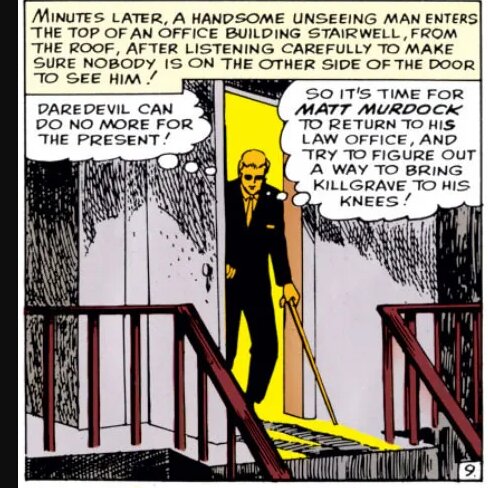
At first glance, Matt’s blindness is handled well by Marvel; they even expand the definition of blindness to say that Matt can see some things. Exciting, right? What can he see — dark shapes, shadows, blurry, unfocused images when lights are on? Nope. He “sees” through a “radar sense” to “a world on fire.” This world seems to work much like X-ray vision, with Matt even talking about his “extra-sensory” abilities “recognizing a radar image (of a villain, Stilt Man) anywhere.” in Volume One Issue Eight: The Stiltman Cometh. ANYWHERE? Really? He was on stilts; would you recognize him without them, Matt? Would you?
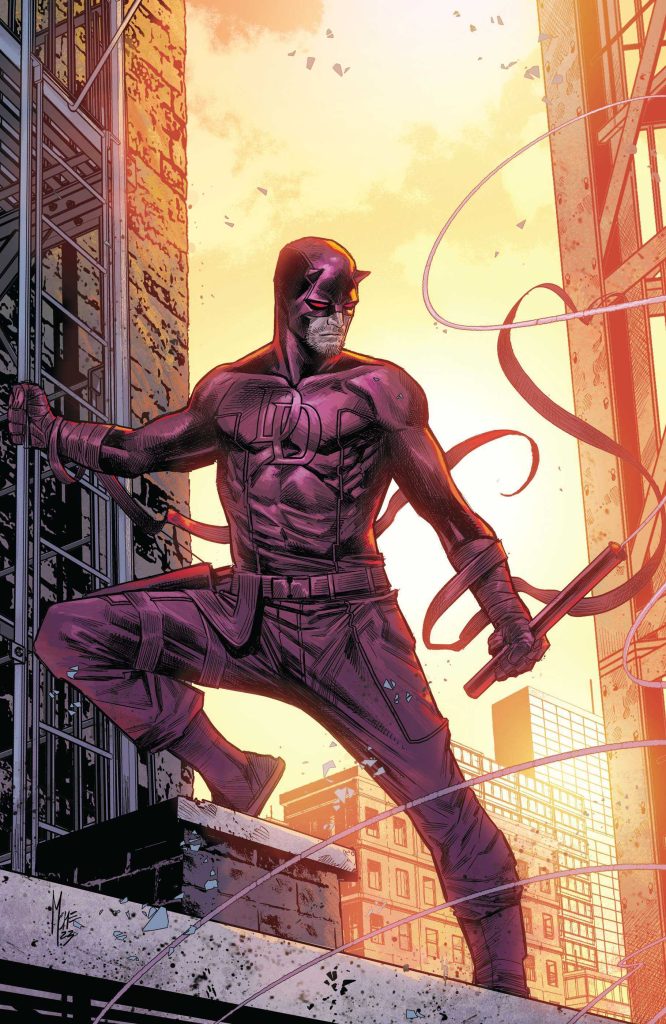
Putting aside his “sight” (which is saying a lot!), Matt’s accident also gave him expert tracking skills, which are aided by his senses. I had a hard time believing that his senses are heightened to the levels explored in the comics. For example, his sense of touch is so enhanced that it allows him to feel how the ink changes on the paper when the letters change, or he can hear a heartbeat from 20 feet away. While there is some truth to hyper-awareness with senses (according to a Harvard study on brain development), the measurements given for Daredevil are greatly exaggerated.
If you are looking at Matt Murdock as a blind man for representation, on a surface level, he is great. All the times that we see him through the eyes of those around him, like his best friend Foggy Nelson, he is a perfect representation of some blindness as a disability. But the mere second it becomes deeper than that, or he shows off something enhanced as a replacement survival tool, one that is arguably advanced beyond able-bodied capability, Matt Murdock as Daredevil loses credibility as a disabled hero.
Barbara Gordon (Batgirl and The Oracle)
Barbara Gordon is the daughter of Commissioner James Gordon within the DCU. She takes up the mantle of Batgirl, helping Batman and Robin throughout various volumes. Her crime-fighting skills and smarts don’t disappear when she is shot by The Joker in her home in The Killing Joke. She uses her eidetic memory and computer skills to provide overwatch to many other teams in-universe as “The Oracle.”
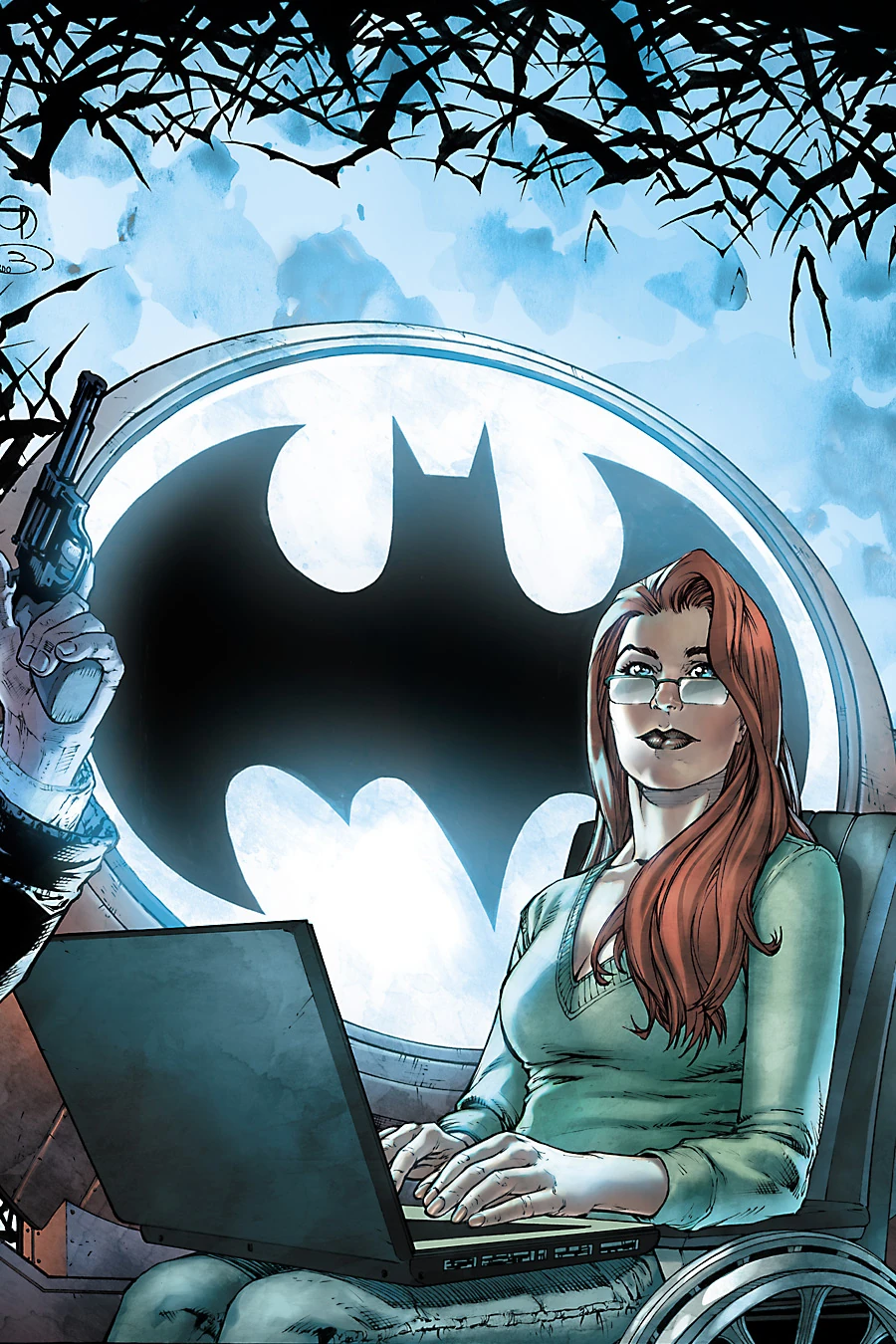
Now, let’s break this down in terms of representation: Barbara became a wheelchair user through a Complete L1 Spinal Cord injury resulting in paralysis of the legs (aka paraplegia). The L1 distinction was made in “Shattered” Volume One, Issue One of Batgirl: The Darkest Reflection. The classification of complete would mean that she lost “all motor control and feeling below their level of injury,” as defined by Flint Rehab. This is depicted throughout her appearances as The Oracle, in which she is confined to a chair and must be carried if she cannot use her wheelchair (as seen in Batman: Gotham Knights, Issue 43).
With this diagnosis, walking more than short distances and without assistive devices is unlikely. Granted, the ability to walk short distances was only possible due to extensive therapy and surgeries. However, in some versions of Barbara, she is so motivated by her father’s death that she pushes herself to walk again. In The New 52 timeline, James Gordon is alive and well, but Barbara is able to be fully mobile just three years after her injury. This miracle is due to an experimental implant, and while treatments like the implant exist, there are very few studies that show long-term effects and are nowhere near as advanced as the one used in the world-building.
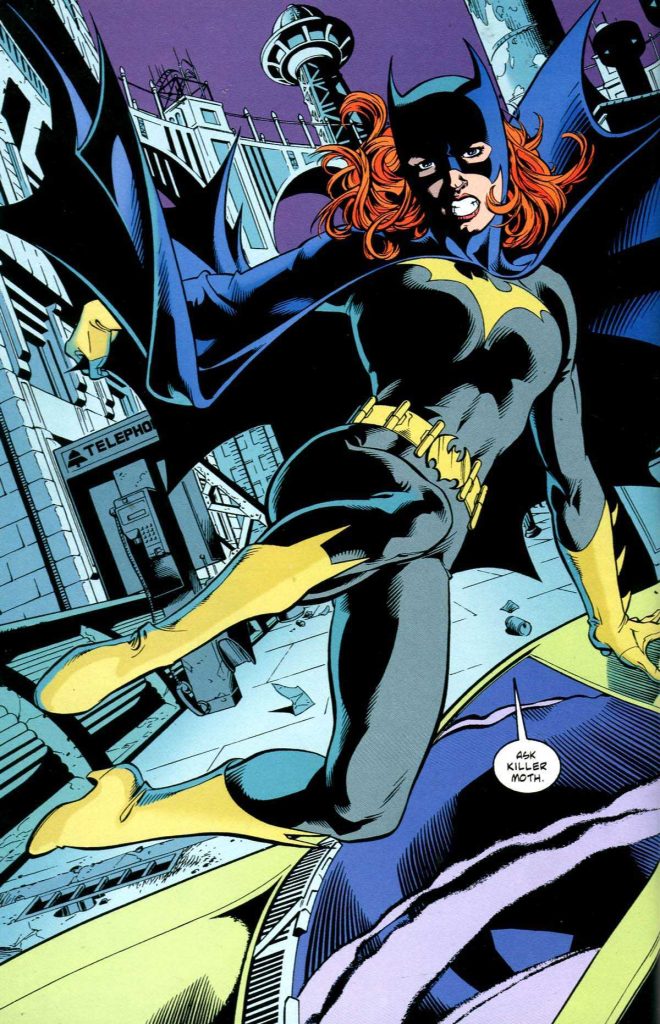
The magical healing of a disability in order to change the narrative could be considered, in my opinion, disability erasure. Although I know deep in Reddit somewhere, there is an argument brewing about alternate universes, but in this case, I think the alternate universe argument works if you think the healing erases her disability, not her trauma, which is, at the very least, an attempt. Overall, the DC franchise tried really hard to create representation in Barbara, and somewhere along the line, it was lost and discarded for other plotlines by different able-bodied writers. Perhaps they will try again in the future or when they need another shocking tragedy to befall an “invincible” character.
Dr. Stephen Strange (Doctor Strange)
Dr. Strange is a surprising one for me. When researching for this article, his name kept appearing on list after list. It was then I realized I wasn’t thinking broadly in my definition even still. Stephen Strange was a talented but arrogant neurosurgeon who was involved in a near-fatal car crash, crushing his hands and ending his career. Crush injuries are not something you can easily correct. The damage to your bone and nerve endings alone would require surgery on top of surgery to repair, not to mention extensive occupational therapy to regain slivers of control. And like in Stephen’s case, it may not even work. After the system he had devoted his life to failed him, he turned to the mystic arts for healing. He used their skills to get his hands back and began training to become the Sorcerer Supreme.
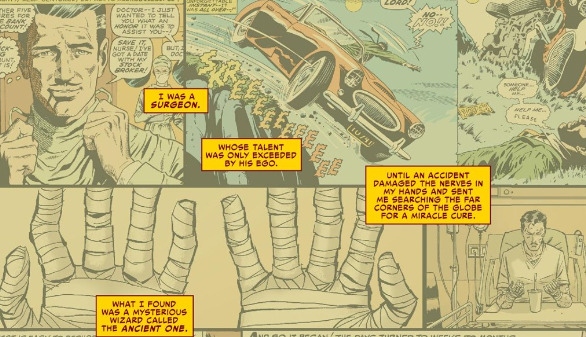
In Doctor Strange: Strange Origins, his struggle for control over his hands is apparent. He has tremors, which create a weakness in his dexterity and fine motor skills. Stephen struggles with opening cans and maintaining a stable hand. However, you would never know the injury was life-altering. In fact, if you were looking at his first appearance in the Marvel Comics in Strange Tales, Volume One Issue 110, years before Strange Origins showcased the true struggles of this magical Doctor, you might never know of his injury. It is not even mentioned fully until the final page of the comic, in what can only be described as a “flashback” strip of images, like the one pictured above, explaining his accident for the new strain of the 2015 comics.
Much like the implant for Barbara Gordon, if Dr. Strange’s magic abilities were to disappear, so would the use of his hands. Therefore, it brings up an interesting question of magic as an assistive device. Now, if it were handled as such, I would be ecstatic, but sadly, disability is once again used as a means to an end in terms of superpower development.
Dr. Charles Xavier (Professor X)
Dr. Charles Xavier is another paraplegic, who, like Barbara Gordon, was paralyzed due to his proximity to a villain. He is perhaps the first one most people think of when you ask a representation-based question, and due to his work with the X-Men, he may be someone’s definition of how to treat people with disabilities. I would love to see him like that; however, everything about how he is written contradicts that very message, which I know was not what he was originally created for.
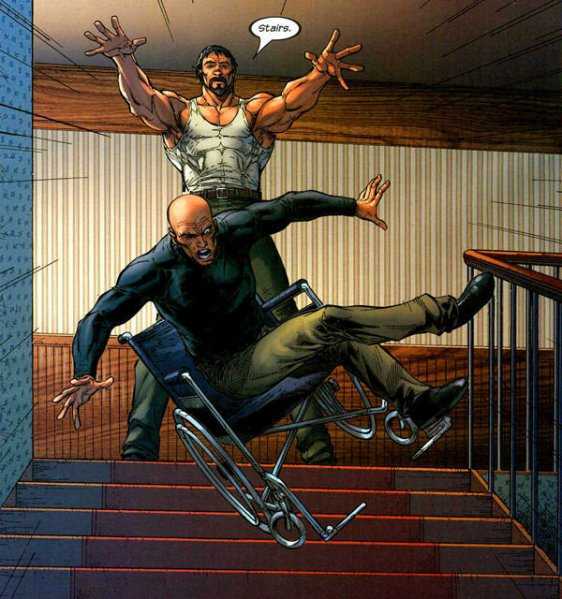
Dr. Xavier is another example of a character whose entire narrative changes for the sake of the plot moving forward. The first time (and yes, the paralysis does fluctuate over many years), Charles Xavier was paralyzed by Lucifer in X-Men: Volume One, Issue 20. It was reversed by alien technology in X-Men: Volume One, Issue 167, where his conscience is transferred to a working body. (Yay, “Science”?). This is a pattern of healing and reoccurring injury, either by breaking or paralysis, that hurts me on a narrative level.
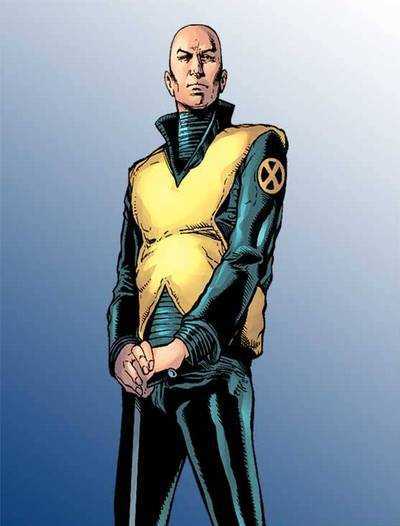
It may have been “necessary” to create a backstory for Charles’ passion for helping mutants, but was it really needed for him to be healed if another villain was just going to attack and place him back in the wheelchair? On top of that, the injury reoccurs very similarly each time, which feels like it wasn’t done deliberately (to showcase a new aspect of Professor X) but was only used to bring back the chair in a way that is “believable.” Marvel, I am begging you, please don’t heal him again. LET. HIM. ROLL.
Clint Barton (Hawkeye)
Now, let me be clear: not all the disability representation we have is bad. Clint Barton is one of the few characters on this journey that I had no comic foundation about. In fact, I was super excited that they were introducing him as a deaf character in his show, to which an immediate Google search told me, “Yeah, this is the way he was originally represented in comic lore.” Thus, the premise of this article was born.
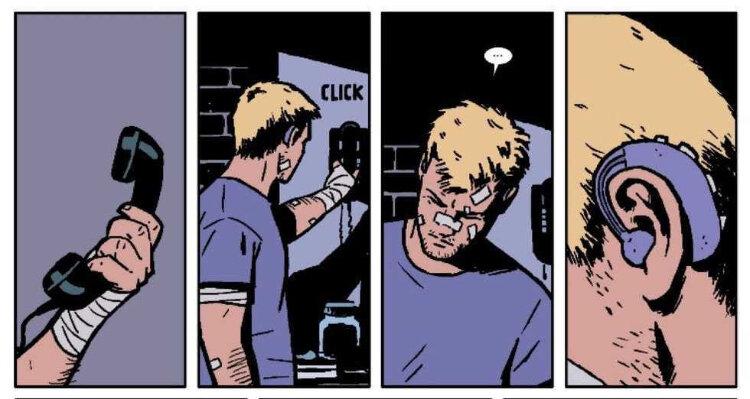
Clint Barton (aka Hawkeye) is a member of the Avengers team and another person to develop his disability while he was already a crime fighter. His hearing loss came from a battle, meaning that it is sensorineural hearing loss and not congenital (meaning at birth). The stories are all different, depending on the writer, but the first instance of deafness was introduced in Hawkeye: Volume One, Issue Four. Unlike others on this list, his skills didn’t enhance or downplay his disability.
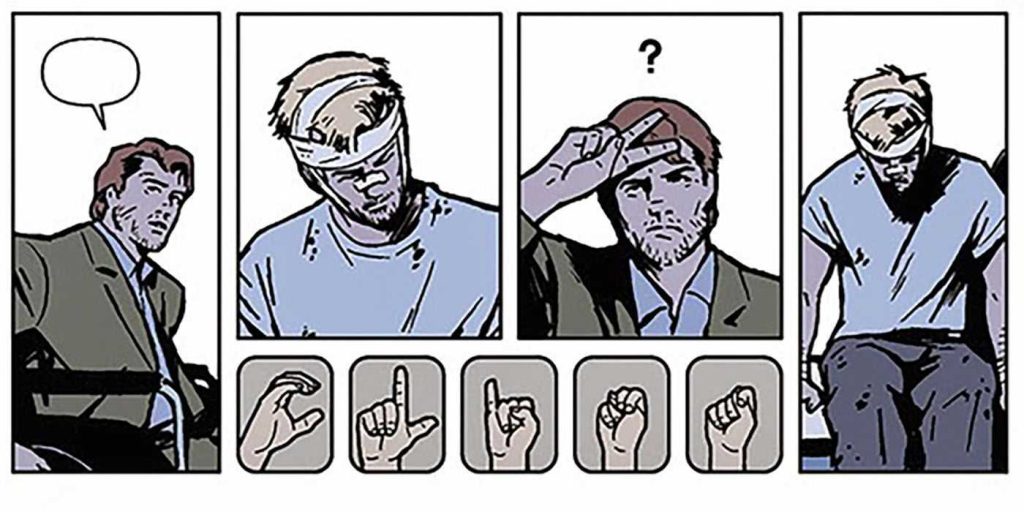
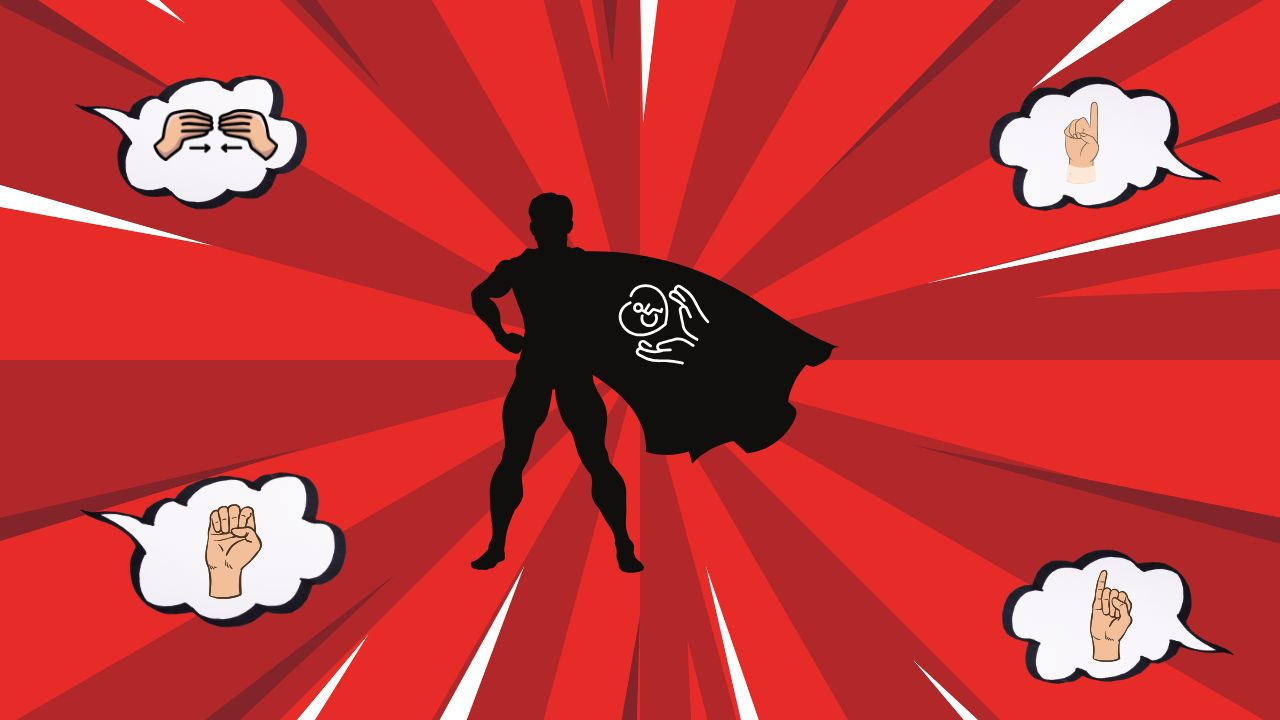
He is still an expert marksman with weapons training. His skills, strategy, and charm are unmatched, and he proves how loved he is by other characters. Some interactions between other characters, for example, Deadpool, include full conversations in ASL. Writers Matt Fraction and David Aja even created an entire issue with ASL and hand motions in Hawkeye: Volume Four, Issue 19. The fact that these writers dedicated a full comic to something that could have been thrown away gives me hope for the future when it comes to diversity inclusion in media if the same care and attention is paid to other representations.
Joseph Wilson (Jericho)
Joseph Wilson is the son of Slade Wilson, the masked vigilante known as Deathstroke the Terminator. As a child, Joseph was held hostage in retaliation for his father’s actions. Although he survived, Joey was left mute after his captor slit his throat, damaging his vocal cords beyond repair. This type of injury is known as Laryngeal nerve damage or Vocal Paralysis. His injuries were not life-threatening, and he returned to his family just as he was fully coming into his superpowers. He is still able to be a hero (aka Jericho) alongside his father, with powers that, in this case, slightly feed into his disability, especially when it comes to possession and telepathy, as these are outwardly non-verbal.
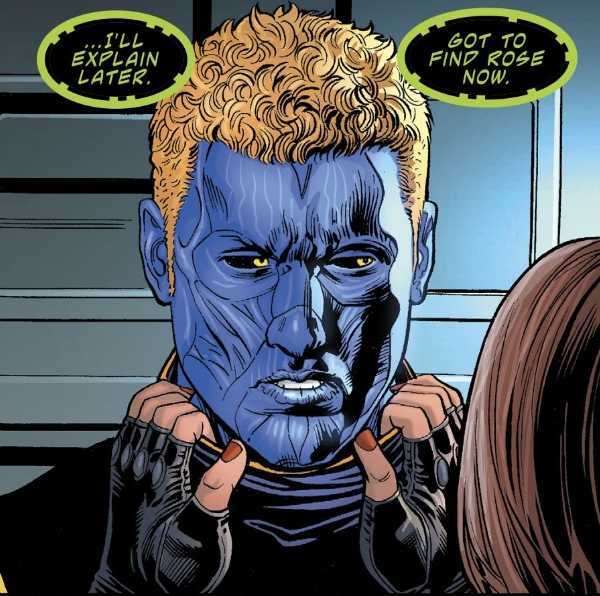
With his depiction, it was really interesting to see how an actual assistive device (like a communication tablet) is shown. In this instance, it looks like a speech bubble, but the outer edge is drawn to look like it’s been infected by technology. He also has no mouth opening on his suit (as seen in Deathstroke: Volume Four, Issue 24). The visual details really mattered to the artist, and the care and thought put into his interactions outside of his persona as Jericho is astonishing. They were clearly asking questions about whether Joseph would use his device or ASL and where, when, or with whom? People taking the time to get those answers and implement them is such a kind gesture that makes me wish more people knew about this character in the DCU.
Eddie McDonough (Hornet)
Eddie McDonough is another character who was born with his disability: Cerebral Palsy (CP) in his right arm. I was very excited about this representation because I could finally see myself somehow. Cerebral Palsy is not generally mentioned in media representation because it is not one of the disabilities brought on by a tragic accident or injury. Cerebral Palsy is a neurological condition that causes a reduced range of motion in joints due to muscle stiffness, lack of muscle control, and balance, depending on the severity and affected limb(s). Cerebral Palsy is diagnosed at birth or in early childhood, and it is not considered a “birth defect” like it is often confused for in the media.
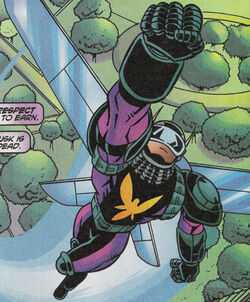
His palsy only affects one extremity and is compensated for with superhuman strength and high-performance technology in his Hornet suit (as mentioned in Slingers: Volume Zero, The Learning Curve). This, once again, could be considered an assistive device, not erasure, if the audience were able to see Eddie outside of the suit still existing within his disability. It is definitely a welcome representation, even if the majority of people with CP cannot fly through windows and disarm attackers. I feel very conflicted about his representation, especially because, as Hornet, one of his first lines is: “Eddie McDonough is useless here, but the Hornet isn’t.”
One could say that his comments are a compensation tool for his arm, but considering his range of movement in the other limbs and his superhuman strength when wearing the suit, I disagree. I think the writer wanted to channel the shame that some feel over their disability. This is valid and accurate, although it might also be beneficial to see him use slightly more positive wording, especially since the target audience for comic books tends to be younger. As we take steps to further diversify the media, it would be nice to see a positive existence without tragedy or malice and I think Hornet is a big step in the right direction.
All of these examples show me (and I hope others!) that there are spaces for you to exist all throughout history. Representation is by no means perfect and there are still many more under-served people to add when it comes to diversifying media, however, knowing that you exist in some universes is all the more reason to have you exist in EVERY universe.
Want to see more about disability representation? Click here.
Check out our Comic Book shelf on Bookshop to pick up your latest volume!