


















We’ve all had required reading lists for an English class a time or two. You know, those lists that, no matter what high school you attend, almost always have the same ancient texts that kids must read. These texts tend to date back three to four decades and drill into our heads the same aspects of ethos, pathos, and logos that we’ve all come to know. But the recommendations on these reading lists feel as if they’ve aged out of time. While their meanings still remain relevant, the stories themselves may dull the passions for new generations to break into reading and fully enjoy the art of storytelling. So, why can’t we as a society upgrade to more modern tales that explore the same lessons that those books of yesteryear taught us? Now, with new forms of media, maybe it’s time we add a modern flair that can both teach and engage young readers, and nix those ancient texts for some more current ones we love.
Harper Lee’s To Kill a Mockingbird for Tomi Adeyemi’s Children of Blood and Bone
A true classic, Harper Lee’s To Kill a Mockingbird stands as an eye-opening, poignant testament to the discussion of race and class in the 1930s American deep South, where we find the complexities of human nature tested against the human heart. The injustice surrounding a Black man accused of a crime he didn’t commit, who must now prove his innocence to an all-white jury ready to find him guilty without just cause. These complexities still stand today, and the issues around race and class remain prevalent topics of discussion.
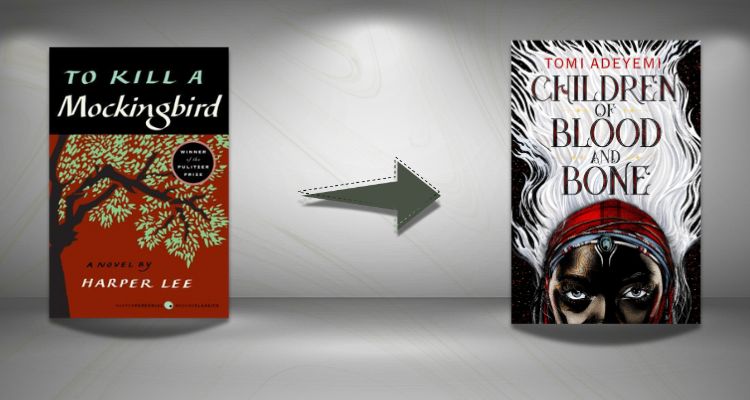
So, why not move the conversation forward into our modern age and add to our reading lists Tomi Adeyemi’s vivid tale of inequality and prejudice, where a young teen girl must fight for justice for her fellow majis? Where you are guilty at birth due to your gods’ given ability to do magic. Where fear of another fuels bigotry and means brutality and death. Like Lee, Adeyemi’s storytelling paints an equally riveting narrative that’s sure to engage students, and around which fundamental conversations can be had.
Anthony Burgess’s A Clockwork Orange for Leigh Bardugo’s Six of Crows
Anthony Burgess takes teen angst and ideas around human freedom to another level in this evocatively dark tale, featuring a boy who leads a gang of young teens to commit heinous crimes, all in the spirit of balking at society’s norms. This intriguing novel is told in the artful slang of its main character as he waxes poetically about the ills of society. However, Burgess’s tale is a retro look into the past, and society has moved forward quite a bit. There are still those societal norms surrounding good and evil that a more modern version of A Clockwork Orange can tell.
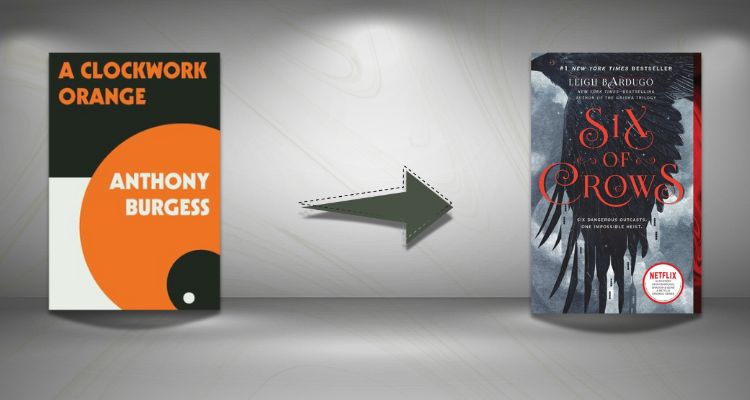
If English teachers are seeking to upgrade their reading lists with storytelling that showcases teen angst wrapped up in the ideas of freedom, posited around good and evil, then look no further than to Leigh Bardugo’s Six of Crows. This motley crew of young teen humans and Grisha (characters with magical abilities) create an elaborate heist that brings about the promise of liberation from the heartbreaking lives that society has dealt them. Just like Burgess, Bardugo turns the idea of good and evil on its head.
John Steinbeck’s Of Mice and Men for Hiromu Arakawa’s Silver Spoon
Finding your place in the world can be a difficult feat when you’re unsure of where to go. While you may set in your sights the perfect ending, achieving that goal brings issues of their own. John Steinbeck’s Of Mice and Men is the tale of two men seeking their piece of the American dream, where their perfect end is having a shack on their own acre of land. However, this dream comes with more nightmarish problems when the two laborers land jobs at the Salinas Valley ranch. Traveling the road of hardship to reach your personal freedom speaks to a societal ideal that still persists today, so why not revamp those reading lists to reflect the continuous idea of individualism and happiness we as humans forever strive for?
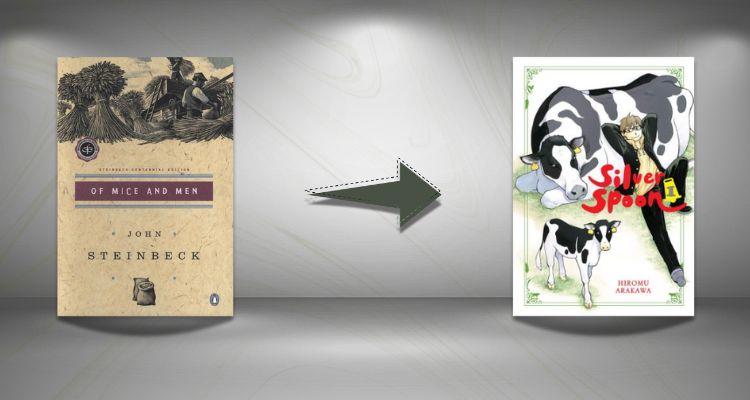
Maybe those high school English teachers should consider adding Hiromu Arakawa’s manga, Silver Spoon, to that list. This fish-out-of-water story follows a city boy who enrolls in an agricultural high school after failing one of his city school’s tests. He’s on a trek of his own, seeking true happiness for himself. This coming-of-age tale depicts the struggle of finding your path in life while trying to meet the expectations of your loved ones. Any high school student can relate to that feeling of being at a crossroads. Like Steinbeck, Arakawa creates a richly layered, complex story of discovering, through misguided steps and consequences, one’s own individualism and fulfillment.
Nathaniel Hawthorne’s The Scarlet Letter for Brianna Jonnie’s If I Go Missing
What happens when an 1850s puritanical society deems you unworthy and casts upon you their idea of judgement as a means of punishment? When a woman births an illegitimate child by the town reverend, it is she who is forced to wear upon her chest the blazing scarlet ‘A’ for ‘adulterer,’ while her lover receives no consequences due to his being male and she female. The heart of Nathaniel Hawthorne’s eye-opening tale is in how it explores themes of sin, guilt, rights, and gender through a cowardly letter written and a letter bravely worn. These deeper societal ideals can also be found in a more modern take that likewise explores themes of worth and identity.
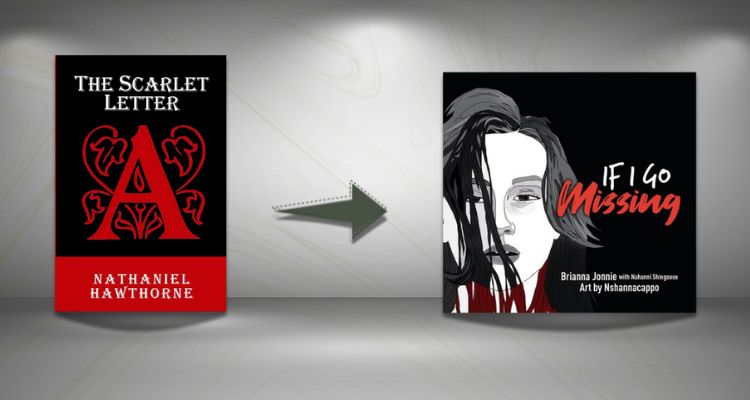
Let Brianna Jonnie’s If I Go Missing take up the mantle in place of Hawthorne’s The Scarlet Letter and lead students on a new path that contends with old ideas of deeper issues around mores cast by those of a society that determines your worth based on certain, albeit bigoted, criteria. If I Go Missing stresses the plight of indigenous people who’ve disappeared, yet their disappearances are never taken seriously. In this poignant true story, young Jonnie herself writes a letter to authorities about their utter neglect of people like her when they go missing or are murdered. This vivid nonfic graphic novel illustrated by Neal Shannacappo makes readers uncomfortable in the best of ways to express the idea of how we are judged in society — of who’s worthy and who’s not. A read that certainly belongs on any school reading list.
F. Scott Fitzgerald’s The Great Gatsby for James Baldwin’s Giovanni’s Room
Among the glitz and glamour of the roaring twenties, insanity and jealousy brew beneath the surface. The elusive Gatsby is a person of splendid wonder among the crowds of eager partygoers who wish to get close to him, even if it’s just to enter his decadent home, where the party never ends. They’ve heard the tales about him, but Gatsby’s true self is a possessive, narcissistic man who always gets what he wants, even if what he wants is out of his reach. While The Great Gatsby explores a myriad of themes, who one truly is in private stands out as Gatsby unravels and death becomes him. This quintessential tale is one for the ages. But maybe it’s time we rolled into modernity with a fresher take that dives into who we are in the shadows versus who we are in the public’s eyes.
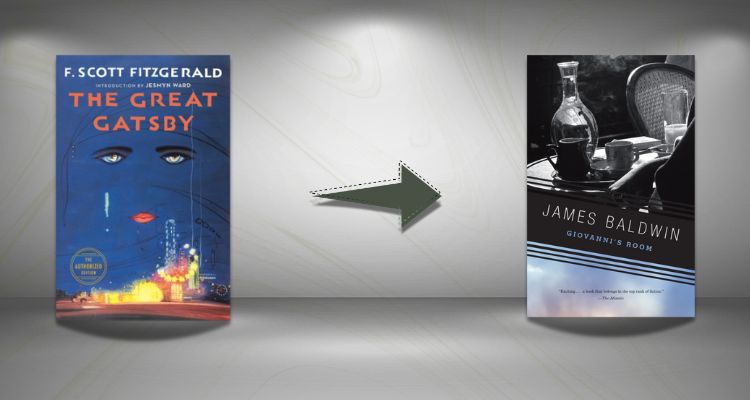
James Baldwin’s Giovanni’s Room is told from the perspective of David, who’s in a situationship with Giovanni as he struggles with his own sexuality. This tale of a carnal affair mixes with the fear of one’s true identity being discovered. David’s public persona is a mask he puts up to the world — and his fiancée — all the while suppressing a greater aspect of himself that causes greater conflict within him as he contends with who he really is verses societal norms. For both books, identity is the core theme that rears its ugly head and causes great friction, heartache, and even death. It stands to reason why Baldwin’s evocative novel should take a modern place on every English reading list for years to come.
William Golding’s Lord of the Flies for Suzanne Collins’s The Hunger Games
The collapse of a society is the first step to humanity’s decline, no matter the society. Marooned on an island, a group of young boys create their own society that seems fun in the beginning but soon devolves into chaos — and even death. The world the boys knew is gone, and they must now grapple with a new paradigm structure, where primal instincts for survival take precedence over what used to be normal. Golding’s story is a gripping narrative of the desolation of humankind, yet its classic take could certainly use some tweaking. Ala in the more modernized form of Suzanne Collins’s The Hunger Games perhaps?
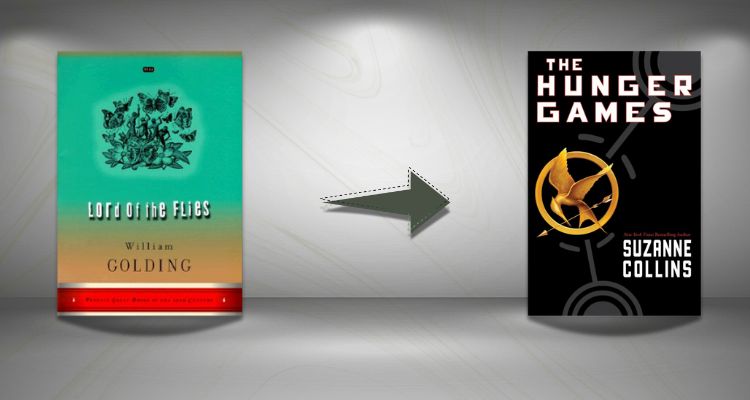
Not only does this tale teach incredible lessons about sharp fiction writing, it also introduces teen readers to topics like totalitarianism, war, genocide, spectacle, and more. It’s a perfect way to draw in young readers to a fast-paced, high-stakes world and make them fall in love with reading. As Collins’s story delves into the intricacies of humankind through a brutally deadly obstacle course, where teens are pitted against one another in the ultimate contest of survival of the fittest, young readers will get an understanding of just how such a world is possible; and how we as humans are our own worst enemies in the grand scheme of things. Like Golding, Collins showcases ideas surrounding power dynamics as who we truly are as part of both society and to ourselves. Knowing these themes will never cease to exist, it is high time we add The Hunger Games to any and all high school reading lists.
George Orwell’s Animal Farm for Hiromu Arakawa’s Fullmetal Alchemist
George Orwell’s 1945 novella of overworked animals that take over their master’s farm may be an imaginative satirical farce, but it is nothing short of themes surrounding political corruption and what it means to be equal in a hierarchical society. Behind every great farce is the meaning of ethics and humanity. And while Orwell’s story continues to speak to the ideals of equality within class structures, human nature, and the rearing up of the destructive, corruptive side of politics, it may be time to shelve this book and pull out a more modernized version that’s just as engaging.
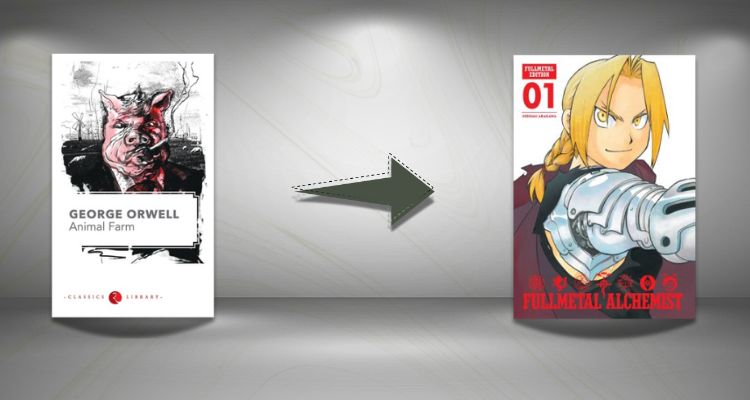
Making our list for a second time, Hiromu Arakawa’s deeply thought-provoking (and sometimes traumatizing) manga displays themes surrounding the consequences of ambition, ethics of science, and the essential nature of humanity. The Elric brothers go through tremendous growth in this perfect blend of complex action, “magic,” drama, horror, and humor in this page-turning read.
Fullmetal Alchemist constantly raises moral and ethical questions, largely around the use of alchemy and the pursuit of knowledge at all costs, as well as ones concerning redemption. Arakawa’s artwork is iconically smart, expressive, at times horrifically graphic, and scientifically imaginative (literally bending the laws of science). Like Orwell, Arakawa delves into the same themes dealing with humanity in all of its good and bad forms. While both stories seem to graze the surface, they are anything but surface-level reads. So, as with all of our aforementioned contemporary tales, maybe it’s time for an upgrade.
There’re many more classics out there that have made for interesting and thought-provoking discussions in English classrooms, and for good reason. These stories hold weight, not just because of the wild and poignant tales they tell but because they hold greater significance with how people view the world around them. But when do we set the classics aside and allow them to continue aging gracefully by swapping them for more contemporary works that are equally captivating and profound? There’s something to be said about moving on with the changing of the ages, and this may be one area that could indeed do with some decades-old proverbial spring cleaning — reading list style. Out with the old, in with the new!
Not yet ready to give up your classics? Check out these articles here and here!
Be sure to peruse our vast selection of Bookstr Team Recs on Bookshop.org!
