
















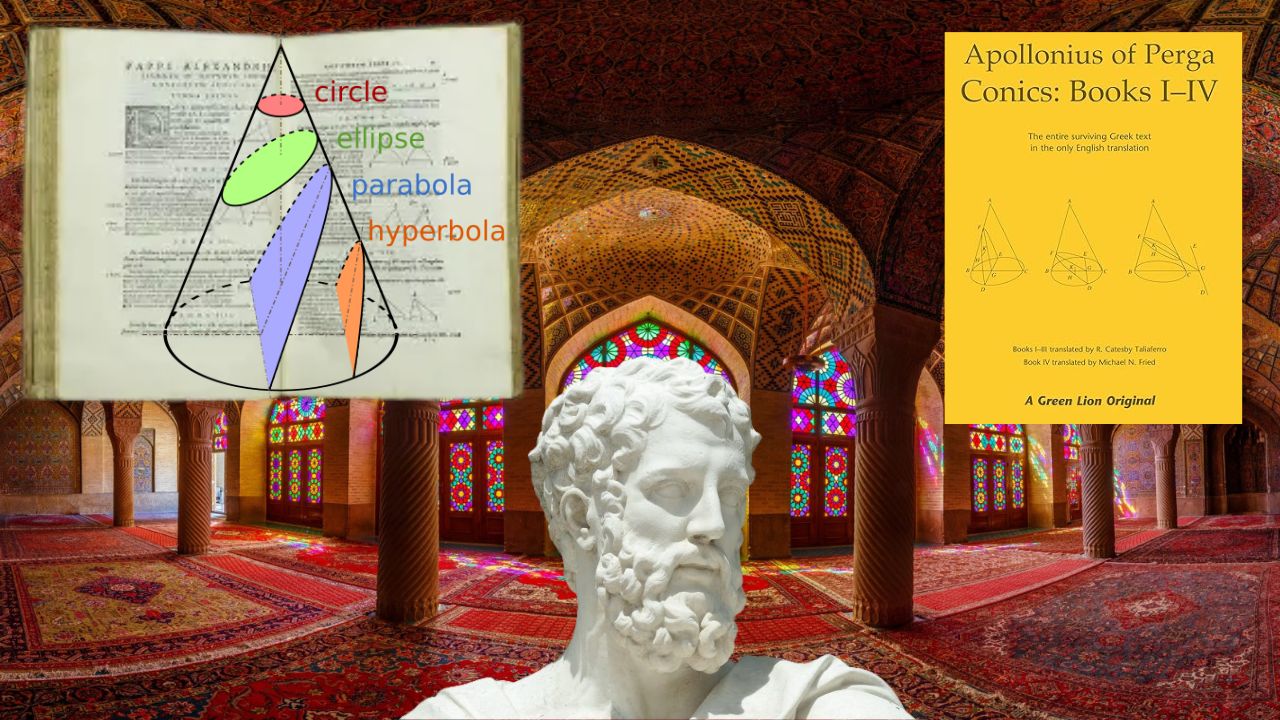
Two long-lost volumes from Apollonius’s Conics have resurfaced, and you’d think it was found in some forgotten, dusty Greek temple archives. But after centuries of mathematical mystery, the plot thickened when this remarkable find turned up within a rare 11th-century Arabic manuscript. Just when we thought the history of mathematics had squared itself away, a new curveball has entered the equation! And there’s more: these books come with a few surprising variables historians didn’t account for. Could it be that one of math’s most important figures left behind more than just formulas? Dust off your compass and prep your proofs, because this is one story where geometry, mystery, and a touch of ancient drama intersect — beautifully.
The “Great Geometer”

Before there were calculators, before there were chalkboards, even before Rome had indoor plumbing, there was Apollonius of Perga (262 BC – 190 BC), the mathematical marvel of the 3rd century BCE. Known to his friends and modern fan club as the “Great Geometer,” he didn’t just dabble in geometric diagrams — he defined them. You could say he was one of the original influencers of mathematical language. His most famous flex is the Conics, a work so influential that it coined terms we still use today (ellipses, parabolas, and hyperbolas — oh, my!).

Apollonius took the cone shape and turned it into math that would shape astronomy, physics, engineering, and everyone’s high school nightmares. His work helped future minds plot planetary motion and inspired countless thinkers to go off on tangents — pun very much intended. Basically, if geometry had a morally clean Mount Rushmore, he would be carved in stone with excellent symmetry. And while much of Apollonius’s work was thought to be divided, subtracted, or otherwise lost to time, it turns out he wasn’t quite finished making history. Centuries later, he’s proving once again that real legends don’t fade — they just occasionally hide in Arabic manuscripts.
Found in Translation
These rediscovered volumes weren’t hiding in a cave or stashed in some millionaire’s collection. No, they were quietly hanging out in a library at Leiden University, minding their own hyperbolic business for centuries. It was once part of a collection brought to the Netherlands by 17th-century scholar Jacob Golius — shelved, cataloged, and nearly forgotten until a few scholars recently decided to do some math-y translations for an anthology titled Prophets, Poets and Scholars: The Collections of the Middle Eastern Library of Leiden University. That’s when they found, perfectly preserved in the calligraphic curves of ancient Arabic, Books V and VII of Apollonius’s Conics, which had been presumed lost all this time.

When Civilizations Collide (Collaboratively)
If you ever doubted math’s ability to unite civilizations, let this historical find be your proof. The preservation and translation of Apollonius’s work by Islamic scholars during the Golden Age of science wasn’t just about copying old Greek texts brought over by merchants and explorers — it was about transforming them, building on them, and passing the intellectual torch to the future with cosine-level precision. Think of it as maybe the world’s first global group project in math, one that yielded centuries of incredible progress.

This manuscript doesn’t just solve a math mystery — Apollonius’s re-discovered books prove a profound historical truth: when cultures connect through curiosity instead of conquest, knowledge doesn’t just survive — it exponentiates. He may have lived a very, very long time ago, but his legacy flourished thanks to the many thinkers throughout history who worked to preserve knowledge. This is a mathematical love story across languages, time, cultures, and hemispheres — a shining variable in the ever-expanding equation of human collaboration.
With two of Apollonius’s Conics formerly-lost books now back in the equation, historians and mathematicians alike can integrate new insights into how ancient minds calculated, collaborated, and quite literally geometrically shaped the world. It’s a sharp reminder that the past can lose track of things, only for the right angle to show up ages later. Thanks to preserved Arabic texts, a group of mathlete scholars, and the world’s most well-traveled cone, Apollonius’s legacy is once again intersecting with modern minds.
Speaking of recently uncovered ancient books, you should check out my article: The Oldest Known English Book About Cheese Now Available Online.
Browse our bookshelf for more Non-Fiction Titles for the Enlightened Mind.