


















Poetry is one of the oldest and most respected forms of literature. The Road Not Taken by Robert Frost, Sonnet 18 by William Shakespeare, and O Captain! My Captain! by Walt Whitman are some of the most iconic and revered poems. Now it’s time for you to utterly corrupt them.
The (Noun) Not Taken by Robert Frost and You

Two (plural nouns) diverged in a yellow wood,
And sorry I could not (verb) both
And be one traveler, (adjective) I stood
And (verb past tense) down one as far as I could
To where it (verb past tense) in the undergrowth;
Then took the other, as just as (adjective),
And having perhaps the (adjective ending in -er) claim,
Because it was (adjective) and wanted wear;
Though as for that the (verb ending in -ing) there
Had worn them (adverb) about the same,
And both that (time of day) equally lay
In leaves no step had trodden (color).
(exclamation), I kept the first for another day!
Yet knowing how way leads (preposition) to way,
I (verb ending in -ed) if I should ever come back.
I shall be (verb ending in -ing) this with a sigh
Somewhere ages and ages hence:
Two (plural noun) diverged in a wood, and I—
I took the one less traveled by,
And that has made all the difference.
Sonnet (Number) by William Shakespeare and You

Shall I compare thee to a (season)’s day?
Thou art more (adjective) and more temperate:
(Adjective) winds do shake the darling buds of (month),
And (season)’s lease hath all too (adjective) a date;
Sometime too hot the eye of (location) shines,
And often is his (color) complexion dimm’d;
And every fair from fair sometime declines,
By chance or nature’s (verb ending in -ing) course untrimm’d;
But thy eternal (season) shall not fade,
Nor (verb) possession of that fair thou ow’st;
Nor shall death brag thou wander’st in (possessive pronoun) shade,
When in eternal lines to time thou grow’st:
So long as men can (verb) or eyes can see,
So long lives this, and this gives life to thee.
O Captain! My Captain! by Walt Whitman and You
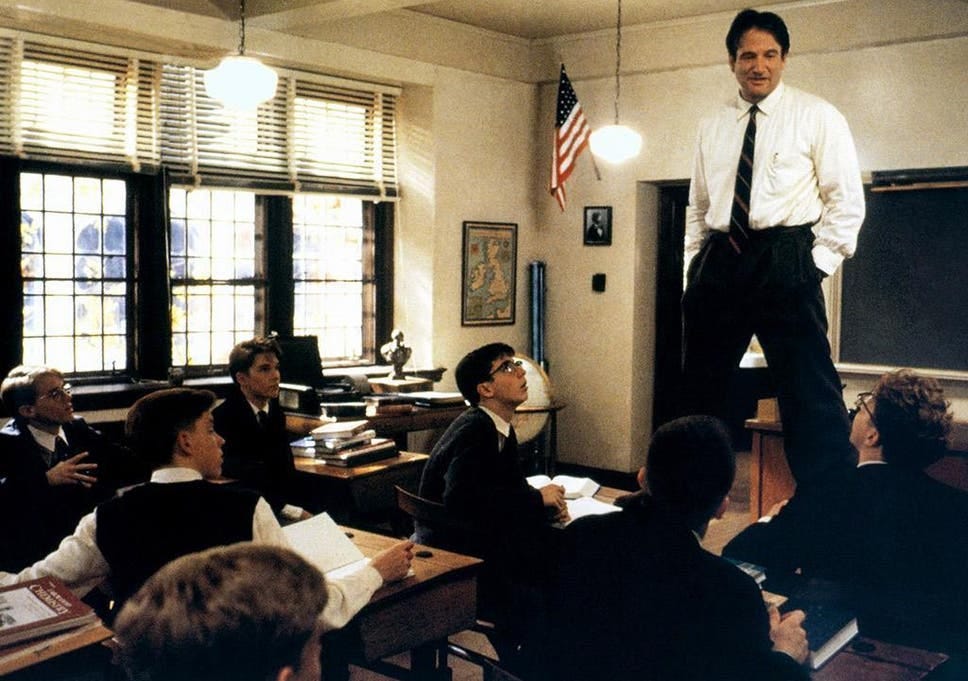
O Captain! my Captain! our (adjective) trip is done,
The (vehicle of transportation) has weather’d every rack, the prize we sought is won,
The (place) is near, the bells I hear, the people all exulting,
While follow eyes the steady keel, the vessel grim and (adjective);
But O heart! heart! heart!
O the bleeding drops of (color),
Where (preposition) the deck my Captain lies,
Fallen (adjective) and dead.
O Captain! My Captain! rise up and (verb) the bells;
Rise up—for you the (object) is flung—for you the bugle trills,
For you (object) and ribbon’d wreaths—for you the shores a-crowding,
For you they call, the (verb ending in -ing) mass, their eager faces turning;
Here Captain! dear father!
This (body part) beneath your head!
It is some dream that (preposition) the deck,
You’ve fallen (adjective) and dead.
My Captain does not answer, his lips are (adjective) and still,
My father does not feel my (body part), he has no pulse nor will,
The ship is anchor’d safe and (adjective), its voyage closed and done,
From fearful trip the victor (vehicle of transportation) comes in with object won;
Exult O shores, and (verb present tense) O bells!
But I with mournful tread,
Walk the deck my Captain lies,
Fallen (adjective) and dead.
Perhaps now that you’ve torpedoed these brilliant works of poetry, you can put your literary cap on and pen some great poems of your own. Who knows, maybe in 100 years your Notes App Poetry will become as iconic as the works you’ve just desecrated. Only time will tell!
To learn some more about poetry and the geniuses behind it, click here.
For some poetry recommendations from the Bookstr team, click here.
