

















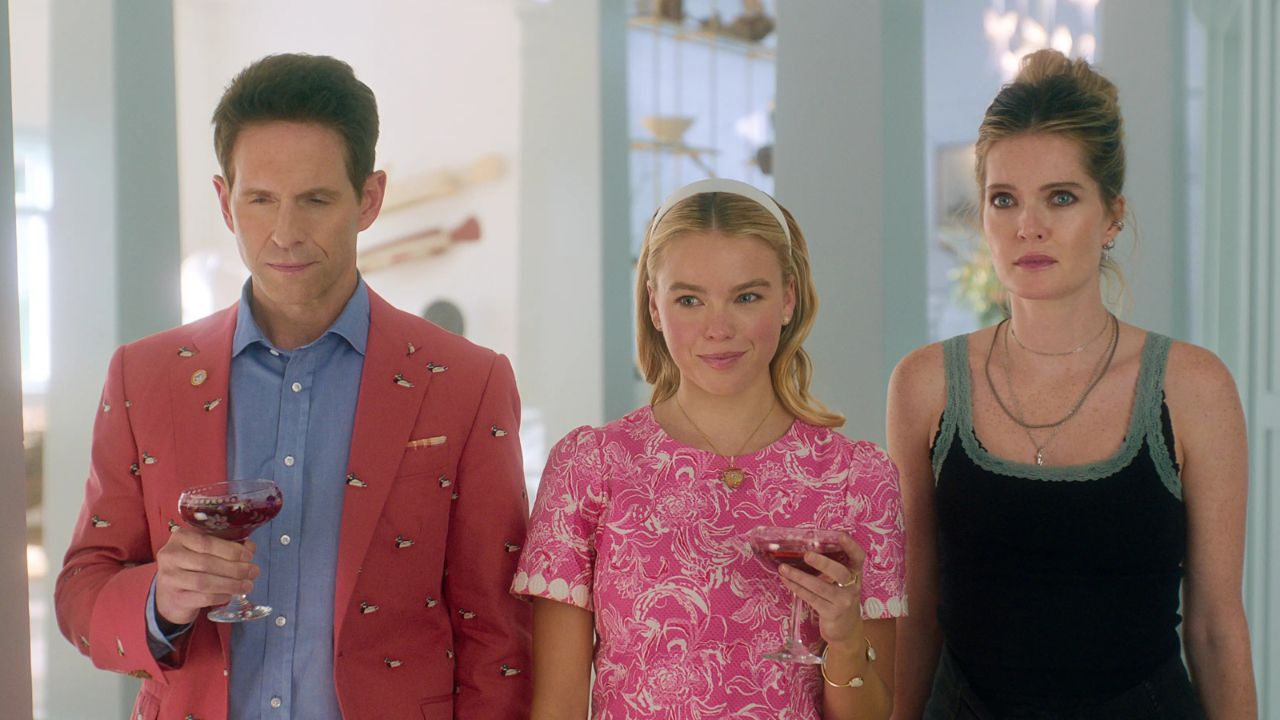
Sirens are often depicted as mermaids. Beautiful but deadly women of the sea luring sailors to their death with their hypnotic hymns. However, the earliest depiction of sirens in Homer’s The Odyssey describes them as creatures with the upper body of a woman and the lower body and wings of a bird, flying above their prey, singing mesmerizing songs, and drowning sailors in the sea or crashing them into the cliffs. Over time, their image started to change along with societal depictions of women. Rather than resembling cunning and strategic birds of prey, they took on the more sexualized image of a mermaid — for how could a woman ever outsmart a man if not with her sexual allure?
In Netflix’s new limited series Sirens, based on Molly Smith Metzler’s 2011 play Elemeno Pea, the original mythology of the siren grounds a fairly familiar plot analyzing the hardships and misuse of women and the working class through the juxtaposition of the present-day affluent, out-of-touch society summering in Port Haven. Substitute this fictional town for names like the Hamptons, Nantucket, and Martha’s Vineyard, flooded with elites occupying their summer homes, decked in ridiculously expensive and nausea-inducing vibrant patterns, spending money like it’s oxygen, and you can easily ground this somewhat absurdist depiction in reality. (I should know, I’ve been a fine dining summer server on Cape Cod for years — Metzler’s show contains the swan song of someone who’s worked in hospitality.)
Trigger Warning: The mention of addiction, child abuse, suicide, and post-traumatic stress disorder (PTSD) may be triggering for some readers. Please exercise personal care when reading.
Content Warning: This article contains spoilers for the television series Sirens.
Something’s Missing…
Yet, something about Sirens leaves you wanting. Metzler digs her talons into so many topics: sexism, class disparity, childhood trauma, and its effects on adult counterparts, familial relationships, and marriage. It’s a comedy, it’s a thriller, it’s a drama, it’s a tragedy, it’s sensationalist, it’s folklore, it’s realist. Rarely, though, do her talons break the skin; the layers of these disparate elements form a protective gear over the real meat of the story: what do you do when your back is up against the wall? When one option is habitually scratching at an open wound and one is personal freedom with a self-paid cost, which will you choose?
Don’t get me wrong, this was a highly watchable and enjoyable series that had me laughing one moment and delving into introspection the next. However, much of this is owed to the intoxicating chemistry between the main cast. They’re simply too good to turn away from, no matter the holes left in the plot and the waxing and waning continuity of its layered construction.
An Overstimulating, Fun Start
Sirens opens with Michaela Kell (Julianne Moore) in an airy green gown approaching a cliffside with a wooden cage containing a peregrine falcon, whom she urges to take to the skies. Immediately, the relevance of birds of prey and the mythology of sirens is introduced to the plot. A quick tonal shift comes when we see a disheveled Devon (Meghan Fahy) stumbling out of a Buffalo jail and resting on the curbside as she repeatedly and desperately texts the word “sirens” (an emergency code word) to her unresponsive sister, Simone (Milly Alcock). This brought out a petty annoyance in me. The siren mythology was so half-baked throughout the series (still unclear if these women have a mystical magnetism or if it was just a tool to expose men’s love of strictly casting women in angel or monster roles). The code word was never followed up on — a weak effort to form some continuity.
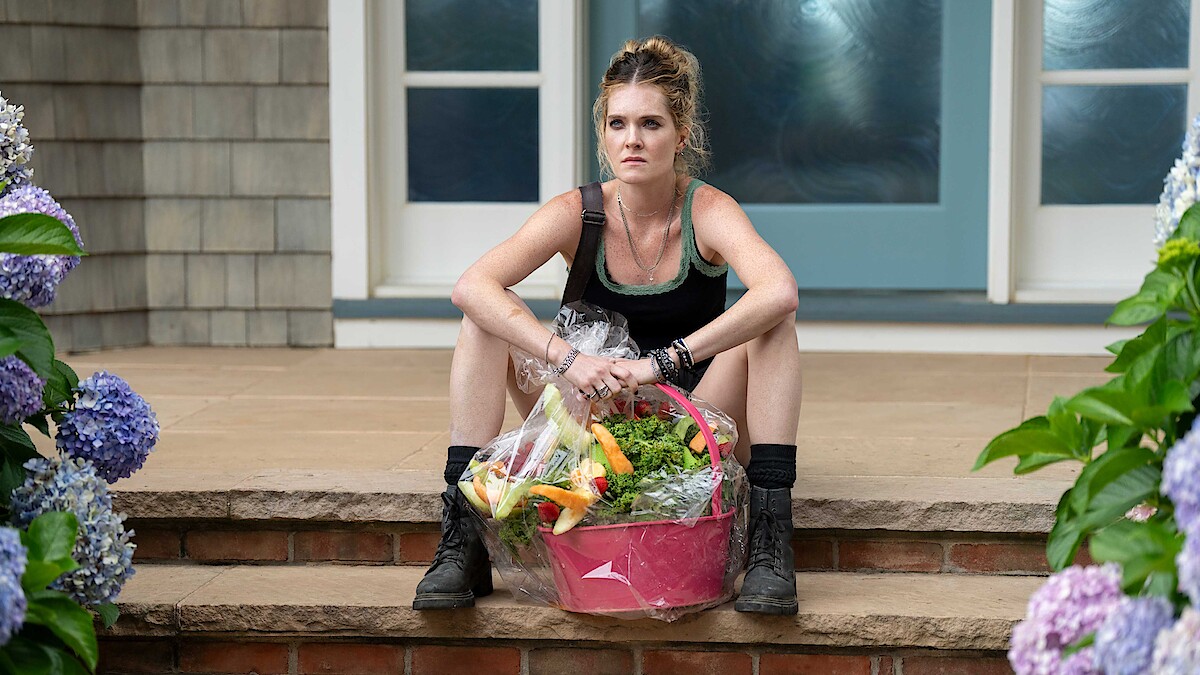
After being greeted by an absurd edible arrangement on her doorstep with an impersonal typed note, “Keep your chin up! XO Simone,” Devon takes off on a long trek fueled by anger and the occasional bite of a strawberry. By way of a 17-hour Peter Pan bus, a ferry ride where we first get a glimpse of her untreated sex addiction, and a multi-mile hike to “the Cliff House” to avoid the cab fare, Devon arrives at Simone’s place of work. A fern amongst dizzying arrays of flowers, Devon sticks out and seems to revel in Simone’s anxiety at her arrival. She chucks Simone’s “thoughtful” gift at her across the lawn. Here, we find out Devon’s emergency: their father has been diagnosed with early-onset dementia, and she needs help managing it.
Slightly Cliche, Complex Female Relationships

The juxtaposition between the two sisters is stark and, some may argue, tired. Devon, the older sister, is a semi-functioning alcoholic; works a minimum wage job at a falafel fast food shop in Buffalo, where she occasionally sleeps with her ex-high-school-sweetheart-turned-married-manager; and works valiantly to keep a roof over her sick and absent father. She’s loud-mouthed and easily gives in to her vices, but acts from a place of care.
Simone is a type-A, Yale graduate who has turned her position as assistant to Michaela (former high-power attorney; wife of billionaire Peter Kell, played by Kevin Bacon; and bird protection advocate) into her entire life. With a militant and cruel management of the household staff who openly mock her, a blind admiration of her boss, and a clear, deep-rooted need to please her, Simone has completely changed since Devon saw her last. She’s removed her tattoos (even their matching sister one), got a nose job, dresses like a “doily” as Devon says, and has lost interest in anything except her job and her secret rich socialite boyfriend, double her age, played by Glenn Howerton. The writing of their life trajectory rings a tad cliche, but Alcock and Fahy breathe such life into their roles. Any two sisters can attest: they nail the dynamic.
When Devon first witnesses the codependent-definitely-teetering-into-creepy relationship between Kiki (Simone gets to call her that which “is a really special honor”), complete with the terrified silences of her staff when asked about her (they’ve all signed NDAs), and the rumor that Kiki killed Peter’s first wife, Jocelyn, she becomes convinced Simone is in a cult and needs to be broken out. It’s true — the relationship is worrying. Simone lives her life to please Kiki: she wears clothes picked out for her, ensures every minor detail of the house satisfies her, restricts her romantic relationships, has cut off her family, and even sends sexts to her husband for her. In the process of saving Simone, Devon feels herself pulled into Kiki’s unpinnable, yet undeniable orbit. Devon could not be more different than the residents of Port Haven, so this was simply a blast to watch.
Simone has eagerly left any traces of her past life behind and has clung to this intoxicating woman for dear life and, as we discover later on, for good reason. When Simone was seven, their mentally ill mother ran a tube from the exhaust pipe to the front window with her in the backseat to kill them both. Simone made it out alive and was left with not only the horrific trauma of the event to unpack but with a clinically depressed father who didn’t take care of her. The situation got so bad that she was put into foster care, leading Devon to drop out of college and take care of her full time.
Sirens Saving Themselves
One of the most nuanced aspects of the show, in my opinion, is its dealing with the manifestation of childhood trauma in adults. Devon and Simone both go to great lengths for self-preservation. They take different forms: Devon is desperately seeking a way out of the caretaker role she’s felt thrust into her whole life, even if it means dragging her sister back into a triggering environment. She copes by seeking out anything that gives her pleasure: drinking (though she’s been trying to stay sober), cigarettes, and sex. Simone is willing to alter her entire personality, forsake her family, and become a clone of her boss for some semblance of stability and nurturing. Alcock really shines in Simone’s internal battle between her past and present. There are moments when she says nothing at all, but the sheer look in her eyes is enough to fill you with panic.

Similarly, even though she is painted as a villain with an unpinnable cult-like persona, we soon see Kiki’s image is a thinly veiled facade. She is ruled by the fear of her hidden expiration date for her husband. In a rare, vulnerable moment, she tells Simone, “I work for him. We all do.” Kiki’s main plot, besides running interference on Devon and Simone rekindling their relationship, is trying to get proof that Peter is cheating on her so that their prenup becomes void; without it, she’d get nothing.
This is our first glimpse that the confident and mythological air she walks around with isn’t as powerful as previously believed. She demands that Simone follow him and uncover anything suspicious. When she is inevitably caught by Peter, he, like the resident-cool-weed-smoking-billionaire he is, decides to simply drag her along quahogging with him to bond. Towards the end, he kisses her and Simone rapidly pulls away over loyalty to Kiki. But it’s too late. A photographer snapped a picture.
Simone’s new life deteriorates at a great speed after Devon arrives. After Devon divulges their traumatic backstory to Simone’s new boyfriend, Ethan, he decides he loves her even more than before. Everyone loves a wounded bird, but this isn’t just any bird: she’s a siren. When Ethan goes missing after Kiki discovers they are together, Simone finally begins to question her morality. However, Ethan is alive, and, urged by Kiki, he has gone to Buffalo and brought their abusive father (whom she hasn’t seen in over a decade since standing against him in court) to witness his proposal.
Simone, who suffers from PTSD, is bombarded with the ghosts of her past and a decision about her future. She turns Ethan down on the advice of Kiki, who has enticed her with a senior position at their foundation. Ethan gets drunk and repeatedly screams at Simone that she’s a “monster” before falling off a cliff. A word that calls to mind the many ill-fated lives of women in Greek mythology; she wasn’t the perfect, amenable woman, so now she’s a monster.
Half-Baked But Still Devoured
The last episode is a bit of a blur and ultimately reveals the half-baked nature of the show. Simone is ecstatic about her new job opportunity, convincing Devon that she can finally leave taking care of their dad to someone else and start living her life purely for herself. However, Simone doesn’t know that Kiki has received the photo of Peter and her kissing and has already begun packing up all of her belongings for donation. This siren appears to be headed for rocky cliffs herself.
When Simone is faced with going back home to Buffalo with her abusive father, she has a nervous breakdown. Peter, disgusted by Kiki’s callous treatment (but really just in desperate need of an excuse to divorce her), ends their marriage as if she’s an employee: “You’re done.” Suddenly, Peter’s in love with Simone? They’re running to each other on the beach? Simone is the new woman of the Kell house and fortune within the same couple of hours. The ending is so strange but oddly hypnotic. It doesn’t work, but it also does.
At its best, Sirens showcases the intricacy of female relationships, the complexity of women, and the choices and roles they’re faced with, and, honestly, it’s just funny. Meghann Fahy has a unique capacity for dark comedy; something so fragile quickly becomes blunt and heavy with such fluidity. At its worst, it’s another show cashing in on affluence porn. Sirens held a certain charisma, a certain compulsion to watch. A good watch, but a slight shame. There was a lot that could have been done here, but it appears the effort to hypnotize the audience led to drowning in open waters. At least the swim was fun.
For another Netflix review, check out the final season of You here!
Need some reading and viewing inspiration? Check out our Book to Screen Adaptation bookshelf on Bookshop.
