



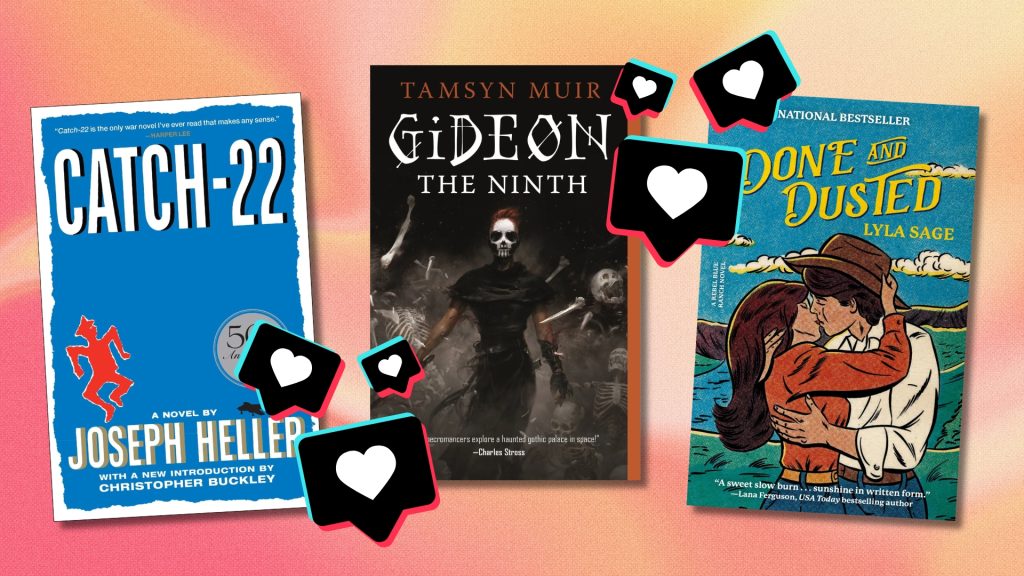


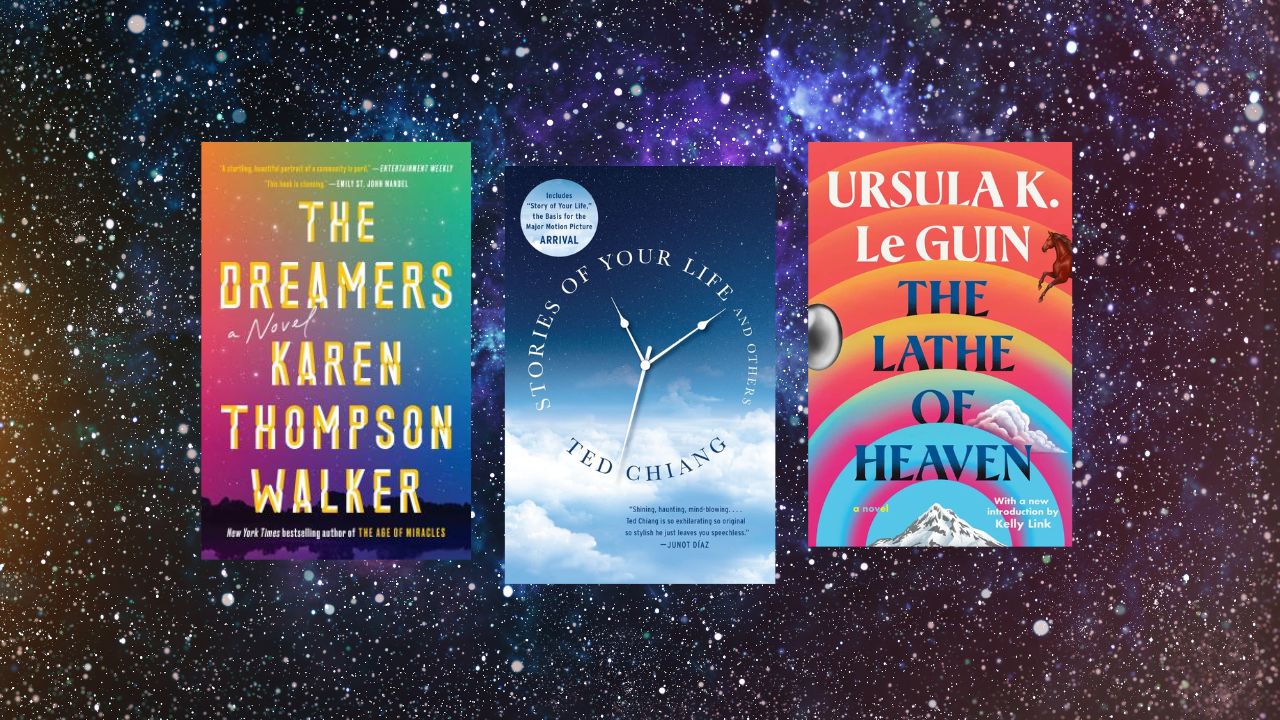
Words Rated ranks 1984, Dune, and The Hitchhiker’s Guide To The Galaxy as the bestselling science fiction titles of all time. If this list is anything to go by, readers are drawn to sci-fi for its haunting totalitarian futures, its projections of human corruption, and, sometimes, for its absurd sketches of inter-planetary culture shock. Often, though, the most profound elements of sci-fi come from the questions which quietly undercut these stories — and, a lot of the time, from fiction that we don’t realize is sci-fi to begin with.
Read on for 5 novels and short stories that deserve a place on your sci-fi shelf.
Story of Your Life by Ted Chiang
Published in 2002, Ted Chiang’s sci-fi novella formed the inspiration behind Arrival, the 2016 Oscar-Nominated movie known for its floating disk-like spaceships and towering, mist-painting aliens. Condensed into 55 pages, Story of Your Life shouldn’t take much of your time to read. In fact, if it has Chiang’s intended effect, it should reshape your perception of time altogether.
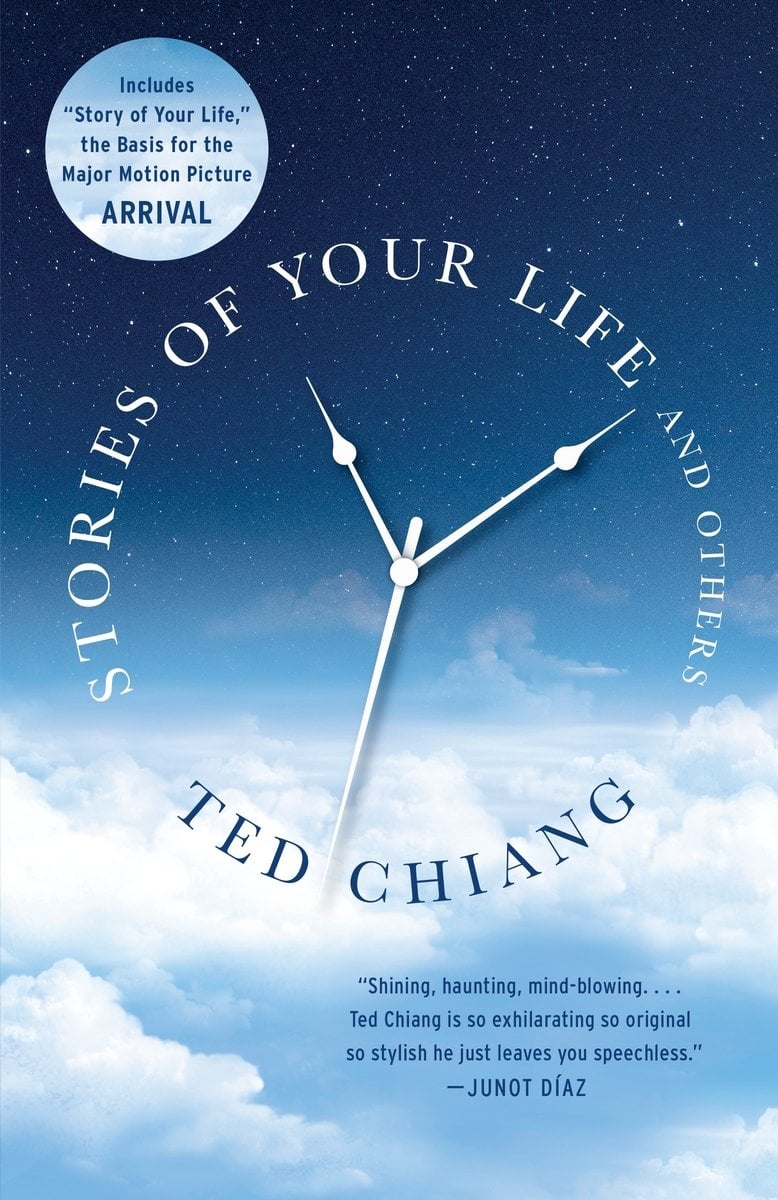
Dr. Louise Banks is a linguistics expert, and the first port of call for translation when the heptapods arrive scattered across Earth; great claw-like, seven-limbed creatures who communicate through logographic symbols. Louise is also a mother — or at least, she will be. The present-day plot, in which she returns day after day to develop a method of communication with the nearest heptapods, is interspersed with scattered snippets of her future memories of her unborn daughter, known only as “you”. She “remembers” how her daughter will complain about chores. Her graduation. Her learning to walk. And, somewhere in this timeline, the ill-fated day Louise is called to the hospital.
Story of Your Life builds on the Sapir-Whorf hypothesis; essentially, that the language a person speaks determines their wider perception of the world, including their perception of time. And the novella, with its jumbled narrative, is underrated compared to the more visually-focused film adaptation when it comes to unpacking this concept. Gradually, Louise learns that the heptapods’ language is non-linear; they experience the past, present, and future simultaneously. And the more time she spends decoding their language, the more she is able to adopt a holistic understanding of time, too, spanning across her life. Ultimately, Chiang’s time-bending narrative asks the question: would you choose to love somebody if you knew you would lose them?
The Lathe of Heaven by Ursula K. Le Guin
Chances are, you can think of at least one dream so good that when you woke up, you wished it had carried into reality. But what if you started waking up to find that your more destructive dreams had altered not only what is, but what always was?
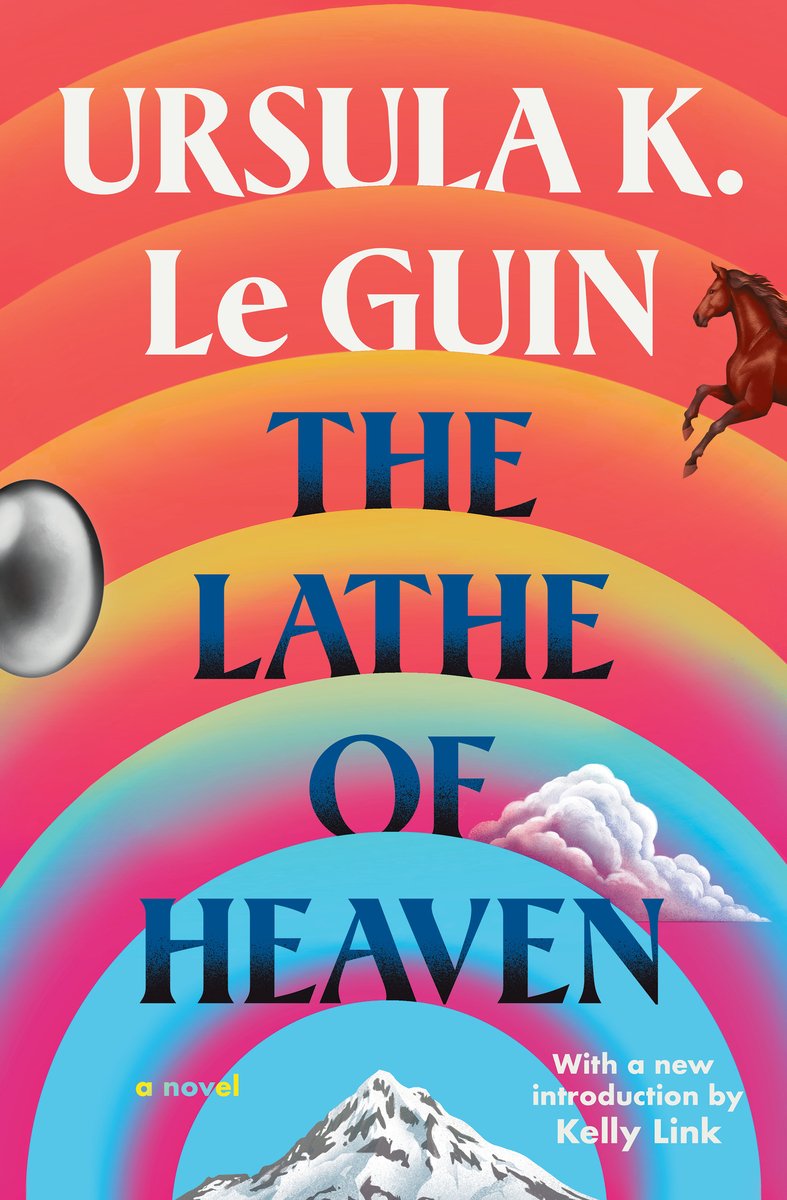
“I am living in a nightmare, which from time to time I wake in sleep”. When we meet him, George Orr’s somnambulant abilities have already dreamed away his most dislikable family member. He wakes up to discover that she was dead — she’d died in an accident six weeks ago. By the time he’s referred to dream psychiatrist Dr. Haber, George’s self-induced insomnia has pushed him to the edge of his tether. And here’s where the sci-fi comes in. Dr. Haber has a biofeedback machine he calls “the Augmentor”, which theoretically enhances dreams according to his suggested dream prompts.
Except — whether due to Dr. Haber’s untameable ambition, George’s cynical mindset, or the Augmentor being severely undertested — these prompts backfire drastically. Dr. Haber tells George to dream there is “peace on earth”, and so his dreams create war with aliens instead. He tells him to dream there is no racism, and when George awakes, there are no people of color; there never were. As Dr. Haber remarks darkly, “war’s a problem we’ve outgrown and race is a problem we never had!” The Lathe of Heaven will make you shudder with relief that your dreams are safe in the unconscious — however good some of them may be.
The Dreamers by Karen Thompson Walker
Ursula K. Le Guin covered reality-altering dreams back in 1971. But what about dreams that trap their victims in a sleeping epidemic?
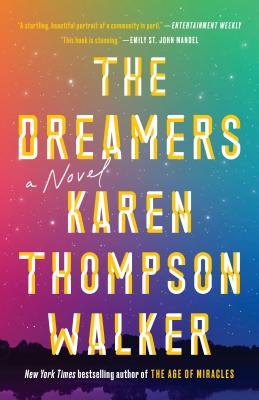
Santa Lora, California, is the seemingly arbitrary target of a sleeping virus, and the first “dreamer” is a college student who falls asleep after a night out and doesn’t wake up. Its next victims: another student in her dorms, then a janitor from the college, and soon the victim count rises to five hundred, resulting in a localized lockdown. It’s somewhat prescient that The Dreamers, with its talk of virus and quarantine, was published in 2019. And future prediction makes its way into the plot, too — one character dreams of a fire in the college library, which is ultimately what awakens the survivors. The same character foresees global warming events in Antarctica, too.
The Dreamers makes soft sci-fi lists for its pseudo-scientific elements — precognitive dreaming, sleep paralysis, even theories of parallel universes. Alternate realities are thrown into the mix, with characters dreaming of family members they never had, and waking up unable to discern dreams from reality. Consider this a reminder to set your alarm.
Never Let Me Go by Kazuo Ishiguro
Never Let Me Go has been named by TIME as the top novel of 2005. In 2010, it was adapted for the screen, starring Keira Knightley, Andrew Garfield, and Carey Mulligan. Given these accolades, it may seem a stretch to call it underrated — however, the novel often slips under the radar when it comes to sci-fi.

At first, Never Let Me Go reads like a campus novel, recounting Kathy’s childhood at Hailsham, an exclusive boarding school in the English countryside. Her years here are stable, relatively happy — and very sheltered. As Kathy recalls, “any place beyond Hailsham was like a fantasy land; we had only the haziest notions of the world outside and what was and wasn’t possible there”. Clues of the students’ hushed futures seep through the narrative, as Kathy, Ruth, and Tommy become surrounded by talk of “possibles”, “donors”, and “carers”. The concept at the heart of the tale is innately science-fictional. The Hailsham children, readers learn, are clones created and raised for their “possibles” — the original copies for whom they will eventually donate their organs. What undermines the sci-fi here is just how little time Ishiguro spends explaining this frankly horrifying concept. And, somehow, its understated nature only increases its horror, turning what seemed at first like a cozy old-school setting into a futuristic dystopia — which is perhaps a nearer technological possibility than we’d care to imagine.
Oryx and Crake by Margaret Atwood
Perhaps more terrifying than clone organ harvesting is the idea of uninhibited genetic engineering. Oryx and Crake is the first in Margaret Atwood’s MaddAddam (I recommend reading this backwards) series, a novel which combines textbook dystopia with the chilling touch of sci-fi innovation.
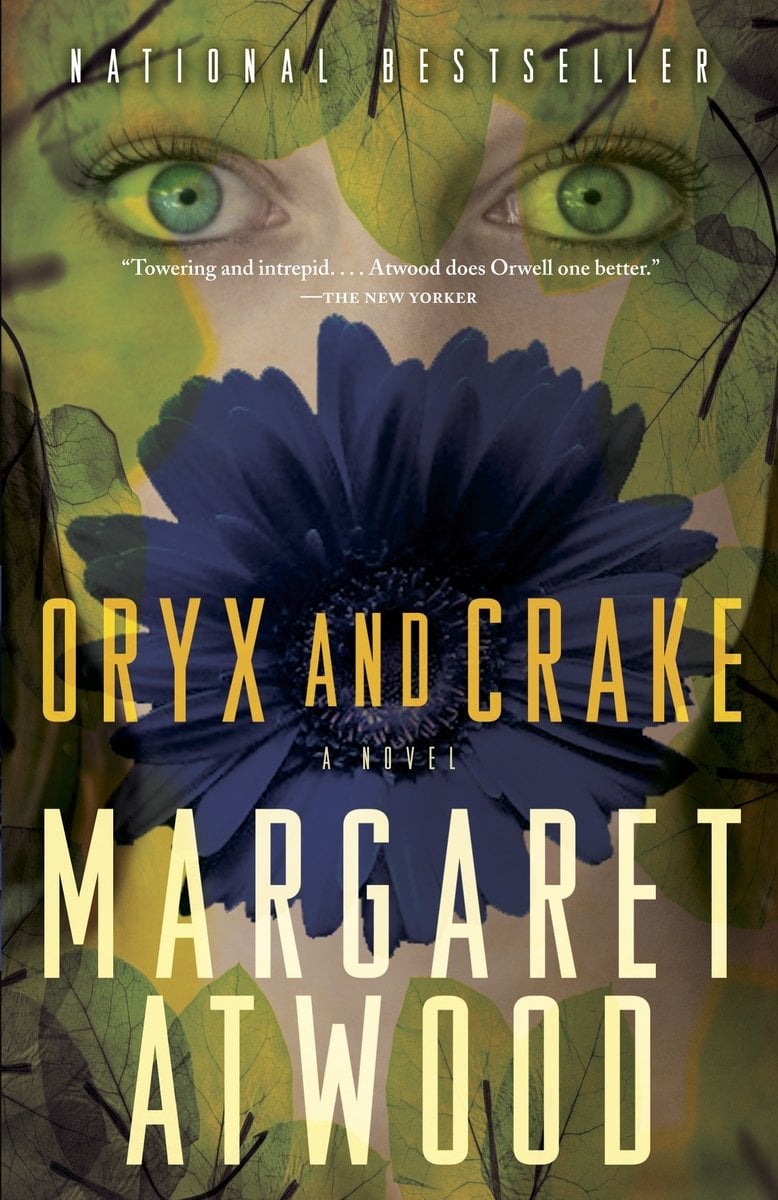
If Atwood is known for anything, it’s for her haunting dystopian visions, and Oryx and Crake is no exception. A plague has swept the planet — a man-made one, too — and Snowman may well be the last human survivor. His only companions: the Children of Crake, guinea pigs of a government-controlled genetic engineering feat. A genetically “perfected” human subspecies, the Crakers are aesthetically flawless, aromantic herbivores, immune to sunburn and sexual frustration. Animals haven’t been spared from human experiments, either. There are pigoons — pigs that produce organs for human transplants (I couldn’t help but think of Hitchhiker’s pig on a dish who is desperate to be eaten). Readers soon learn how the entire system was built on class inequality, and the book has come to be labelled as a critique of bio-capitalism. Genetic engineering is a hallmark of sci-fi, but Atwood is a speculative fiction writer at heart, and the message is clear: now is the time to stop experimenting.
From time-bending linguistics and uncontrollable precognitive dreaming to freak feats of genetic engineering, these 5 works show that the most profound works of sci-fi don’t always involve robot invasions and intergalactic wars. Sometimes, the greatest works of sci-fi are those hiding behind a movie adaptation — or hiding in a different section altogether.
To refresh your sci-fi shelf, check out 6 great Black Authors shaping sci-fi and fantasy in our article here.
Or for more futuristic reads, check out Bookstr’s science fiction recommendations here.