







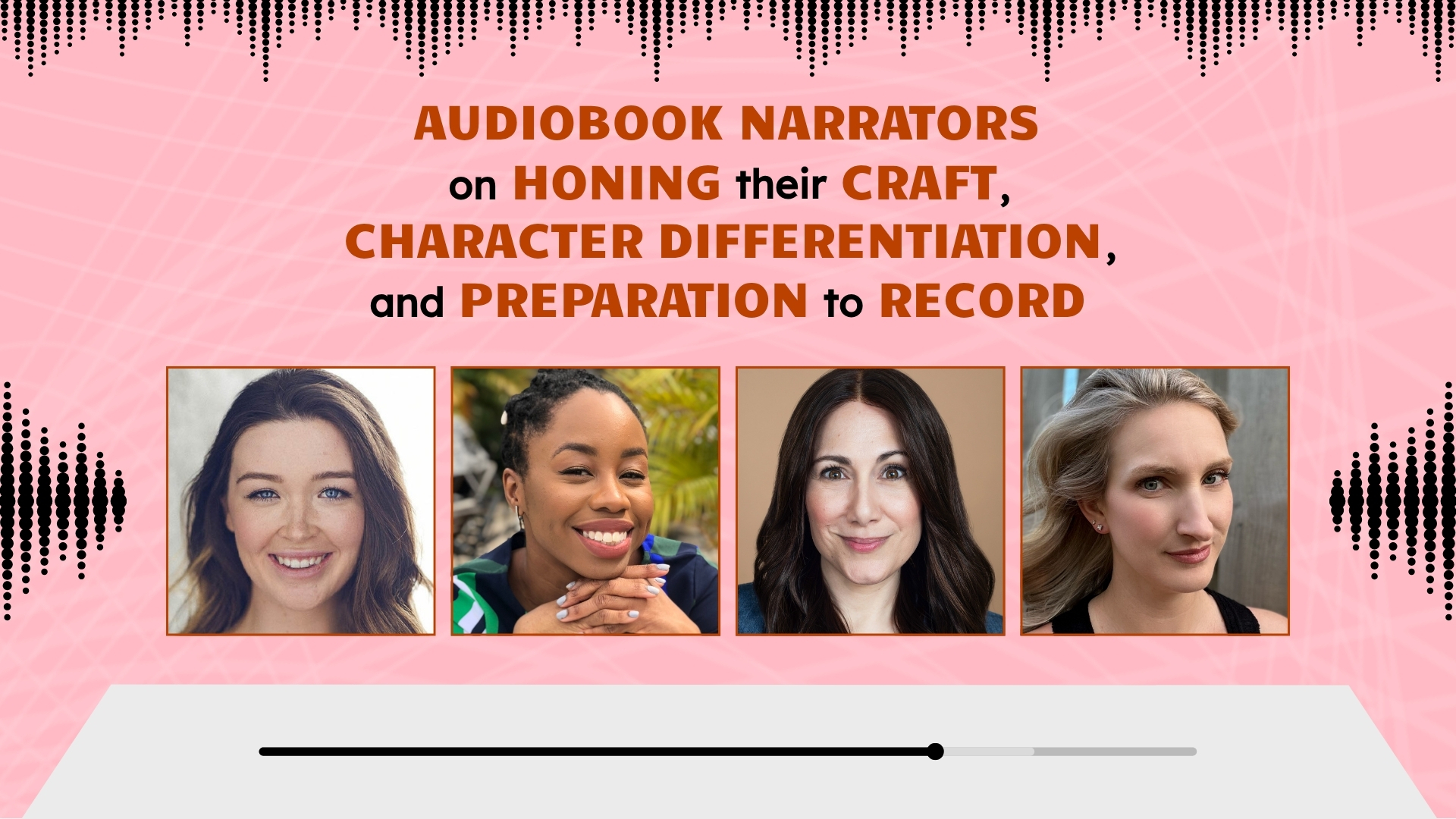
Behind every great audiobook is at least one amazing narrator working to bring it to life. Creating a quality audiobook requires much more than reading into a microphone. Careful thought and meticulous planning go into shaping every character and every inflection. Audiobook narration is an art that takes time, skill, and a lot of hydration for those hardworking vocal cords.
Today, we’re going behind the scenes with four audiobook narrators as they walk us through their preparation, how they manage collaborations, and what it takes to build a voiceover career.
The Narrators
Megan Wicks
Megan Wicks is a performer and voiceover artist with a career spanning theatre, film, television, and audio production. She has lived and performed in San Francisco and New York City and currently resides in Sacramento. With an extensive background in acting, she can regularly be found performing in productions at Capital Stage, B Street Theatre, and across the Bay Area, as well as appearing on television and in national commercials. Megan has been featured in video games like Vampire: The Masquerade and has narrated over 35 audiobooks.

Laura Horowitz
Laura Horowitz is an accomplished American actress with over 150 audiobooks to her credit. You may recognize her from her TikTok (170K+ followers) or Instagram (200K+ followers) feeds for her bookish outtakes and behind-the-scenes glances into the world of audiobook production. She has her Master’s Degree in Composition and Rhetoric and is a wife, mom, soccer coach, and avid reader. She loves to travel and be outside, but is also very cozy at home in her padded room, reading.
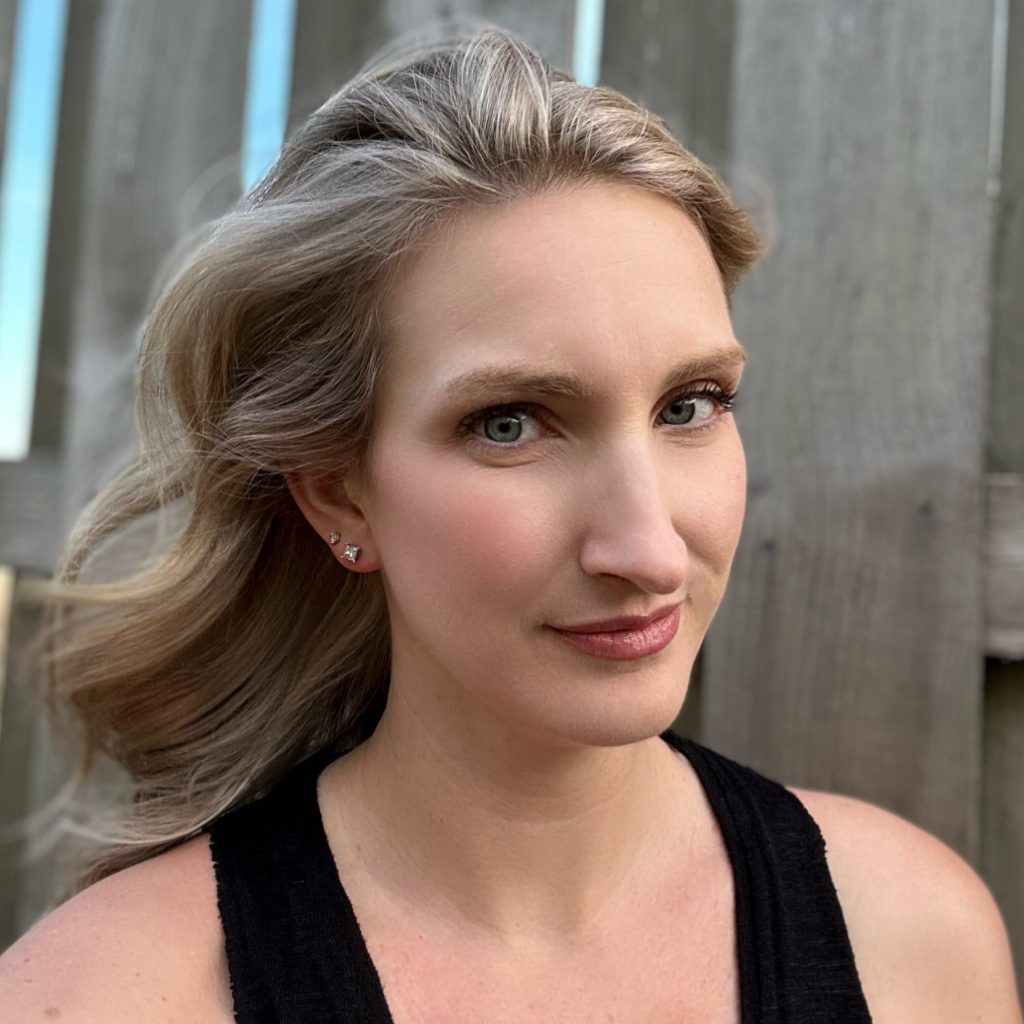
Amy Hutchins
Amy Hutchins is a NYC-based, classically trained actor (with 20+ years of stage experience), an accent nerd (with 25+ dialects in her pocket), and an Audie-nominated narrator (with 130+ audiobooks recorded, most under her pseudonym, Amelia Hugh). Whether it’s a time-travel romance, a psychological thriller, a romantic fantasy, or a memoir, her favorite stories to tell have strong lead characters who go on some sort of journey where they discover their inner strength — bonus points if there are fun accents involved. When she’s not in the booth, she’s cuddling with her two Sphynx cats, Celia and Rye, or traveling with her husband somewhere off the beaten path.

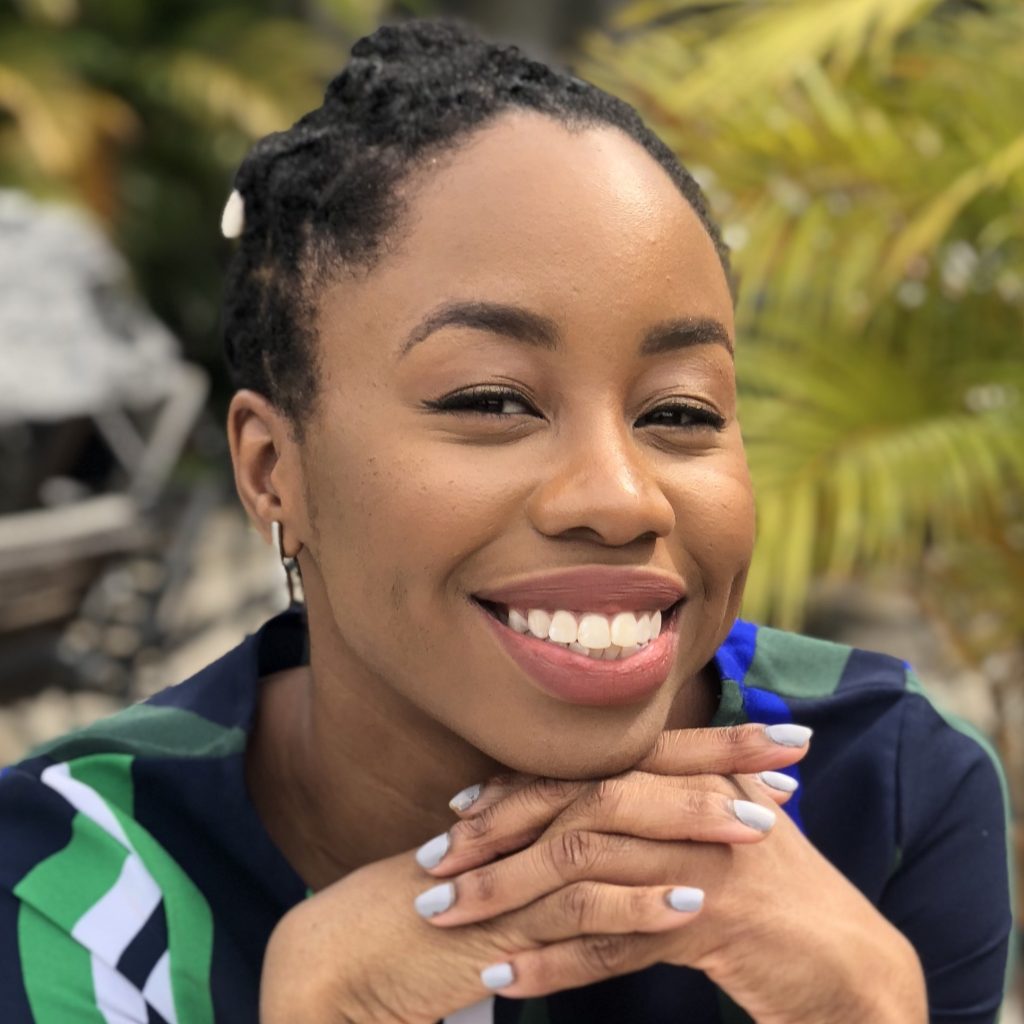
A’rese Emokpae
A’rese Emokpae is a Nigerian-American actress, singer, and dancer with over 15 years of experience in musical theater and on-camera acting. As an award-winning audiobook narrator, she channels her accumulated skills and unique lived experiences into each performance, bringing gravitas (with a little twinkle of glitter) to every story she tells. When she’s not having the time of her life recording in her home studio, she’s making noise in other ways: usually belting out karaoke tunes while baking up a storm in the kitchen.
The Questions
1. How do you mentally and physically prepare yourself for recording a narration? Are some books harder than others to prepare for?
Megan: Before I ever hit record, I read the entire book cover to cover — no skipping! Then I go into full-on analysis mode. I look at the emotional arc of the main character, map out the tone of each voice, and ask myself: Where does this character start? Where do they end up? What’s the vibe? I take tons of notes — inflection, pacing, energy — and build what I call an audio tone palette. It’s like a mood board for voices, and I’ll even match characters to pop culture references to help anchor their personality in my mind (“fake-nice Regina George” or “kinda like Luna Lovegood”).
Fantasy books? Absolute beasts. You have to build pronunciation guides from scratch for names that sound like ancient spells. Romances, though — they’re like comfort food. Once I know the beats, I can settle into the rhythm. Every genre brings its own flavor, but that challenge is part of the fun.

Laura: Before I even open the manuscript, I kick off my preparation by gathering crucial details from the author or publisher. This includes everything from the main characters’ backstories and any potential trigger warnings to specific accent requirements and a general overview of the story or series arc.
Knowing the word count for each book helps me estimate the recording time, and I also inquire about the projected number of books in a series. This allows me to schedule my production calendar well in advance, sometimes even years out, ensuring I can accommodate ongoing projects.
Some books definitely require more intensive preparation than others. For instance, a complex fantasy novel with intricate world-building and a large cast of characters demands a deeper dive into pronunciation guides and character voices than a straightforward contemporary romance. Ultimately, the goal is the same across all genres: to be fully immersed in the story and ready to bring it to life as authentically as possible.
Amy: I always read the entire book first before recording, whether I outsource the “prep” or not. Most of the time, I do my own prep. As I read and annotate the manuscript, I’m also filling out a spreadsheet with a “Characters” tab, a “Pronunciations/Questions” tab, and a “Chapter Summaries” tab, which includes columns for the POV, the characters who have dialogue per chapter, the summary, and the word count. It’s slow going, taking notes of each speaking character and noting any character descriptions, especially vocal descriptions. If it’s a fantasy, it takes even longer to prep since I have to pause and jot down every unique name and word that I’ll need to get pronunciations for. While the prep is very labor-intensive, when it’s thorough and I’ve combed through the entire manuscript and gotten the pronunciations back from the author or my producer, it makes the recording process so much easier.
A’rese: I once had a coach who said “the body remembers” in the context of performance. It was a concept that really stuck with me and became the foundation of my preparation style today. During manuscript prep, I am noting characters, pronunciations, and other things I need to keep track of, yes. However, that takes a backseat to me really letting myself get immersed in a book as a reader; letting myself laugh and cry, gasp at shocking reveals, and side-eye mean characters, haha.
Then, when it comes time to record the book, I have that emotional trajectory baked in and I’m able to really let the story fly. Imagine a dancer rehearsing so much that the choreography becomes muscle memory, and then they turn up the energy even more during performance. This is the mental equivalent of that.
In terms of physical preparation, I just try to maintain as many healthy vocal habits as possible so that my instrument is ready to work whenever I am!
2. What is your process when making sure different characters stand apart from each other in the story? Is it ever difficult to keep characters and their distinct vocal style straight?
Megan: Every new character gets a sample line, which I record and save in a folder right next to my current session. It’s like my little cheat sheet of voices. If it’s a recurring character from another book, I just listen to the old take and recreate it. I also rely on those trusty tone palette notes — energy levels, pitch, cadence. It’s all right there.
The real chaos hits during group scenes. You know, when there are five girls, six guys, and everyone’s talking at once? Those are hard! That’s when I lean into archetypes — maybe one guy is giving skater dude energy while another girl is crisp and clipped like a prep school queen. It’s all about stretching the range just enough to keep things clear without turning it into a cartoon.
Laura: A core part of my process for distinguishing characters is to immerse myself fully in one book at a time (when possible). This allows each story to live vibrantly and uniquely in my mind, preventing any bleed-over from previous or upcoming projects. I also maintain meticulous notes for each main character, detailing their personality traits, emotional arc, and how these inform their vocal delivery. Crucially, I also create a dedicated voice file for each character. In these files, I’ll speak in that character’s established voice, recording key lines or significant quotes. These files are invaluable, instantly reminding me of their distinct sound and helping me maintain consistency throughout the book/series/universe.
While this system is highly effective, it’s not without its challenges. It can be particularly difficult to distinguish minor characters that have similar vocal qualities — perhaps four “Alpha Males,” each described as having “growly/low/rumbly” voices, for example. In those cases, I might exaggerate subtle differences in pitch, rhythm, or even add a slight affectation to ensure they remain distinct. The goal is always to create memorable and believable vocal performances that enhance the listener’s experience, making it effortless for them to follow who’s speaking at any given moment.

Amy: Casting the character as a specific person is the best way to keep the characters sounding different. There’s also where I place the characters vocally, do they have a chest resonance, a nasal resonance, a breathy voice, a hollow mouth resonance, a tight jaw? Do they think and speak quickly, slowly, sporadically? What’s their vocal range? Expressive over many notes or flat with very little range? Do they speak with an accent or regionalism? There are so many ways to change the sound of your voice from character to character. However, the more specific I am in casting the characters as specific people, the less I think about how they sound, and the more I can dial in on the essence of that character and act. I can focus on what the character’s words are and stop worrying about what they sound like. If in the moment of acting I’m thinking about what they sound like, I’m no longer acting.
A’rese: The biggest thing for me is making sure I understand who the characters are, beyond just a basic physical description or a general identity. Their personalities, quirks, energy, inner thoughts, etc., all feed into that understanding. (Meaning, I go beyond descriptions like “she was 5’6” with brown eyes and an afro” and look for clues like “she was always particular about how she likes her coffee.” Does that make sense?)
That baseline alone is usually enough to make each character very distinct in my own mind. Then, to communicate that distinction to the listener, I begin to build out from there, playing with the more technical aspects of my voice (texture, tone, timbre, etc.) to help solidify the distinction between characters.
If and when I get it right, it feels seamless switching between characters because they’re so distinct (in both my head and my body) that it’s easy to keep their delivery distinct as well. That’s not always the case, though. For more difficult-to-access characters, I often use body positioning to help me channel them more quickly. And I also usually have a sentence that is the character’s “signature” that I will use to help me snap into character on a rough day.
3. How do you keep your vocal stamina up when reading aloud for extended periods of time?
Megan: Hydration, hydration, hydration. I drink a ton of water throughout the day. I also use a nebulizer to keep my vocal cords happy mid-session, and I cap my sessions around five hours — with breaks, always. Outside the booth, I treat my voice like an instrument: no yelling, no overuse, no nonsense. Gotta protect the goods!
Laura: Maintaining vocal stamina during long recording sessions is crucial, and it’s a multi-faceted approach for me that begins well before I even step into the booth. I dedicate a significant amount of time to both full-body and vocal warm-ups, and I make sure to take frequent breaks throughout the day. My day typically starts with some form of physical activity, whether it’s light weights, yoga, or stretching. This not only helps to warm up my entire body and engage my diaphragm, which is essential for breath support, but it also mentally prepares me for what can be a long day of focused work inside a padded room.
Once I’m in my studio, I transition to more targeted vocal warm-ups to get my voice ready for narration. If my voice still feels a bit “crunchy,” I’ll use a nebulizer or steamer to hydrate my vocal cords directly. Throughout the recording process, I prioritize regular, short breaks to rest my voice and body, and I stay constantly hydrated. This combination of physical preparation, vocal conditioning, and consistent self-care allows me to maintain the vocal quality and stamina needed to deliver consistent, high-quality narration for extended periods.
Amy: Making sure I get enough sleep and that I don’t fatigue my voice off the clock are so important for keeping my voice healthy while in the booth. I avoid places where I have to yell, which is kind of no fun when I have to leave a party because I have to record the next day. I also still mask up in crowded, unventilated places and on airplanes, because a cold could make me lose two weeks of work. Most people can work when they have a cold. I cannot.

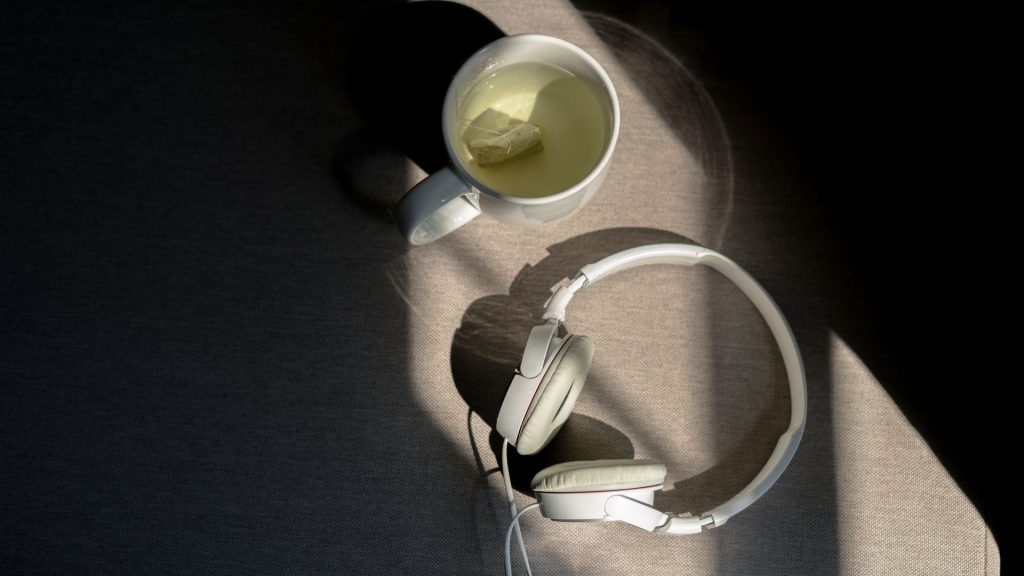
A’rese: I try to do as much work before and after recording to set myself up for success. I try to avoid alcohol, dairy, and caffeine while recording (I’m about 97% successful with it, haha). I don’t skimp on good ol’ fashioned hydration — drinking at least one refill of my half-gallon water jug each day. I will usually steam at least once a day (twice during heavy recording days), followed by vocal rest. When my workload is heavy and I need a little extra help, I love Grether’s pastilles and fresh ginger tea.
4. Have you ever narrated a book with another voice actor? If yes, please walk us through the collaboration process.
Megan: Oh, all the time! Especially with romance novels — there’s usually another narrator on deck. If it’s duet narration, we divide and conquer: I handle the female POV, they do the male, and our chapters live side by side.
But with dual narration, where we’re sharing characters? That takes more teamwork. I’ll send over my tone palette at the start, sometimes even voice clips if I’m doing a strong accent or something stylized. Communication is key because the worst thing ever is when two narrators give the same character completely different personalities. Total immersion-breaker. So I do the prep, share the vision, and stay flexible. If my co-narrator wants to tweak a voice I’ve done? Go for it! It’s a team sport. I let the man take the lead on the male voices, of course, but I always have ideas going in.
Laura: Yes, I’ve had the pleasure of co-narrating many audiobooks, and I truly love the collaborative aspect! While about 60% of my projects are solo, the remaining 40% are either dual, duet, or multi-cast narrations. In dual narration, each narrator records all the character voices, both male and female, within their designated point-of-view chapters. Duet narration, on the other hand, involves each narrator voicing their assigned characters consistently throughout the entire book, regardless of whose POV chapter it is.
It’s rare for duet narrations to be recorded simultaneously in the same room; typically, each narrator records their lines separately, and then an editor splices them together in post-production. While it’s a special treat when we do get to record together, the individual recording process is highly effective. One of the most enjoyable parts of preparing for dual and duet narrations is the opportunity to connect with my fellow narrators and chat about the books and characters we love.
Amy: Yes, I’ve done quite a few dual narrations. Those have the most prep because we both have to pronounce all of the words and names the same way, and we have to voice all of our shared characters with the same energies, vocal placements, and accents. The prep that I do with the manuscript and my spreadsheet is the same, except I add the column “shared character” to the Characters tab. And every time a character speaks, I note which POV they’re speaking in — mine or my co-narrator’s. And then, when that character speaks again in the other POV, I note that they are a shared character.
When my co-narrator and I share a character, we exchange casting ideas and voice memos of how they will sound. Usually, the male narrator does a voice memo for the male shared characters, and the female narrator does the voice memo for the female shared characters. If it’s two narrators of the same gender, it’s more of a matter of which characters appear more in one POV than the other. We also have to agree on all the pronunciations of words and names in the book — any words that might have more than one way of saying them. For example, “aunt”: will my character say “ant” or “awnt,” or are we saying “Brianna” as “bree-ANN-uh” or “bree-AH-nuh”? We have to make sure we are pronouncing everything exactly the same. Otherwise, one of us will have to record a lot of pickups afterwards. And we want to avoid pickups not just for our sake but for the post-production team’s sake.
A’rese: Yes. The process can vary, whether it is a dual narration, duet narration, or multi-cast, and also varies depending on whether or not the production is being handled by a publisher, production company, or is an indie project. At the baseline of all of these, though, is communication. Sharing character samples, pronunciation lists, and whatever else is needed to make sure everyone is on the same page.

5. What is one piece of advice you have for people interested in starting a career in audiobook narration?
Megan: Watch a live recording session. Seriously. There are so many amazing narrators on TikTok showing their setup in real time. You’ll get a feel for the rhythm, the tech, the multitasking chaos that happens in the booth. Also, take an acting class. Then go read several chapters out loud in a small space and see how it feels. Can you do that for hours without hating life? If yes, congrats — this might be your calling.
Laura: For anyone considering a career in audiobook narration, my strongest piece of advice would be to invest in your craft and treat it like a serious business from day one. This isn’t just about having a great voice; it’s about developing a comprehensive skill set. Just as I meticulously prepare for each book by gathering character details and refining voices, you’ll need to cultivate your acting chops, learn vocal stamina techniques, and understand the technical aspects of audio production. This means taking acting classes, finding a good vocal coach, and learning about recording equipment and software.
Beyond the performance itself, understand that this is a highly entrepreneurial field. You’ll be responsible for your own marketing, networking, and often, the entire post-production process. Just like I manage my production calendar years in advance, maintain a very active social media presence, and collaborate with other narrators, you’ll need to be organized, proactive, and persistent. Create strong samples and demos, connect with other narrators and authors, and be prepared to put in the consistent effort required to build a sustainable career. It’s incredibly rewarding work, but success comes from a combination of talent, dedication, and a strong business mindset.
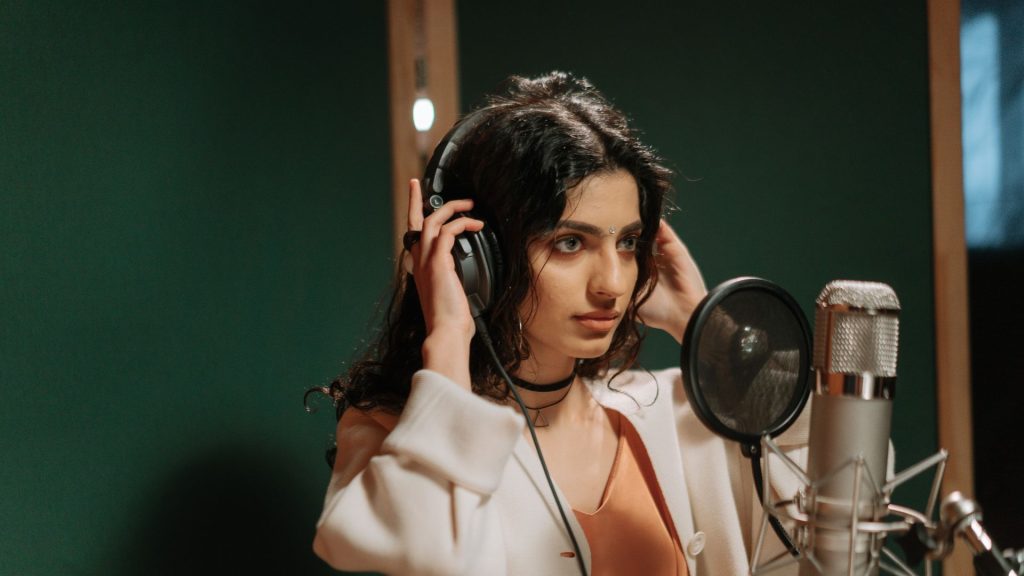
Amy: Make sure you have an acting background first. Audiobook narration isn’t reading, it’s acting. If you don’t have an acting background, take some acting classes, get some coaching, and then start recording some samples. I always recommend NarratorsRoadmap.com as a great resource for those who are curious about audiobook narration. And if you’re a professional actor who is a member of Actors’ Equity or SAG-AFTRA, check out the SAG-AFTRA Foundation’s VO Lab. That’s where I started to learn about all things voiceover in 2019.
A’rese: Do. Your. Research! This is a field that appears so simple and easy on paper (press record, read book out loud, done). But there is so much more that goes into it. I don’t say that to dissuade anyone, but rather to try to encourage interested parties to arm themselves with knowledge so they can give themselves a strong start. Also, as is true for the early days of any new business, there are a lot of financial investments that need to be made in the beginning. That can be daunting when you don’t know what equipment you need, who the trustworthy coaches are, where to find work, how to act…the list goes on. It’s hard to make sound decisions about those investments if you have no clue what anything is.
So I always say, research is free, and knowledge really is power. Having a solid understanding of the industry you’re preparing to enter is always going to be a good bet.
Lastly, remember that this is a collaboration. It’s tempting to just “wing it” because, again, on paper, it seems like a simple undertaking. When starting out, there’s a good chance that most of your early clients will be indie authors who don’t know a lot about the audiobook production process, but have poured everything into the thing they know (writing) and are relying on your expertise in bringing their baby to audio. Using those books as “practice” to “learn as you go” does a disservice to both you and the author. This industry has so many people who openly and freely share their knowledge and advice. Take advantage of that! You won’t regret it. Best of luck!
Bonus Questions
6. Who is your personal favorite narrator to listen to and why? Do you feel that they influence your own style in any way?
Megan: Julia Whelan. Hands down. Her narration in Thank You for Listening made me rethink everything I thought I knew about vocal nuance and accent work. She’s just so good. I don’t try to imitate her, but I definitely get inspired. I’ll hear a take she does and go, “Wait…I didn’t even think to approach a scene like that!” And suddenly I’m experimenting with new layers in my own delivery.
I’m also wildly inspired by my peers, especially the women narrating in the same series or genre as me. I listen, I take notes, I evolve. It’s all part of the process.
Laura: When it comes to personal favorite narrators, Nick Podehl and Elizabeth Evans are at the top of my list, largely because they both excel in my absolute favorite genres to listen to and narrate: fantasy and romance. Their performances were actually a significant part of what inspired me to get into audiobook narration myself.
What draws me to Nick Podehl is his incredible versatility, particularly in fantasy. He brings such distinct and memorable voices to a vast array of characters, making it easy to get lost in complex worlds. Elizabeth Evans, on the other hand, captures the nuances and emotional depth of romance so beautifully. Her ability to convey subtle feelings and build chemistry between characters is something I truly admire. While I strive to develop my own unique style, I definitely feel their influence, especially in my approach to character distinction and emotional portrayal within their respective genres. They’ve shown me the immense power of a narrator to elevate a story and create an unforgettable listening experience.
Amy: I have too many, and yes, they all have influenced me. I love January Lavoy, Andi Arndt, Lori Prince, Jeremy Carlisle Parker, Saskia Maarleveld — too many to name.
A’rese: It’s a tie between Natalie Naudus and January LaVoy. I just love January’s dynamism and the way Natalie uses breath. I feel like I learn something from every veteran narrator I’ve ever listened to, so I’m sure there are influences I’m not even aware of! Though I try to listen widely and with variety, so that I don’t fall into the creative trap of leaning too heavily into the influence of any one narrator I admire.
7. What is your go-to drink to have on hand while recording?
Megan: I wish I had a cool answer like “chamomile with honey and a dash of magic.” But nope — it’s water. Plain, boring, reliable water. Sometimes I’ll sneak in a hot tea, but it’s hard to juggle in a tiny booth without burning my hand. So yeah…water. Hydration forever. Afterwards? A dirty Shirley.
Laura: My absolute go-to drink while recording is the hottest herbal tea I can comfortably drink. I actually consume a significant amount, around 90 ounces of tea daily! For me, hydration truly matters, especially since I spend anywhere from four to six hours narrating every weekday. Staying consistently hydrated is key to keeping my voice strong and resilient. It’s a critical element that helps me power through those extra-long sessions, particularly when I’m up against tight, deadline-driven projects.
Amy: Ice water because it gets so warm in the booth, and Throat Coat tea.
A’rese: Tea! Tea of any kind, but particularly Throat Coat or Breathe Easy. If I’m sick or vocally fatigued, I swear by fresh ginger tea with honey. I like to simmer the ginger until it almost becomes a ginger concentrate. The end result is spicy, delicious, and attacks inflammation and soothes hoarseness incredibly effectively.
Thanks again to these fantastic narrators for speaking with us! We can’t wait to hear about all the upcoming projects they’ll infuse with their vocal magic.
Find Megan Wicks here.
Find Laura Horowitz here.
Find Amy Hutchins here.
Find A’rese Emokpae here.
Click here to read our interview with two librarians about the ongoing book bans.
Find more amazing reads to add to your TBR pile at our Bookshop.