


















Trigger Warning: The books discussed in this article contain potentially distressing content, including cannibalism, gore, child abuse, sexual assault, queerphobia, self-harm, mutilation, and religious abuse. Please exercise care while reading.
In October 2023, Filipino drag artist Pura Luka Vega was arrested for “immoral doctrines, obscene publications and exhibitions, and indecent shows.” Their crime? Performing the Our Father prayer as a drag number. Though many Catholics viewed Vega’s performance as blasphemous, the act was not intended as mockery. Rather, reciting the prayer while dressed as the Black Nazarene was an expression of faith: a defiant celebration of God and the Church that for so long had rejected its queer followers.
For groups that have experienced religious persecution or trauma, particularly the LGBTQ+ community, redefining and reclaiming one’s relationship with religion can be a powerful act. Among queer ex-Catholics and some other ex-Christians, this has given rise to a subculture called “sacricore,” a fusion of sacrilege and hardcore. Sacricore repurposes traditional religious aesthetics and concepts to embrace rather than reject behaviors and practices that are stigmatized or demonized within the church.
Though sacricore originated in alternative queer communities, creatives of all kinds have reinterpreted and reimagined church tradition. Today, we’ll explore the world of literary sacrilege and how writers challenge established religious tradition.
Why Sacricore?
Though the exact origins of sacricore are difficult to pinpoint, it has clear roots in online queer and particularly trans/genderqueer communities, namely on Tumblr. Participants in sacricore draw on their religious background, reclaiming its aesthetics and/or narratives to forge new meaning and find personal affirmation. This personal connection distinguishes sacricore from cultural appropriation, where an outsider takes aesthetics from a religion they don’t belong to with no real understanding of their significance. Sacricore is not meant to be weaponized as a form of religious bigotry, unlike antisemitism or Islamophobia.
Catholicism is the primary influence for sacricore, in large part due to its recognizable iconography as well as its penchant for the opulent. Amid the Church’s repression and condemnation of queerness, queer Catholics and ex-Catholics find kinship and representation in saints and holy figures, from St. Sebastian to Joan of Arc.
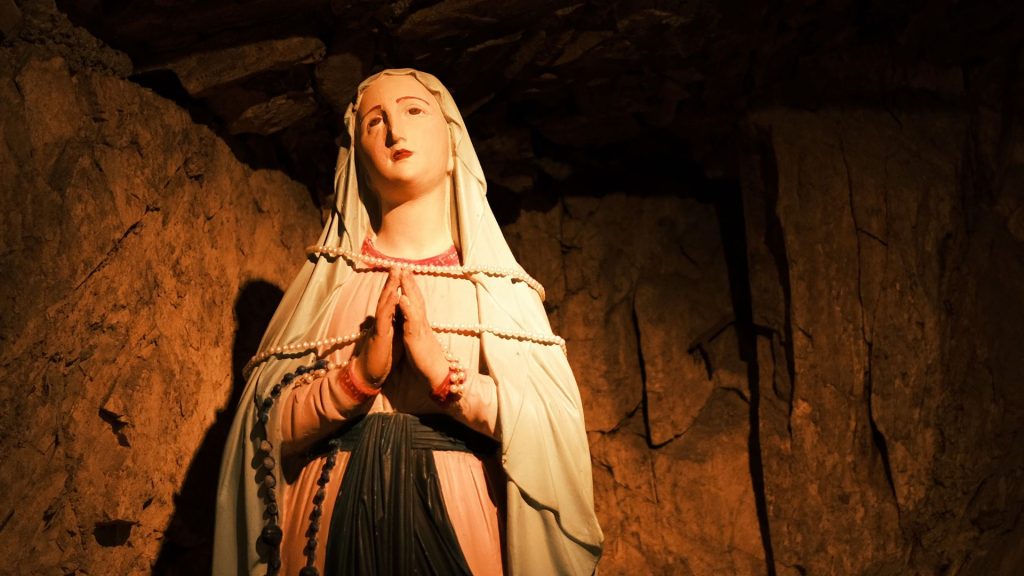
In curating this list, I’ve selected works that I think capture the spirit of sacricore, even if they might not necessarily define themselves as such. Some reinterpret Catholicism from a queer lens. Some offer alternate perspectives on Biblical history. Some illustrate the healing that can be found when one steps away from organized religion altogether and finds their people. And some use religious institutions as creative inspiration to imagine new worlds and possibilities.
People use religion as a vehicle to express their own traditions. For that reason, it’s really interesting to inject queerness into that mix of reclaiming what’s often forced on us.”
Robin Gow, The Rumpus
Our Lady of Perpetual Degeneracy by Robin Gow

Catholic saints bridge the divide between the earthly and the divine, transcending humanity through their devotion to God. This poetry collection from Robin Gow humanizes these holy figures in visceral, sometimes gory detail. Taking readers through kitchens, bedrooms, and backyard gardens, Gow’s lyrical vignettes portray the saints as friends, lovers, and allies of the so-called “degenerates.” A particular highlight is on eating, in which the transmasculine narrator communes with St. Agatha over the mutual experience of losing their breasts — one by choice, the other by force.
Gay Girl Prayers by Emily Austin

Scripture has long been used to subjugate women and demonize queer sexualities. Emily Austin’s poetry collection rewrites Bible verses through a feminist, queer-empowering lens, from memorializing Lot’s wife to reimagining Ruth and Naomi as U-Haul lesbians. By turns witty, righteously angry, and fiercely loving, Gay Girl Prayers is an unabashed ode to those the Church rejects.
The Book of Longings by Sue Monk Kidd

What if Jesus had a wife? Sue Monk Kidd’s alternate history introduces readers to Ana, a bright young woman from Galilee slated for an unhappy arranged marriage with an older widower — until she meets 18-year-old Jesus. As Ana and Jesus build a life together in Nazareth, tensions brew between the Israelites and their Roman occupiers.
The Testament of Mary by Colm Tóibín

Colm Tóibín’s provocative novella explores the grief and pain of Mary, Jesus’s mother. Living in Ephesus after the crucifixion, Mary is still mourning her son when two men appear at her doorstep, seeking her story. But where her visitors see a Messiah, Mary sees only a deeply misguided man who died senselessly. Long revered by Catholic tradition yet denied a voice of her own, Mary in Tóibín’s eyes is strikingly, devastatingly human.
The Angels Trilogy by rafael nicolás

Fallen angels are as much a subject of fascination as saints and Biblical figures, particularly in the work of rafael nicolás. Angels Before Man chronicles the fall of Lucifer, while Angels & Man takes a queer perspective on the apocryphal Book of Enoch and the rebellion of the Watchers (angels who fell in love with mortals, triggering the Genesis flood). Though the trilogy’s final book is still in the works, the companion story Horns for Hell takes place between its two predecessors, focusing on the demon Rosier.
Covenant by LySandra Vuong

Originally published on Webtoon, Covenant follows disillusioned exorcist Ezra as the Archangel Gabriel assigns him to protect a young man named Sunny, who inexplicably attracts the interest of powerful demonic forces. What is it about this seemingly ordinary man that endangers him so? And why, despite their lack of common ground, do Ezra and Sunny still gravitate toward each other?
Mercy by Ian Haramaki

Sent to the forest to kill an injured monster, Father Ilya Pavlovich Sokolov expects not to survive the encounter. But the monster turns out to be a man named Danya, cursed and amnesiac. As a relationship blossoms between the outcast priest and his new charge, they work to recover Danya’s past and salvage Ilya’s corrupt church.
Vespertine by Margaret Rogerson

When a troop of possessed soldiers attacks young Artemisia’s convent, a dying nun entrusts her with the care of a powerful relic. This relic binds a dangerous spirit, a revenant, who may be the key to stopping a deadly supernatural threat. As the unlikely pair search for answers, they develop a fascinating — and ultimately heartwarming — relationship.
Hell Followed With Us by Andrew Joseph White

On the run from a fundamentalist cult, 16-year-old trans boy Benji seeks refuge from the doomsday monsters they’ve unleashed. Coming to his rescue is the Acheson LGBTQ+ Center, or ALC, a motley crew of queer youth led by charismatic sharpshooter Nick. Infected with a bioweapon by his former cult, Benji is destined to transform into the monster that will bring about humanity’s downfall — but he’s not the only one harboring secrets. Hell Followed With Us fuses American Gothic with body horror, exploring the alienation that many trans and autistic teens experience, as well as the impact of US fundamentalism.
Sorrowland by Rivers Solomon

After being raised in the Blessed Acres of Cain, a Black separatist group turned restrictive cult, pregnant teenager Vern escapes to the woods. But she and her newborn twins are far from safe, and as the heteropatriarchal world she fought to leave threatens to reel her back in, Vern finds herself mutating into something stronger, more powerful — and potentially monstrous. In Vern, Sorrowland gives readers a protagonist who survives, shatters binaries, and refuses to become a victim.
If you’re just starting to dip your toes into this fascinating genre, I highly recommend checking out Keaton St. James’s poetry. Musicians are also particularly fond of deconstructing the divine, so if these stories resonate with you, consider giving Hozier, Ethel Cain, or even Lady Gaga a listen.
Now go in peace, dear reader, and may the grace of the literary gods be with you.
Click here to explore the sinful world of priest kink and priest romance.
Visit our Bookshop for more great reads to add to your TBR.
