

















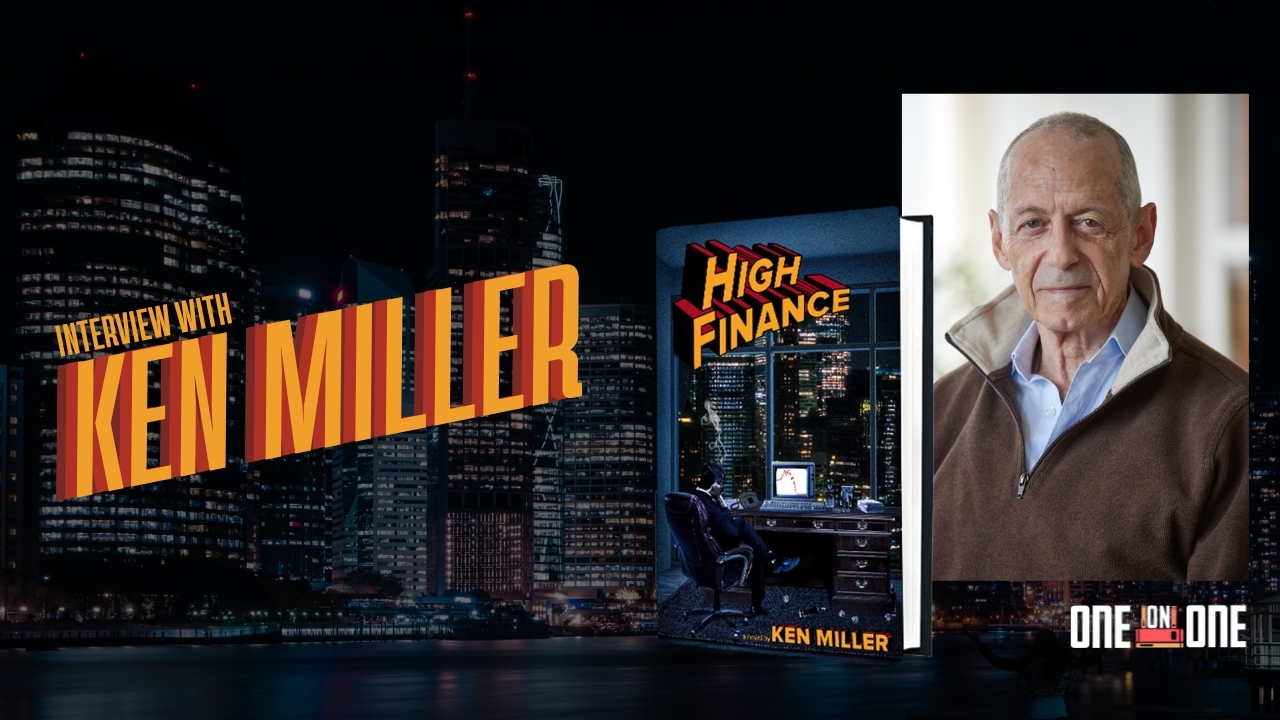
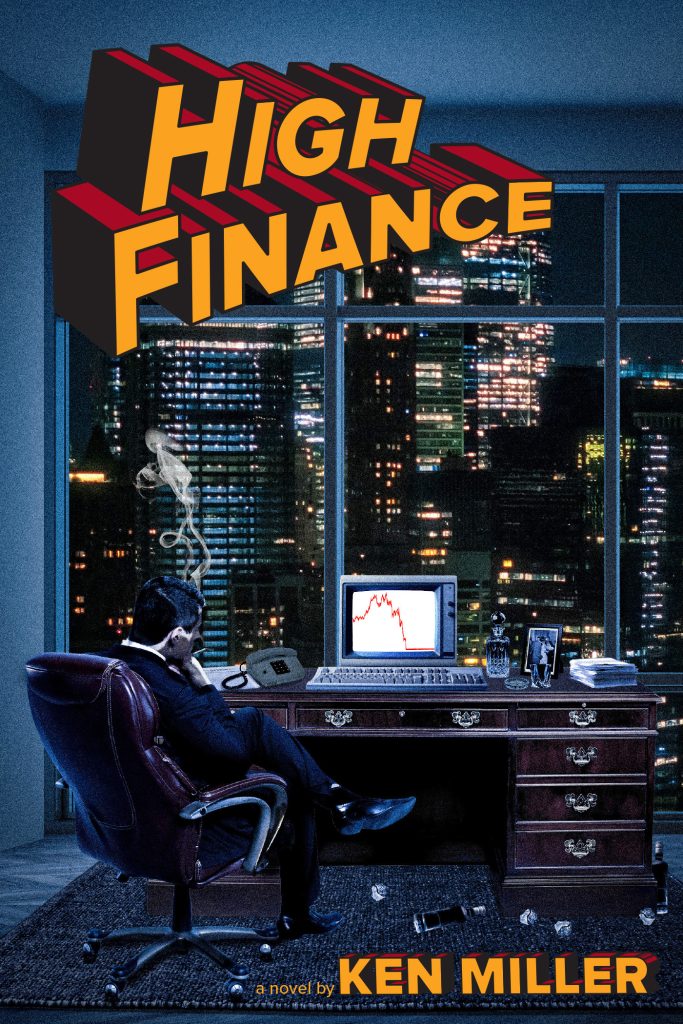
How exactly does one go from Wall Street to writing novels? Just ask Ken Miller, who made his extraordinary career change at age 82. His literary debut, High Finance, offers readers a window into the ruthless world of investment banking through the ambitious eyes of Jed Czincosca. As Jed climbs the ranks, he grows increasingly consumed by vice and greed until everything he worked for inevitably comes crashing down.
Today, Ken talks us through the deals, diction, and drama of Wall Street, the catalyst for his writerly journey, and what readers can expect to see next.
Trigger warning: The book discussed in this article contains depictions of substance misuse. Please exercise care when reading.
About Ken Miller
Ken Miller is President & CEO of Ken Miller Capital, LLC (“KMC”), a closely held merchant banking firm which invests in early-stage companies. He is the former Vice Chairman of Merrill Lynch Capital Markets and Credit Suisse First Boston. Mr. Miller has served as a member of the Board of Directors of Viacom, Inc., Intelsat Corporation, Kinder Care Learning Centers, CNA Surety, and Loews Corporation. He serves on the board of the National Committee on US-China Relations and PEN America and is an active member of the Council on Foreign Relations.
Mr. Miller received his B.A. with honors from the University of Michigan (1964), and, in addition to a M.A. from Yale University (1965 – Chinese Studies), received his J.D. from Harvard University (1969). His articles on China, venture capital, economic development, international relations, and the merger market have appeared in publications like The Harvard Journal of Legislation, The Business Lawyer, The Far Eastern Economic Review, The New Republic, The Deal, The Nation, and Fortune, Foreign Affairs, and Time. High Finance is his first novel.

Thanks for joining us, Ken! Let’s get started.
High Finance plunges us into the wild, volatile world of Wall Street. Forget the spreadsheets and the balance sheets — what was the dirtiest, most ethically questionable cocktail party conversation or behind-the-scenes moment you witnessed in your finance career that made you think, “I have to put this in a novel before I explode?”
I was Vice Chair of Merrill Lynch and head of its Mergers & Acquisitions Department when T. Boone Pickens, a Texas raider, began accumulating shares of Gulf Oil in a bid to take over that company against the will of its management. My team was hired to defend Gulf, but when Pickens drove the stock to new highs, our mandate changed: Sell to the highest bidder.
Two mammoth oil companies, Chevron and Arco, signed up for the auction, and so did KKR, the famous pioneer in leveraged buyouts. That’s the kind of deal where you borrow massive amounts of debt on top of a sliver of risk capital.
By the time the auction came to a head, it was clear that the management of Gulf was backing the KKR offer. In fact, they had become part of it. The deal would allow them to keep their jobs and give them a shot at serious wealth through options on shares KKR would grant them. Right before the critical Board meeting where the winner would be chosen, I was in the men’s room when I heard the sound of a zipper from the urinal on my right. I looked over to see KKR’s senior banker. Catching my eye, he whispered, “Take the dive, Ken. The fix is in.”
Though we sometimes jokingly referred to the Mergers & Acquisitions advisory business as Murders & Accusations, I was shocked. What is this, the fight racket?
On our advice, the Board chose the lower but less risky Chevron offer, and the company was sold for $13.2 billion, the biggest acquisition ever! The banker in question was subsequently convicted of systematically trading on inside information. KKR didn’t get Gulf, but their later acquisition of RJR Nabisco itself became the largest ever deal and the subject of the best seller, Barbarians at the Gate.
I didn’t put this actual incident in the book, but it prompted my interest in writing about Wall Street’s shady side and its unique culture.
Since your book is told through multiple voices and stories, it feels like a prism exposing the system’s flaws. If High Finance were a confession booth, which character’s secret do you think is the most painful or most necessary for the average reader to finally hear?
When Jed Czincosca, the central character of High Finance, hits Wall Street in 1977, he is a greedy nobody with a good education. He has many secrets in addition to his illegal stock trades, such as a father who is a serial business failure and a mother who’s a secret success. He’s smoking cannabis when it’s seriously against the law, cheating on his wife, and pursuing a secret program of accumulating shares in Lehman Brothers. He dedicates his life and talent to helping corporations game the system. He is the embodiment of a culture that worships at the altar of near-term profits and prays to the god of too-much-ain’t enough. So it’s fun, I hope, to see him heading for his own financial wipe-out in the Lehman bankruptcy… and how he copes with it. The biggest secret of the book itself, which I try to tell in subtle brushstrokes and in passing giveaways, is that another market crash is baked into Wall Street’s DNA. And Jed is a metaphor for that reality.
You went from being a Wall Street executive to a debut novelist. That’s like trading a power suit for pajamas. What was the absolute weirdest part of switching from the cutthroat, data-driven world of making money to the solitary, purely imaginative world of making meaning?
I love writing fiction, but I think of the process as more like listening intently than making meaning. When a character whispers something revelatory in my ear, and I succeed in finding just the right words to put on a page, there is a kind of in-and-of-itself pleasure, an immediate gratification that isn’t available on Wall Street. There, you work through technicalities and egos to achieve an outcome. And when you finally do close a deal, it’s, but a yoctosecond before The Firm’s bottom line asks its perpetual implicit question: When’s the next one, pal?
The weirdest part of publishing has been the transition from big wheel to insignificant wannabe… perhaps one who is wearing glow-in-the-dark pajamas. I went from working on multi-billion-dollar transactions and handing out multi-million-dollar bonuses to begging for the attention of a potential agent who might be able to win me the task of selling objects for $29.75 apiece (14 bucks or so for ebook or audio 😊).
But the whole process has been fun! I was a nobody when I was in the civil rights movement, and, as there, I drew strength from being part of something bigger and more meaningful than my individual self. With novels banned and libraries facing budget cuts, staff reductions, shortened hours, or temporary closures, it’s especially gratifying to add my debut novel to the culture.
The finance world loves its jargon and its high-stakes theater. What’s one hilarious or utterly ridiculous part of Wall Street culture that people on the outside would never believe is actually true?
Practitioners of high finance think of themselves as warriors, but their stakes are dollars, not lives or national security. More rōnin than samurai, investment bankers, like Jed of High Finance, will work for any fee-paying daimyō they can onboard as a client. And they love to use military jargon to describe the battles. A company that their client wants to take over is commonly referred to as “the target.” Military-sounding code-names like Falcon or Overlord are used routinely to avoid leaks, and a project with a name like Operation Cobra might originate on Wall Street as organically as in the Pentagon. If the cost of doing a deal hurts a certain group, well, too bad… sometimes you can’t avoid collateral damage. When I first came to the street, a senior banker told me, “The client is the enemy,” but he was just frustrated by some difficult fee negotiation he was in.
And it is amusing for me to note how the language itself evolved to emphasize how importantly busy we were. No time for politeness, the pleases and thank yous that lubricate social interaction in the lives of mere mortals. The word “business” became “bidness” (silent d), and the new client whose mandate we turned to was “nex vic”.
Publishing a brilliant first novel at 82 is arguably the best “screw it, I’m doing it” story we’ve heard all year. For everyone else stuck in a rut — creative or professional — what finally convinced you to trade your “should-haves” for “now-I-cans” and commit to writing?
I had been writing fiction sub rosa for years when I attended a writer’s workshop at the Stony Brook University campus led by the great Ursula Hegi (e.g., Stones from the River). She urged us to think of ourselves as writers, and at the end of the seminar, she gave each of us a little sign with a quote from Horace, the great satirist, poet, and critic (65-8 B.C.), which said in Latin, “No day without a line.”
One line??! That low bar worked like a charm, pulling me to my desk. I have the Horace quotation pasted over the door to my home office. Since then, I’ve managed to squeeze out at least two to three hours a day for writing.
And I set myself a low bar for publishing, too. As long as the novel was not universally panned and enough copies were sold that my publisher would take on my next one, I’d declare victory. I guess I’m more of the as-long-as-it-doesn’t-kill-you-it-makes-you-stronger school than the better-safe-than-sorry.
But “Screw it, I’m doing it” was followed by many a “Screw it, there’s no way I’m doing it.” And by “it” I mean publishing; the writing would have continued one way or the other. But I often considered leaving the publishing problem to my heirs. I know people do crazy s— as they get older. I had begun to wonder if I was one of them. The contemporaries I showed the work to were friends, so maybe they were just being nice, or maybe they were crazy too! My mother, may she rest in peace, was always asking, “What do you need this for?” In the end, I chose the potential reputational damage from publishing over the embarrassment of chickening out.
After all those years in business, you’re now a storyteller. Did your family and friends immediately rally around the new literary Ken, or were there a few skeptical looks from people who still thought you should be calculating returns?
My family has seen prior discontinuities. My switches from Chinese studies to civil rights activist to Wall Street financier each involved radical change, but seemed both organic and pre-ordained at the time. Whatever grousing or jokes at my expense may have been going on, it never got to the point of telling grandpa he’s got to hand over the keys. I guess they figured what I was doing behind closed doors was unlikely to maim or kill anyone.
And friends? Most friends from business probably took it as confirmation that I was no longer a player, but there was a validating handful, mentioned in the acknowledgements, that gave me the strength to persevere.
Given the dark realities you expose in High Finance, the book feels less like entertainment and more like a carefully aimed grenade. If your novel could instantly detonate one massive, systemic misconception the public has about the financial world, what would you want it to be?
People may not fully understand the underlying mechanism whereby greed leads to disaster. Excessive leverage (borrowing) inevitably brings ruin to the markets. Jed borrows to acquire Lehman shares, and the unraveling of his world is an example of what happens when you take on too much debt and put too many eggs in one basket. Financial institutions throughout history borrow too much… and then invest the proceeds in illiquid assets — stuff it’s hard to sell when panic sets in. You can never tell what will burst a bubble, but on Wall Street, you can always count on those in charge of risk management to lose out to the big producers whose risk-taking adds profit to the bottom line.
Most people fight the system with protests or policy papers. You chose a novel. Why do you believe a well-told story is ultimately a more persuasive, and perhaps more dangerous, weapon than a thick stack of economic analysis?
When I write fiction, I am not trying to persuade. In an opinion piece, I might be making a full-frontal attack on your beliefs. The cool thing about made-up stories is that they allow a reader to come to their own conclusion by entering the mind of the writer’s invented others. They may learn some lessons, but they are drawing their own conclusions, teaching their own self.
That said, I have not abandoned fighting the system with protests.
You’ve conquered Wall Street and now the literary world. What’s the next great challenge Ken Miller is looking to take on? Are you already mapping out a sequel or a story about something totally new?
I would not say that I conquered Wall Street, but I hope I can say I got out without it conquering me.
The next great challenge is to bring forth another novel, but I am having trouble deciding which of two candidates that will be. One that’s finished but needs an edit is called The Maggie Chronicles. I spent a lot of time visiting New York State high-security prisons and befriended several formerly incarcerated persons researching this one. It’s sort of a spin-off of High Finance in that it features the internal auditor who’s always trying to nail Jed for insider trading. This guy, Bobby Cherubini, has been stealing from the hotel conglomerate he eventually works for to pay for high-class prostitutes. From “Sennagunk,” an amalgam of Sing Sing, Attica, and [other prisons], Bobby, a lapsed Catholic, founds a new religion with Rivka Rubenstein, an observant Jew. She is ending an affair with the grand Rebbe of Burrough Park while running a secret sex chat business. It’s a fun satire, but I’m about forty percent through another one I call Sex with Bots, set in 2037, which explores the human/machine meld taking place before our eyes. And it would be even more timely than The Maggies for this moment in post-Trump America. So, as is typical for me, I am simultaneously charging down a couple of paths, hoping for a save from some deus ex machina before I hit a wall.
Thanks again to Ken for speaking with us! To keep up with his work, visit his website or follow him on Instagram — and don’t forget to check out High Finance!
Click here to read our interview with nature enthusiast Jarod K. Anderson.
Find more new releases from 2025 at our Bookshop.
