


Trigger warning: The book discussed in this article contains content some readers may find distressing, including depictions of mental health issues, drug use, bullying, and gore. Click here for a full list of content warnings.
If you, like many of us, spent COVID isolated and chronically online, Mar Romasco-Moore’s latest novel, Deadstream, will surely resonate with you. Traumatized after a car accident, Mar’s protagonist, Teresa, lives her life on the internet, connecting with people through livestreaming. But something sinister lurks within the screens of the streamers Teresa watches, a deadly reminder that no corner of the internet is truly safe.
Today, Mar joins us to chat (pun intended) about the pros and cons of social media, the ghosts that haunt pages and screens alike, and the fresh horror that awaits readers once the Deadstream feed gets cut.
About Mar Romasco-Moore
Mar Romasco-Moore is the author of the novels Deadstream, I Am the Ghost in Your House, Krazyland, and Some Kind of Animal, as well as Ghostographs, an interconnected collection of flash fiction inspired by vintage photographs.
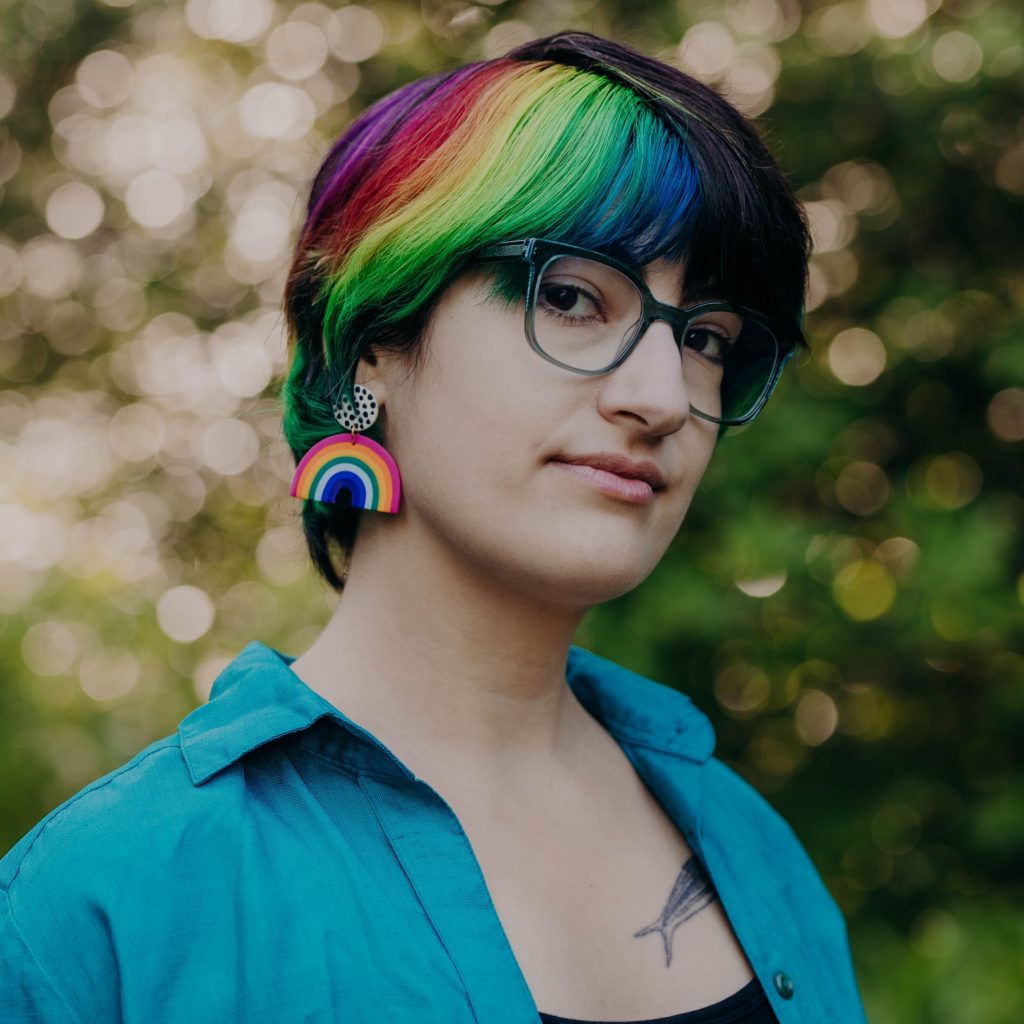
Thanks for joining us, Mar! Let’s get started.
For any readers unfamiliar with it, can you give us an elevator pitch for Deadstream?
Due to her severe agoraphobia, Teresa’s only window to the outside world is the online community she’s found through live streaming. But one night, a ghostly figure appears on the stream and Teresa’s safe world shatters. She realizes that her computer isn’t a window but a door — and something is trying to get in.

Your book provides an interesting view of the internet, showcasing both the positives, such as community building and finding identity, and the negatives, such as bullying. Did you intend for the ghost to act as a metaphor for the darker side of the internet?
The internet already feels genuinely very haunted. This was really just my best guess at precisely what sort of ghost a certain corner of the internet would produce. You could definitely call it a metaphor, but to me it feels more like just a very minor exaggeration of what is already happening.
Deadstream touches on how much society and teens live and breathe the internet, and it’s often recommended that we step away from time to time. What are some ways that you like to detox from the internet and social media?
I love to leave the house without my phone sometimes. I love places with no wifi. For me, they are the best places to write.
Embroidery and collage are two activities I do to relax and ground myself in the physical world. I also (big surprise!) play lots of games on my computer, but my absolute favorite games are all physical board games. There’s just something really special about sitting down at a table across from living, breathing people and moving little wooden pieces around with your hands.
In Deadstream, Teresa finds comfort in online streaming after a tragic accident, and in recent years, the internet has been seen as a detriment to one’s mental health. How do you feel the internet can be utilized in a positive way to support those struggling with their mental health?
Simply finding out that other people are going through the exact same struggles that you are can be very helpful. While the internet has, at times, sent me down some really negative rabbit holes of fear and obsession, it has also allowed me to gain a greater understanding of why I’m experiencing those symptoms and shown me I’m not an aberrant anomaly. Do those things balance out? I’m not sure!
A recent Goodreads review described you as someone who is “deeply interested in identity, going against social norms, social commentary, and creating characters that help young adults feel seen in an ever-confusing world.” What drew you to covering these themes in your works?
Well, that’s pretty simple: I was once a teen who felt completely unseen, stifled by social norms, and uncertain about my identity. My writing is both an attempt to work through those issues for myself and, hopefully, a signal to anyone else out there dealing with similar struggles that they are not alone.
Viewing social media from the perspective of publishing, what has your experience been with interacting with the online bookish community? Any particularly fond or upsetting moments?
I’ll never get tired of hearing from readers that they enjoyed my book or that it meant something to them. One young reader told me they usually can’t focus on books at all, but mine was an exception. For Deadstream in particular, I love hearing about people scaring themselves by reading it at night! That said, I’m naturally a very private person, and the current expectation that authors should become mini-influencers in order to promote their books is not something I love. It never stops feeling weird and uncomfortable to me to put myself out there online.
In your interview with The Nerd Daily, you gave us a sneak peek at your next book, a horror that focuses on wellness influencers, dodgy supplements, and a plant-based cult. Could you share more details with your readers?
I literally just turned in a rough draft of that book to my editor right before answering these questions! The working title is Saint Kayleigh, and while more of it takes place offline than Deadstream, it also engages with similar questions about how we create identity in digital spaces and the possible pitfalls of parasocial obsession.
The idea/characterization of ghosts has come up in several of your books now. Why is that? What about ghosts fascinates you and inspires you to use them in your writing?
I read a theory recently that the modern conception of ghosts as floaty and transparent comes directly from the development of photography, which shows that ghosts and technology are more intertwined than we might imagine. So I guess the answer is this: I’ve been fascinated with ghosts since I was a little kid, and yet I still keep finding new dimensions to them, new ways that they reflect our human fears and hopes.
We saw that you have a playlist for your short story collection, Ghostagraphs. Do you have a playlist for each of your books or for Deadstream?
For Deadstream, I would probably choose the soundtrack to Bo Burnham’s Inside, played over and over! While drafting, though, what I actually listened to most often was the instrumental album Convocations by Sufjan Stevens.
The ending of the book leaves readers with an interesting takeaway about the impact of our digital footprints. What message about technology and social media do you hope to convey through your work?
No message. I don’t have all the answers. But it’s something I’m always thinking about — trying to assess the ways technology changes my brain and behavior. So I guess I’d just encourage people to do the same. Don’t let the effects of technology or social media become invisible to you. Notice them. Question them.
Thanks again to Mar for speaking with us! To keep up with their work, be sure to stop by their website or follow them on Instagram — and don’t forget to check out Deadstream!
Want more queer YA horror? Click here to read our interview with Trang Thanh Tran.
Find these and other terrifying reads at our Bookshop.