














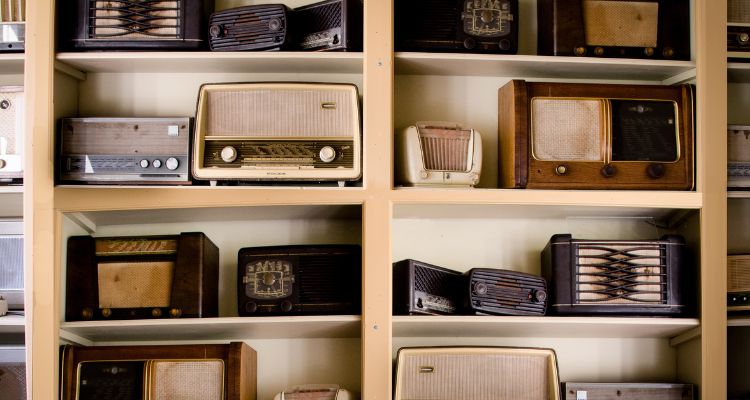
In this modern age, our society has countless different conduits of media, but radio has proven to be one of the most reliable and long-standing sources. Today, we jam out to our favorite songs while cruising down the road. But, besides music, the radio provides a vital source for news, traffic, and talk radio. Over the years, some of the most historical moments in American history have been transmitted through the airwaves.
“On this World Radio Day, we celebrate not only the history of radio, but also its central role in our societies, now and in the years to come.”
– Audrey Azoulay, Director-General of UNESCO
The importance of radio is even recognized by UNESCO, and they acknowledge how radio is essential in harnessing the power of free speech and access to information. Today, we want to highlight five of the extraordinary moments in radio history.
War of the Worlds
It was the night before Halloween in 1938. Before making a name for himself as an actor, director, and producer in Hollywood, a man named Orson Welles was the host of an hour-long radio series called Mercury Theatre on the Air. On this particular night, Welles set out to produce a live radio adaption of H.G. Wells’ classic novel, The War of the Worlds, a book that was published forty years prior. Unfortunately, many listeners tuning in did not realize this was a fictional performance and believed that an alien invasion was transpiring over New Jersey. The result was mass panic, an outcome that Orson Welles never intended to happen:

“I had conceived the idea of doing a radio broadcast in such a manner that a crisis would actually seem to be happening and would be broadcast in such a dramatized form as to appear to be a real event taking place at that time, rather than a mere radio play.”

The narrative has been adapted for film multiple times, including in 1953 and 2005 — the latter starring Tom Cruise and Dakota Fanning. However, you can listen to the original broadcast on Spotify.
The Beginning of Talk Radio
In addition to listening to your favorite jams, talk radio programming is highly popular on the airwaves. You can thank Barry Gray for birthing the concept of “talk radio.” Way back in 1945, Barry was disc jockeying on WOR in NYC. After referencing bandleader Woody Herman, Herman called into the station, leading to an entertaining on-air dialogue between the two men. The moment was deemed so entertaining that producers continued the format and scheduled interviews on the radio with Barry, leading him to be known as “The Father of Talk Radio.”

Shortly after, Barry moved to Miami for a short time but then returned to NYC to continue talk radio for 39 more years. Barry’s format transformed into a more political message. His journey and position in widespread media gave him a platform to combat bigotry and McCarthyism during the Red Scare.
Martin Luther King’s “I Have a Dream” speech
In what was a pivotal moment for the Civil Rights movement, Martin Luther King Jr. addressed the nation from the steps of the Lincoln Memorial on August 28, 1963. The location was symbolic due to Lincoln’s Emancipation Proclamation from a century prior. Even a hundred years later, the Black community was still fighting for basic human rights, and MLK Jr. was the voice to lead this fight. Radio was crucial in this address, as the speech was broadcasted across the nation, reaching millions of Americans even in the comfort of their own homes.
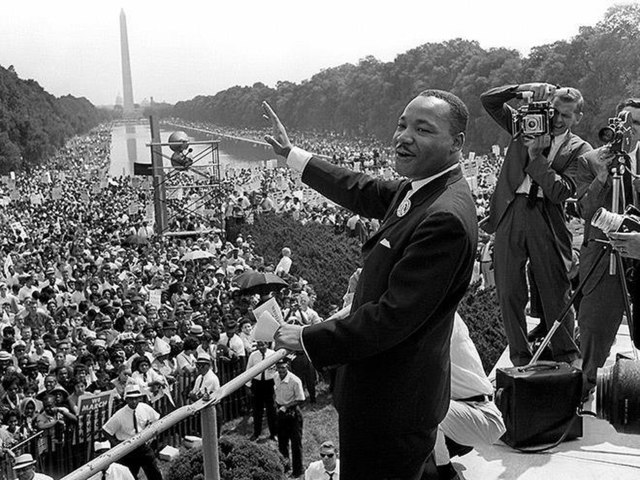
To listen to this iconic speech or read the transcript, check out this NPR article.
The Beginning of NBC
Before the days of popular television series such as Saturday Night Live, The Office, and 30 Rock, the National Broadcasting Company — also known as NBC — started on the radio. Led by David Sarnoff, NBC Radio first went live on November 15, 1926. Their signal spanned 19 different stations from the east coast extending westward to Kansas City, Missouri. It was not until 1939 that NBC was introduced to television sets.

The First Rap Song Played on Radio
Ushering in the genre of rap, the first rap song on the radio was played in 1979. That song was The Sugar Hill Gang’s Rapper’s Delight. The original version of the song was 15 minutes long but was edited down to 6 and ½ minutes for the radio. After this first airing, Rapper’s Delight reached #36 on the pop charts, making it the first hip-hop single to break into the Top 40 charts.

With the numerous advancements in technology, it may be easy to forget how radio is so prominent in our lives. But even to this day, it is indispensable for civilization. What have been some of your favorite historical radio moments?
To discover some interesting podcasts, check out our past article: National Radio Day: The Spookiest True Crime Podcasts to Listen To.
If you are interested in finding some non-fiction reads, check out our bookshelf: Non-Fiction Titles for the Enlightened Mind.