
















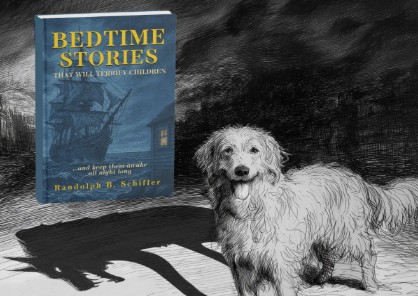
An old-fashioned gentleman with a sharp wit, a lifelong career in medicine, and a healthy distaste for the modern world of social media, Randolph Schiffer is not your typical author. He’s a storyteller in the truest sense, drawing from a deep well of classical literature, personal experience, and a worldview shaped by both the operating room and the tragedies of Shakespeare. His new short story collection, Bedtime Stories to Terrify Children: And Keep Them Awake All Night, is a masterclass in psychological storytelling — a book that promises to be as unsettling as it is profound.
In this exclusive interview, Schiffer pulls back the curtain on his creative process, his aversions, and his unique vision. Read on to discover the mind behind the stories — a mind that wants to make you laugh, cry, and perhaps, lose a little sleep.
About Randolph B. Schiffer
Randolph B. Schiffer has lived many lives — Marine, physician, psychotherapist, professor — and now, storyteller. A graduate of Yale College and the University of Michigan Medical School, Schiffer’s career spanned both battlefield and brain. He served as a Marine infantry officer during the Vietnam War, led departments in prestigious medical institutions, and co-founded the American Neuropsychiatric Association.

At one time, he was the only physician listed in Best Doctors in America for both adult neurology and psychiatry. In 2010, he stepped away from medicine to write. His literary voice — measured, unflinching, and strangely tender — blends memory with myth, and mortality with mischief. From their cedar cabin in Bois Blanc Lake, Michigan, he writes in view of the lake that has shaped so many of his stories.
He also resides in Santa Fe, New Mexico, with his wife, Dr. Lynn S. Bickley, closer to his sons and family in Dallas.
You can find Randolph Schiffer on his website and socials: Instagram, Facebook, TikTok, and LinkedIn.
Thank you for joining us, Randolph. Let’s get started.
Randolph, your forthcoming collection, Bedtime Stories That Will Terrify Children: … And Keep Them Awake All Night, seems to turn the classic bedtime story on its head. What inspired you to take a genre typically associated with comfort and gentle dreams and use it to explore fear and anxiety?

When our elder son, Brenton Bickley Schiffer, was three years old, he was diagnosed with acute lymphoblastic leukemia, at that time a fatal disease for many children. The treatment was a grinding ordeal lasting years, with those children who couldn’t take the treatment dying. For children of that age, you can’t use logical positivism to prepare them for the treatment. I decided to embark upon a two-year course of bedtime stories for Brenton (and his younger brother, Randy, too), which might harden him; might inure him to what lay ahead. Bedtime Stories to Terrify Children are those stories.
Your work transforms everyday things — a dog, a plant, a hospital — into menacing presences. What is it about the mundane that you find so ripe for psychological terror?
Each of the eight stories of Bedtime Stories to Terrify Children has the title of a commonly known animal – dog, lion, squirrel, etc. But none of the stories is really about an animal at all. The animals, and the animal pictures which open each story, are windows into the rich world of childhood imagination, with which children are familiar. My hope was not really to terrify children, but through the stories to create a sense of suspense; of drama; of pathos about the passages to wisdom which growing up requires of us all.
The dynamic between the two brothers, Brenton and Randy, is central to many of the stories. What about their relationship — the blend of rivalry and solidarity — is so crucial to the narrative?
All of us have families. Each family is different, and few, if any, hearken to the Leave It To Beaver stereotype. When there are children in the family, the developmental tasks of one affect the tasks of the other(s). There is an interplay, a back and forth, inevitably. Some of the interactions are positive, some competitive, some negative, but the entire system changes. Mostly, the sibling interactions depicted in Bedtime Stories are but the literary narratives of remembered family dramas when there is childhood leukemia.
We know you’re not a fan of social media, yet you’ve expressed an interest in using it to post “micro homilies.” What do you hope to achieve with this approach, and how do you believe it will resonate with readers who are used to more conventional online content?
If Bedtime Stories is not really about animals, then what is it about? In my view, if a book is to be worthwhile, it has to take on some aspect of the terrible dramas that affect our time upon the stage. There is good versus evil; love versus hate; life versus death; the search for wisdom; the seeking of meaningfulness in the limited time that each of us is dealt. Each of the eight stories in Bedtime Stories takes on one of these issues. I don’t have space to elaborate here, but I hope to develop some of these in my social media micro homilies.
Your clinical background in medicine is evident in themes of illness, hospitals, and the fragility of life. How has your experience as a doctor influenced your approach to storytelling and your exploration of these themes?
To write something good, writers must write of what they know; of what they have done; of what they have seen. I am old now and have many memories, not all of them good. I was a Marine infantry officer in the 1960s; I was in VietNam, sought to take some lives while saving others. I was a doctor later, in the academic medical centers of this country, and I sought to develop new ways to save lives, yet many died anyway. Sometimes, looking back on it all, I wonder if the two careers were really just a single one, with two sides to it? For good or for ill, everything I say, do, or write now is invested with these memories.
Your stories are filled with archetypal figures and mythic elements. What is it about ancient folklore and classic tragedies, which you read annually, that continues to inform your creative process?
There is very little that we know now of wisdom and meaning in life, which the ancient Greeks did not know. Aeschylus, Euripides, Sophocles; yet the greatest among them, Aeschylus, was denied the honors at Dionysia until later in his life. Perhaps, thinking back on this, even at my advanced age and after innumerable rejections and dismissals of my literary works, Bedtime Stories will garner such honors for me? (I am teasing here, but would accept the prizes should they come)
What is the one emotion you hope to leave an adult reader with after they finish the collection, and what do you hope to leave with a child?
In my writing, fundamentally, I seek to make people laugh. This I seek for both grownups and children, since, in some ways, grownups are just big children who have forgotten that they were children. I made money for a time as a humorous after-dinner speaker, but I let that career go. The problem here is that to make people laugh, you have to make them cry first. So, in Bedtime Stories, taken as a whole of the eight stories, I hope that all children of whatever size who read them, or hear them, will both laugh and cry.
Finally, you’ve said that the only reason we read anything is to improve ourselves. In what way do you hope your book will improve its readers, and what unique lesson do you believe it offers them?
The heroic figure in Bedtime Stories is the Father. This is self-serving, perhaps, but I’m writing the Stories so this is how it is. The Father, who has a terminal illness, is forced to craft a premature Goodbye for the two children; a Goodbye that will reach into the future lives of the children as his legacy, even though he will not be there. But this is a developmental task that all parents have, isn’t it? How to say Goodbye to the children? If there is a lesson in this book, it is about this.
Thank you, Randolph, for the excellent interview. Ultimately, the wisdom Schiffer offers comes not just from the operating room, but from a life fully lived and deeply examined. His unique blend of humor, classical insight, and personal experience has produced a collection that is as unsettling as it is undeniably human. Bedtime Stories to Terrify Children may keep you awake, but it will certainly keep you thinking, inviting you to see the world — and your own life — through a truly original lens. When the collection arrives, pick it up and prepare for a prescription that is equal parts terrifying, moving, and profoundly insightful.
Out on Tuesday, October 28th, pick up Bedtime Stories to Terrify Children from Amazon.
Want more author interviews? Check out our Author’s Corner to see who we’re talking to!
Find more children’s scary stories on our Bookshop shelves.