









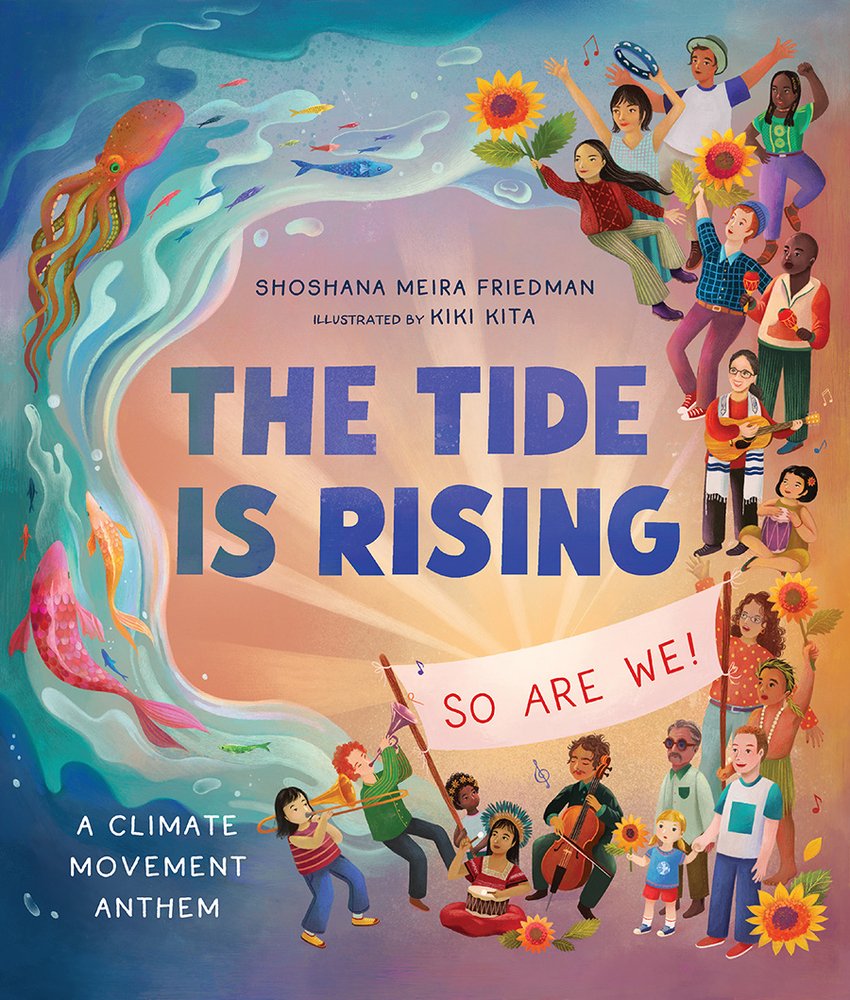
Climate change is a pressing issue for all of humanity, and the youngest generations are often the ones leading the charge to stop and reverse the damaging effects of the human population and industry. However, for little bookworms, the scope of the issue can feel overwhelming, making it difficult to know where to stop for those who want to help. Such hesitation was the inspiration behind Rabbi Shoshana Meira Friedman’s song The Tide Is Rising, which has recently been adapted into the picture book The Tide Is Rising, So Are We! We had a chance to sit down with Rabbi Shoshana to discuss her debut children’s book, climate anxiety, and the power of small kids to make big changes.
About Rabbi Shoshana Meira Friedman
Rabbi Shoshana Meira Friedman is a coach, activist, writer, and all-around passionate creative who grew up in a musical family. After she and her husband, Yotam Schachter, composed The Tide Is Rising in 2015, the anthem spread widely throughout the climate movement and fulfilled Rabbi Shoshana’s lifelong dream of empowering social change through song. Rabbi Shoshana’s writing has been published in venues including The New York Times, Yes! Magazine, and the anthology Rooted & Rising: Voices of Courage in a Time of Climate Crisis. A late-diagnosed Autistic PDA woman, she runs The PDA Safe Circle, a neurodivergent-affirming online community, and coaches PDAers and their loved ones. She lives in a joyful and radically neurodivergent-affirming home in Boston, Massachusetts, with her husband and son.
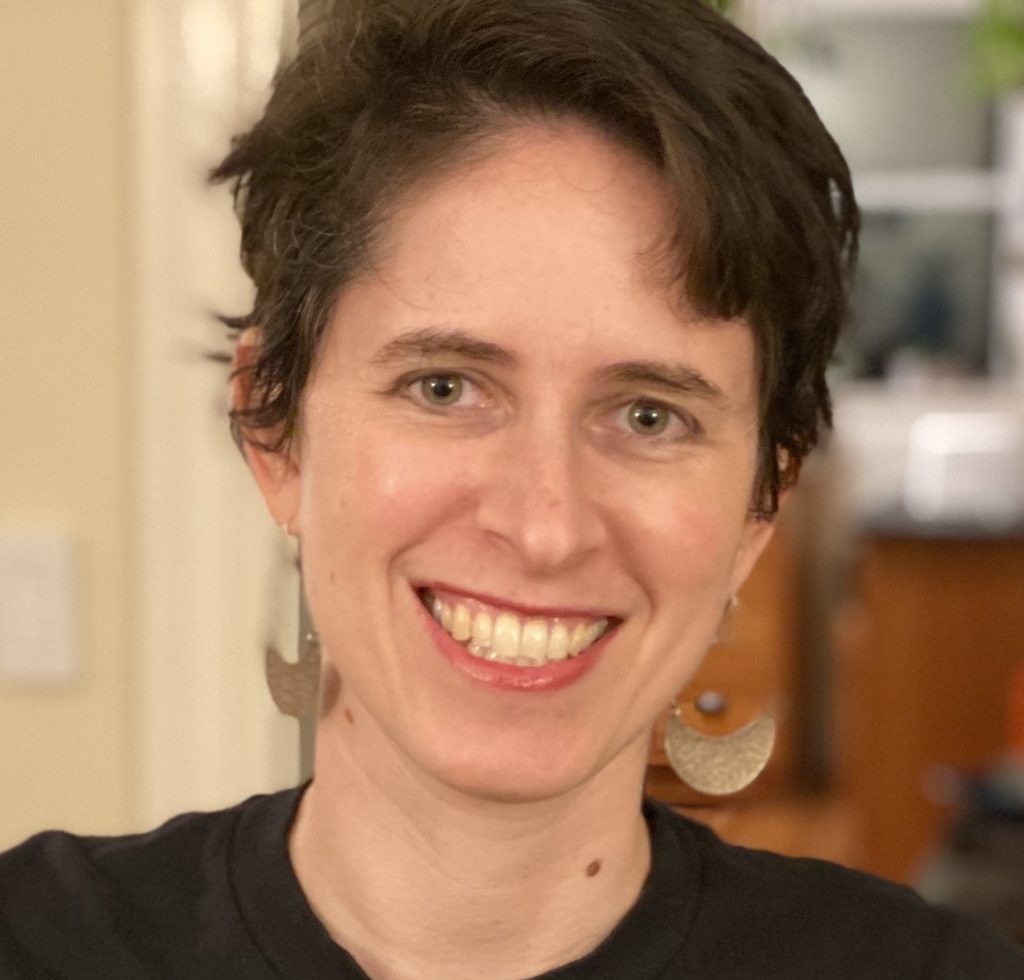
Thank you so much for taking the time to speak with us, Rabbi. Let’s get started.
Can you explain how your climate anxiety as a young girl led you down a path to writing The Tide Is Rising?
When I was a child, I felt overwhelmed by the global environmental crisis. I wanted to save the world, but the problems were so big, and I was so small. I felt sad, alone, and afraid to act.
Amidst all this anxiety, music was a powerful force in my life. I went to a progressive independent school called The Atrium, where we had assemblies each Friday. Sometimes, I would help lead folk songs with my musical family at the assemblies. I loved the transcendent connection I felt while singing in a big group or leading others in song. When we studied the Civil Rights Movement in my sixth-grade class, I learned that it had been a singing movement. I wanted to be a part of something that powerful and important.
Around that time, my mom took me to see Holly Near in concert at Sanders Hall in Cambridge, Massachusetts. Holly Near is a politically minded singer-songwriter, and her presence on stage inspired me. I remember coming home, looking at myself in the mirror before bed, and saying I wanted to write songs for social justice when I grew up.
That dream became reality when I was invited to sing at the National Cathedral in 2015 for an interfaith event on the climate crisis. I knew I needed to write the song I was going to sing – it didn’t exist yet. But I would say The Tide Is Rising was truly born, not written. After seeing a banner at a climate rally that said “The Seas Are Rising, So Are We,” I started humming what would become Tide. My husband, Yotam Schachter, and I co-wrote — or channeled! — the song in about 30 minutes that evening in our Jamaica Plain apartment.
What led to the decision to adapt your song into your picture book debut? And how did you approach that process of adaptation?
I have loved picture books since childhood. And I enjoyed writing many of them as a kid in school — painstakingly forming the letters of the words and drawing the pictures. In second grade, hilariously, I wrote and illustrated a 102-page picture book! I still have it. I have a large collection of my favorite picture books from my childhood and from my son’s younger years that I will read to myself in a cozy corner of my home when I’m stressed out.
Adapting The Tide Is Rising into a picture book felt easy and organic. First, it was the middle of the pandemic, and I was doing a lot of different creative projects — painting and calligraphy, writing essays, and convening a community of Jews who worked in different creative mediums to share our process together over Zoom during a time of great isolation and loneliness.
Meanwhile, Naomi Krueger, an editor at Beaming Books, had contacted me in early 2021 after reading a personal essay of mine about trees in the New York Times. She asked me if I’d like to adapt the essay into a picture book and pitch it to her. While the acquisitions team at Beaming didn’t accept that manuscript, it empowered me to turn Tide into a book.
The stanzas came very easily. I composed them in my head while walking or half asleep… when I do my best creative thinking! Then I typed them up and word-smithed them, which is my favorite stage of the writing process. I knew what I wanted to say: Each stanza needed to expand on the theme of a verse of the song. And, together, they needed to tell the sacred story of the climate movement as a hero’s journey we are on together. Once I had all the basics written, I worked with a wonderful editor on my own to get the manuscript in top notch before pitching it to Naomi.
I knew Beaming Books was my ideal publisher. I had loved talking with Naomi about the tree manuscript and knew I could pitch to her directly without an agent. It all worked out!
One of the main messages of The Tide Is Rising, So Are We! is that through adversity, it’s important to keep trying rather than remain passive in the climate crisis. Why do you think that this is a key mentality for climate movement activists, young and old?
There are two answers to this question, one practical and one spiritual/psychological.
Practically, we absolutely must keep fighting. While it’s too late to avert climate catastrophes, there is a scale of how bad things can get. Every degree of warming matters, and the climate movement has a big role to play in supporting the technological and political shifts needed to keep warming as low as possible.
Spiritually and psychologically, action during a crisis is vital to mental health and nervous system health. We know now that trauma is not defined by the nature of a specific hard event but by how that event lands in the body of the affected person. People who stay physically active during crises, essentially moving their fight/flight energy through their body, are less likely to suffer traumatic effects afterward.
Giving children and people of all ages ways to stay active in the face of the climate crisis is essential, especially for those of us who are staying up worrying or who are directly impacted by climate catastrophes.
Action, like singing, is medicine. It helps us stay grounded and connected and not succumb to despair — which is its own, separate public health risk on top of climate change. It also builds resilient communities. The climate movement stitches people together. At its best, it builds solidarity and the organizing power we need to help keep each other safe and well while living on the planet gets harder.
Your faith, as well as your intersectionality within it, are a huge part of your identity and activism. Could you speak a little on how Judaism relates to the importance of environmental conservation and climate justice?
I am hyper-empathic with nature and animals. That means I feel the pain and joy of nature and animals very, very strongly. This is part of being autistic for me.
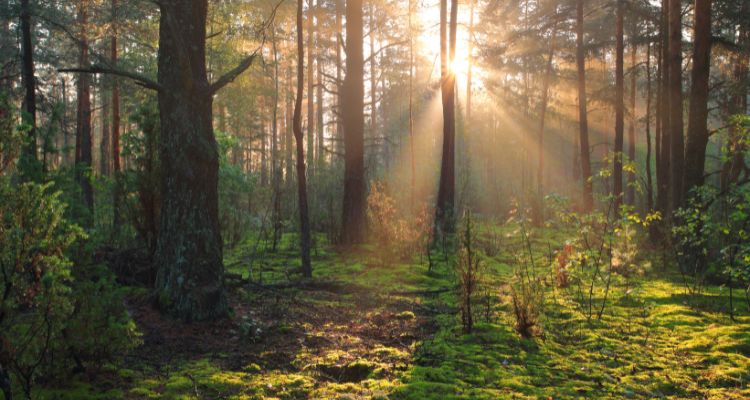
When I was young, I would spend a lot of time alone outside — in the fields, in the woods, in my suburban backyard, on the beach if we went on vacation. I would walk and talk to God/Nature/the living Earth. I felt a deep communion when I did this. I still do. I also felt a tremendous sense of obligation to stand up against the destruction of the world, which I felt in my bones as personal pain. I worried I would never be able to do enough, but I knew I had to try. This “have to” was not cerebral. It came from the deepest reaches of me — and it also came from my personal relationship with God.
This obligation to act is very Jewish. In Hebrew, it’s called being chayav. It refers to the obligation to do a mitzvah, a divine commandment, like keeping Shabbat or caring for the sick or vulnerable. A lot of American Jews don’t know the word chayav, but most of us know the sense of obligation. For many progressive Jews, a primary connection to our Jewishness is working for progressive social causes, like democracy, free speech, immigration rights, etc. It is an obligation for us, a response to our history and to our cultural values. For me, being chayav has always been tied to this deep pain I feel for the pain of ecosystems, landscapes, animals, plants.
Essentially, the Jewish sense of obligation and sacred calling combined with my autistic hyperempathy and led me here.
What are some of the best ways to help the movement and the environment that elementary-aged kids can achieve on their own?
If you go to my website, you can download a whole activist handbook that I wrote for readers!
The ideas in the activist handbook help children contribute to the climate movement as a movement instead of focusing on personal consumer actions. I think we do a massive disservice to children when we tell them to save water and recycle. It’s way too late for that message. It drove me nuts even back in the ’90s. Human beings need to feel like we are part of something meaningful, something that matches the scale of urgency. In this case, a global movement.
So, in the activist handbook, I talk about going to protests, doing fundraisers for climate NGOs, getting out the vote, even playing support roles during planned acts of nonviolent civil disobedience. Essentially, helping to build power and shift the systems that are causing the crisis.
I also talk about the social-emotional resilience we need. The very first suggestion in the handbook is to form a climate team with people you love hanging out with so you can do the rest of the suggestions together. For climate action to work for someone, it has to be fun and joyful and come from a place of connection and belonging.
As a debut picture book author, can you share the experience of watching your words brought to visual life through the artwork of illustrator Kiki Kita?
In a word, the experience was magical.
I was extremely blessed that Kiki illustrated this book. Kiki’s style is a perfect match for the manuscript — I can’t get over how detailed and vibrant the illustrations are, and how much life she gave each character. It’s also fun for me to appear as a character on a number of pages!
In addition to the magic of Kiki’s talent, I am so grateful that Naomi, the editor at Beaming Books, worked closely with me on editing the illustrations. We all agreed the illustrations needed to have iconic images from the climate movement. Since neither Naomi or Kiki had spent time inside the movement, for the book to land with its audience I needed to be able to guide and edit the content much more than I might have in another book. I got to give feedback along the whole way. This is very rare for picture book authors!
It was a truly collaborative and magical process.
We always love to ask children’s authors what their favorite books were when they were young readers themselves. Is there a book or series that you enjoyed as a child that stays with you to this day?
There are so many! For picture books, I’ll say Grandfather Twilight by Barbara Berger and Miss Rumphius by Barbara Cooney.

I also need to give a shout-out to the Young Adult series Anastasia Krupnik by Lois Lowry. I still re-read my copies over and over just to get to hang out with Anastasia and her wonderful family. One of the wildest things about being in my 40s now is that I am older than Anastasia’s mom is in the books!
Lastly, in honor of The Tide Is Rising, So Are We!, what is your favorite way to connect with the natural world?
In addition to walking in the Arnold Arboretum near my house, I give daily thanks to the trees whose bodies made my house and furniture, the plants and animals I eat, the water that I drink. The natural world is not separate from us… Our bodies are molecules of Earth.
An enormous thank you to Rabbi Shoshana for taking the time to speak with us about her work! Be sure to find her online at RabbiShoshana.com, or on Instagram and Facebook. Lastly, don’t forget to check out The Tide Is Rising, So Are We! and add it to your family’s TBR list!
For more picture books that young conservationists will love, check out our article on Books That Will Inspire Kids to Protect Our Remarkable Earth.
To see all of our recommendations for mini bookworms, check out our Bookshop bookshelf.