










The Centre for Literacy in Primary Education (CLPE) released its annual report “Reflecting Realities: Survey of Ethnic Representation within UK Children’s Literature,” on Friday, revealing some disappointing news about the current state of inclusive representation in the UK children’s publishing industry. The study, compiled by the nonprofit and funded by the Arts Council England, revealed a drastic drop in racially minoritized characters in fiction and nonfiction books for ages 3 to 11 that had been published in the UK in 2023.
Disappointing Losses in Inclusive Diversity
This decline was the first overall drop in representation in the seven-year history of the annual report. Farrah Serroukh, the Research and Development Director of the CPLE, attributes this dip in part to the industry’s complacency in the wake of the recent rise in inclusive representation.
“Whilst this is disappointing, we have always expressed cautious optimism regarding the increased output of recent years. […] Historical patterns would indicate that gains regarding inclusion are susceptible to being constrained by the cyclical nature of publishing trends. It is therefore not surprising that in the seventh year of this work, the itch has set in and the tremendous gains made to date are at risk of being compromised if efforts subside.”
Farrah Serroukh, Reflecting Realities 2024
The full report breaks down specific percentages of the dropoff in representation, including:
- A drop in the overall percentage of racial minoritized characters featured in children’s books, from 20% in 2022 to 17% in 2023.
- Racially minoritized main characters dropped from 14% in 2022 to 7% in 2023, meaning that children’s books with underrepresented protagonists dropped by half.
- A significant drop in the percentage of fiction titles to feature racially minoritized characters; over half, from 24% in 2022 to 11% in 2023.
The CPLE adds their reflections and recommendations to the end of the report, which includes the importance of collaboration, mentoring programs, and showcasing inclusive, diverse stories and creators within the UK publishing sphere.
[T]he principle of inclusion simply makes books better. Through every review process of the last seven years we have had the privilege of being treated to stories, characters, writing and worlds that have elevated the literary landscape, enriched the culture and transformed reading experiences. […] We encourage the industry to take the lessons learned and remain steadfast in their commitment to reflecting realities and serving their readership.
Farrah Serroukh, Reflecting Realities 2024
How Does US Children’s Publishing Compare?
The Cooperative Children’s Book Center (CCBC) of the School of Education at the University of Wisconsin-Madison has published a similar report since 1994 that reviews US children’s literature for inclusive diversity, and while the US numbers are slightly better, their 2023 report — released in April of 2024 — noted that there had been little change from the previous year. “We are glad things are not decreasing,” said CCBC Director Tessa Michaelson Schmidt in a statement from the CCBC. “However, it’s disappointing there hasn’t been more movement in an upward direction.”
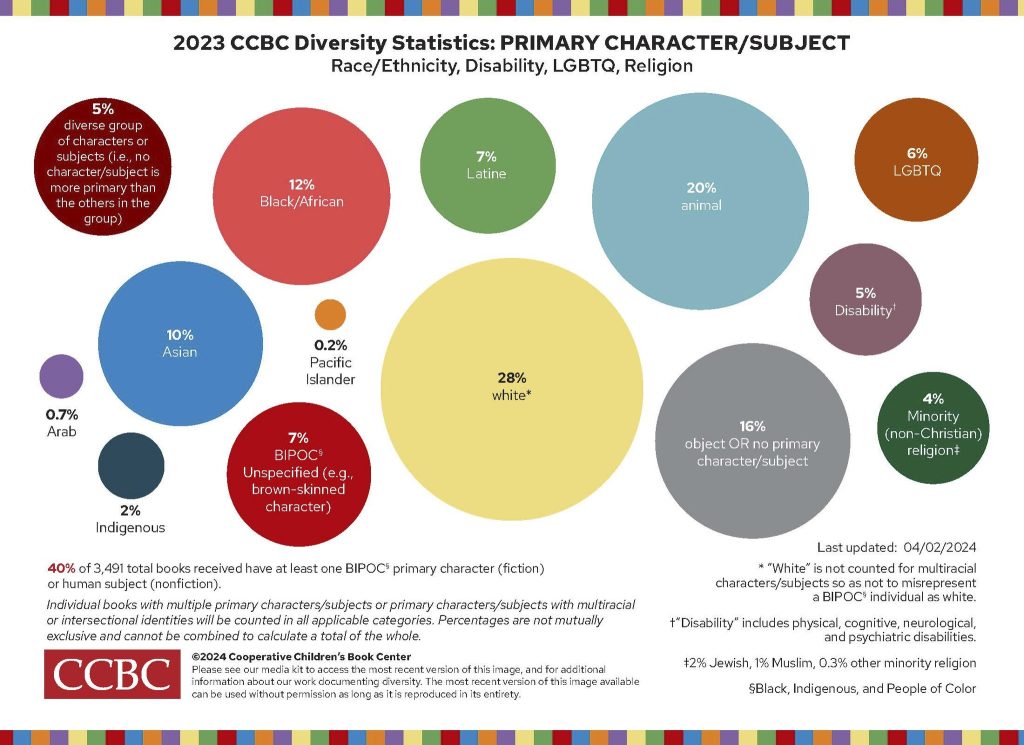
The CCBC found that 40% of children’s books published in the United States in 2023 featured at least one BIPOC main character, up from 39% in 2022. They even reported a slight increase in books that featured significant BIPOC content, meaning “a primary or significant secondary character or human subject who is BIPOC, or the setting or topic of the book relates to BIPOC people or history.” This statistic for 2022 was 46%, yet rose to 49% in 2023. Yet Schmidt, like Serroukh, cautioned that these gains should not signal that the work is done.
“[G]reater numbers inevitably mean more outstanding choices among the books published. Librarians, teachers, parents, and other adults who care for children have more high-quality books to choose from when selecting and recommending books for young readers and listeners that reflect and validate dimensions of their identities and their place in our global society.”
Tessa Michaelson Schmidt, CCBC Diversity Statistics Report 2024
Overall, it appears that both the UK and US children’s publishing industries have more work to do when it comes to inclusive representation, especially at a time when racially minoritized young readers are more in need of validation and affirmation than ever. Hopefully, these industries will heed the words of Serrouhk: “With every gain made a little more of a mark remains in the sand, but until the foundations are solidified, sustained change will always be challenging to achieve.”
To see some of our recommendations for children’s books that celebrate diversity, check out our article here.
To see our latest recommendations for young readers, check out our Bookshop bookshelf here.