




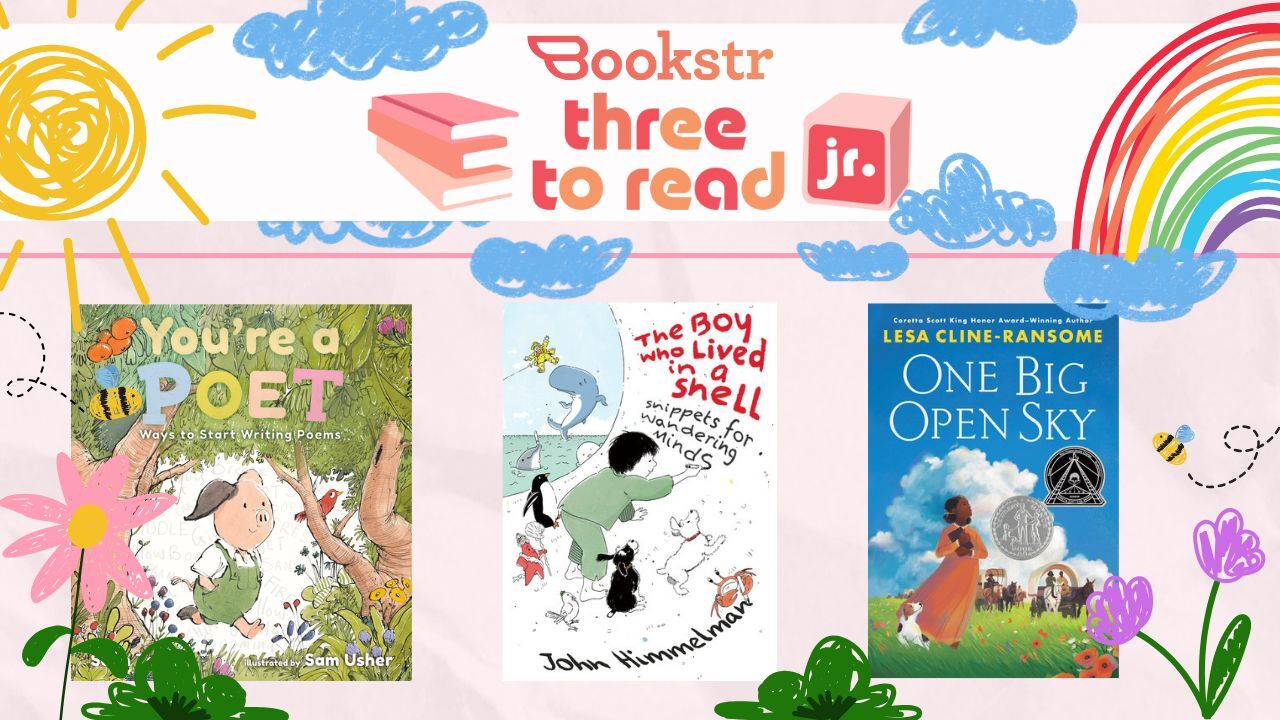
Welcome back to Bookstr’s Three to Read Jr.! In this series, we’re exploring three books for young readers — one for early readers, one for elementary readers, and one for middle-grade readers. This week, in honor of National Poetry Month, we’re looking at books that explore childhood themes through rhyme and, perhaps, encourage young readers to try their hands at poetry themselves.
EARLY READERS
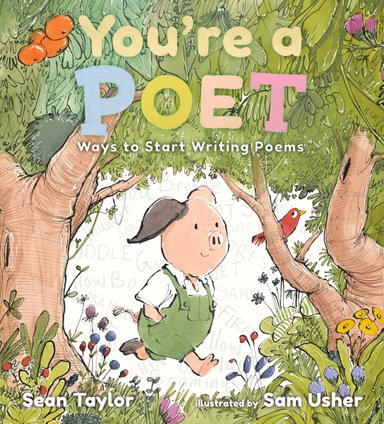
You’re a Poet: Ways to Start Writing Poems by Sean Taylor, Illustrated by Sam Usher
SYNOPSIS:
How does one “become” a poet? Does it take a lot of fancy schooling or an innate genius? Of course not — poetry comes from two places only: the mind and the heart. In five charming tales of young Piglet and several simple instructional pages in between, readers learn all about the simple art of constructing their first poems: taking notice of the world around them and converting it to words. As little ones follow Piglet’s adventures, they also learn how to create a “puddle poem” by drawing a word cloud, a “comparing poem” using metaphor and simile, and a personification poem, or “A Making-a-Person-Out-of-Something Poem.”
WHY:
When facing the challenge of a new art form, youngsters — and hey, some oldsters, too — can often feel intimidated by their freshman efforts. This is precisely why Taylor and Usher’s book is such a treat. By weaving the poetry instruction around wholesome and heartwarming tales of the adorable Piglet, children can learn how to write poetry through the character’s eyes instead of their own, taking some of that early pressure off. Combining this approach with the playful illustrations and helpful, easily reproducible instructions (educators are sure to love the puddle poem approach, for instance) allows children to finish the book feeling like Piglet: inspired and motivated to create their own art.
ELEMENTARY READERS
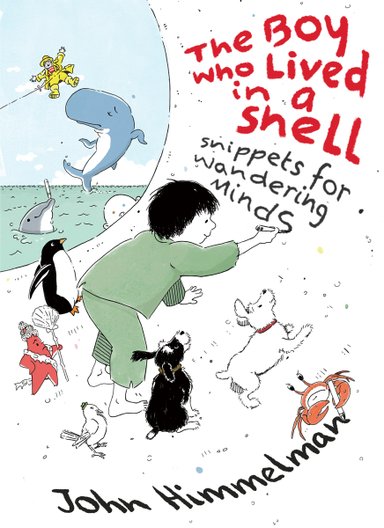
The Boy Who Lived in a Shell: Snippets for Wandering Minds by John Himmelman
SYNOPSIS:
Once upon a time, there was a boy named Ivo who lived in a floating shell. While lonely at first, Ivo began to love his home, especially as he filled the walls with “snippets” — poems — of imagination, humor, and heart. There were poems about happy times and sad ones, witty jokes and peaceful ponderings. With each snippet came a new story, a new joke, a new thought, until the day that Ivo was so filled with “millions and millions” of stories that he outgrew his shell and became something entirely new.
WHY:
Himmelman’s poems are short and sweet, yet fill each page with joy, poignancy, and the occasional opportunity for introspection. This is such a strange and unique little title that it makes it somewhat hard to describe without fully unpacking all of its surprises and moving moments. What we can say is that fans of Shel Silverstein and de Saint-Exupéry’s The Little Prince absolutely must give this one a read, as it simultaneously feels like the successor of both while also being something entirely unique unto itself.
MIDDLE-GRADE READERS
One Big Open Sky by Lesa Cline-Ransome
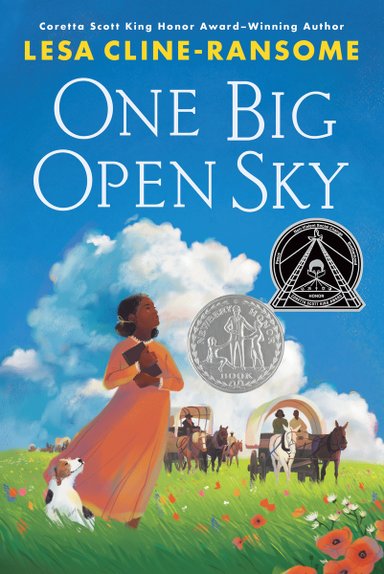
SYNOPSIS:
In the Mississippi of 1879, the Civil War was long over, but opportunities for Black Americans were still extremely limited. To escape this, young Lettie’s father informs his family that they will be joining a wagon trail to Nebraska, where he may seize the opportunity to become a landowner. Yet, when the Black members of the wagon train are left behind by Mississippi steamships that refuse to carry them, they must band together to find an alternate route, something that places additional strain and uncertainty on Lettie’s family. As Lettie, her mother, Sylvia, and their new friend Philomenia work to survive the journey west and find self-emancipation under poverty and patriarchal social structures, this stunning novel-in-verse explores timeless themes of personal freedom, autonomy, and the power of hope.
WHY:
This recent Newbery and Coretta Scott King honor book is a phenomenal example of why the novel-in-verse format works so well for middle-grade readers, especially when capturing historical times and perspectives. Through poetry, the narrative is stripped down to its most potent language and themes, allowing younger audiences to connect with the story without getting bogged down in historical details. Shifting between the intergenerational perspectives of Lettie, Sylvia, and Philomena, readers experience the visceral emotions, hardships, and indignities of life as a Black woman during the Westward Expansion (a historical viewpoint that in and of itself is largely underrepresented). Cline-Ransome pulls the reader in with her evocative poems, crafting a story that grips you until the final page and lingers in the heart thereafter.
That’s it for this week’s Three to Read, Jr! We hope you’ll join us in future installments to see more of our recommendations for young bookworms.
To read our other Three to Read articles, click here!
Browse these books and more reads handpicked by the Bookstr team on our Three to Read bookshelf on Bookshop!