















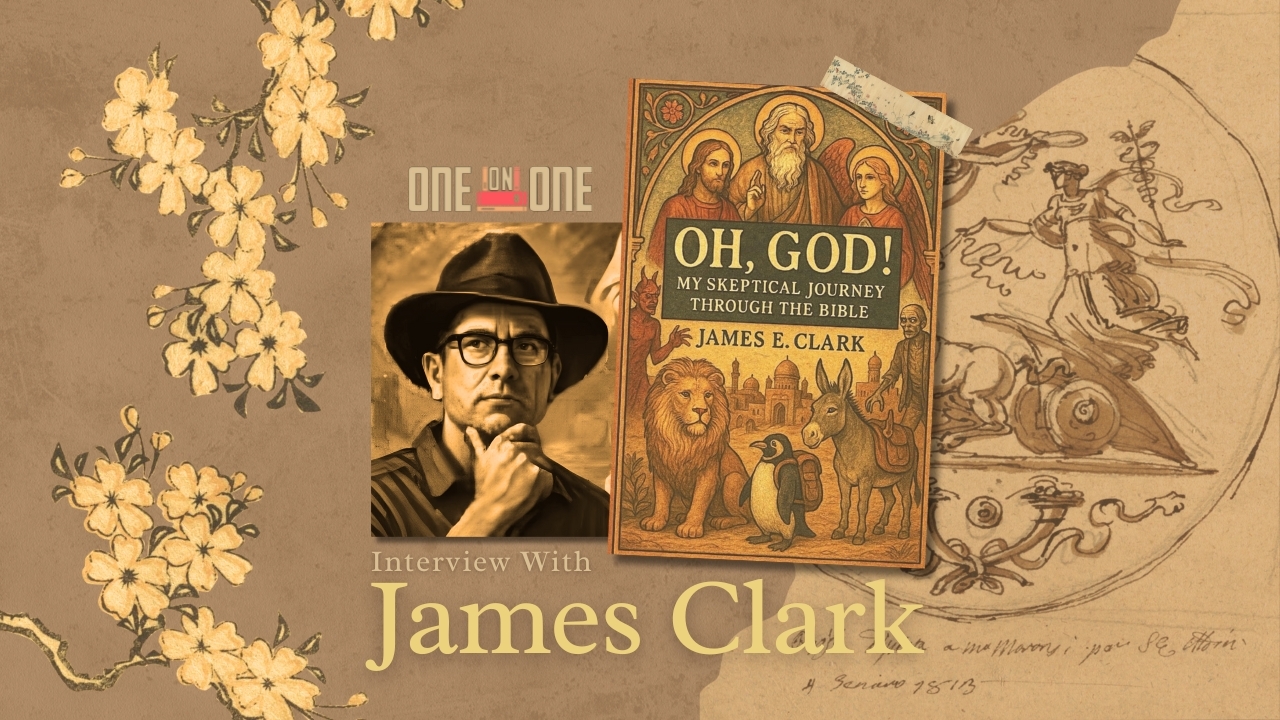
James Clark’s book, Oh, God! My Skeptical Journey Through the Bible is a massive undertaking — a complete, critical, and often humorous exploration of every single book in the biblical canon. From the creation myths of Genesis to the complex visions of Revelation, Clark applies a modern, skeptical lens to history, prophecy, and theology. Today, we sit down with the author to discuss the intense personal motivation behind this exhaustive journey, the intellectual challenges he faced, and what he learned by taking the ultimate deep dive into one of history’s most influential texts.
About James Clark
James E. Clark is a historian, military veteran, and retired financial executive whose work explores culture, belief, and the human condition with an analytical lens. He lives in Northern Virginia with his partner, Melanie, and their border collie, Nina. His debut, Oh, God! My Skeptical Journey Through the Bible, is an eye-opening contemplation on how ancient religious beliefs continue to influence contemporary power structures.
You can find him on his socials: Instagram, TikTok, and LinkedIn.
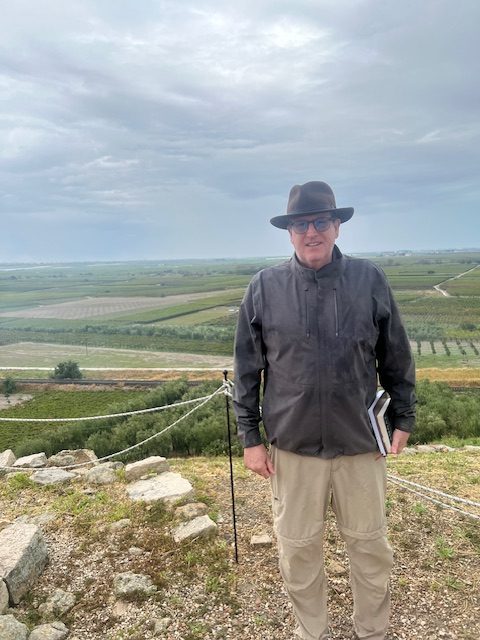
Thanks for joining us, James. Let’s get started.
The title, Oh, God!, is immediately provocative, suggesting both exasperation and perhaps reverence. What was the core, personal motivation — the “oh, God!” moment — that compelled you to embark on such a lengthy, critical, and public analysis of every single book of the Bible, rather than just focusing on the parts typically cited in debate?
Yeah, I meant that dual meaning, and it’s something I try to balance — a certain reverence for the book, while at the same time calling out its many oddities, internal discrepancies, and sometimes awful characters. But it struck me that it wasn’t fair to form an increasingly agnostic worldview when I never read the Bible cover to cover. So I did that. The book started as a Substack project where I read and reacted to the Bible each day. I found the act of having to write about it on a daily basis really motivated me to pay close attention to the material.
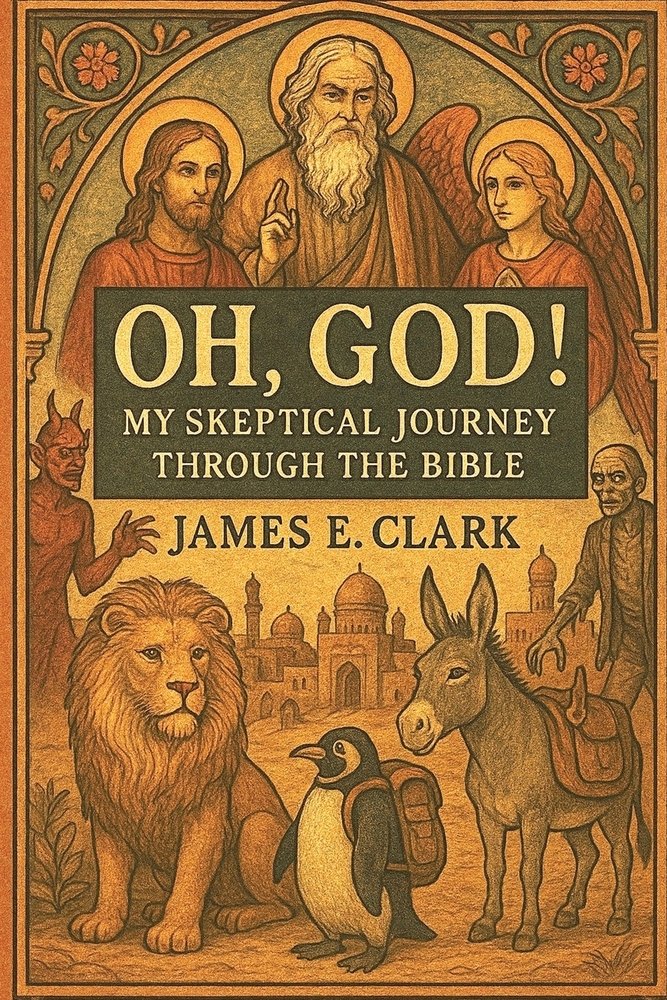
Honestly, I think EVERYONE should do the same thing — reading the Bible cover to cover—and if more people read the Bible carefully, critically, we’d have a lot more atheists. I think a lot of people start out wanting to read the Bible, but just give up when they hit some of the hard spots in the Old Testament — priestly laws, genealogies, and the fanciful stories of the judges and kings that included angels and talking donkeys. It’s easy to just give up and fast forward to a red-lettered New Testament and the comfort of familiar quotes from Jesus. But that’s a mistake. The New Testament authors constantly quote from the Old Testament, so you can’t really make sense of Jesus without understanding it.
Your approach is defined as a “skeptical journey.” For the reader who has read the Bible multiple times or is perhaps approaching it for the first time: how did you define and apply “skepticism” as your methodological lens? Did this approach evolve as you moved from the foundational books of the Old Testament to the epistles of the New Testament?
I intentionally read the book without a lot of preparation. I wanted to encounter the text as it is plainly written, rather than jumping to interpretive frameworks or baggage of what another critic or apologist has said. When I ran into material that I couldn’t make sense of, I tried to find answers, but I wanted to do my best without looking at textbooks. We should be able to experience the Bible without Professor Bart Ehrman sitting on our shoulder, right? One thing that leapt out at me was how varied the Bible is.
The word “Bible” in Greek means “books.” — it’s literally a collection of books like you’d see in a library, not a single book. The first five books (the Pentateuch) are dramatically different than the books covering the judges and kings, and the Prophetic books are often a wild ride. Then in the New Testament, the Gospels are often the focus, but there’s a lot of very interesting material in the letters from Paul and others. You can practically see the Church working out its dogma and meaning. Is good work the ticket to salvation (James) or is faith (Paul)? Must Moses’ laws be kept forever (Jesus) or were they a temporary measure no longer needed after the Resurrection (Paul)?
A skeptical reading of the Bible doesn’t require you to disbelieve God, only to read a text with the same historical lens you’d apply to practically any other ancient text. But if you read the Bible with that lens, you’ll see things that are both illuminating and troubling.
In going through the full canon — every narrative, law, prophecy, and genealogy — what was the single most surprising discovery or realization you encountered? Conversely, what was the most difficult passage or concept to critically unpack, and how did you finally settle on your articulated opinion for the reader?
Where to start? I think one of the most troubling passages is where Moses’ forces defeated the Midianites and paraded the survivors before him. Instead of being satisfied by the spectacle, Moses is white hot with anger. He’d ordered annihilation, yet he’d been given prisoners. He immediately orders the non-virgin women and young boys to be murdered. He gives the virgin girls to the soldiers with the clear understanding that they will be raped and made war brides. Moses could have said, Have mercy on them, treat them as your adopted daughters,” but he didn’t. It’s horrific, and it’s a war crime.
I was also struck by the extent to which, in the New Testament, the Gospel writers bend their accounts into pretzels to have Jesus fulfill prophecy in the Old Testament. Yet, almost always (in truth, always), the prophecy supposedly fulfilled by Jesus is either not truly a prophecy in the Old Testament or relies on a bad translation from Hebrew. One example: In Matthew, the author says Jesus was born in Nazareth to fulfill prophecy, yet there is no such prophecy. Some scholars think Matthew may have been stretching for a word like netzer — “branch” — used in Isaiah to refer to a future ruler from David’s line. It’s plausible as wordplay, but there’s still no verse that mentions Nazareth, and certainly none that says the Messiah would come from there. It feels like a retrofit, not a fulfillment.
@eze2320 Jesus riding two donkeys at same time. Promo for new book, Oh God, My Skeptical Journey Through the Bible
I’ll give you a different kind of example. Christians often cite the Bible when they condemn divorce. Fair enough — there are multiple passages that compare divorce to adultery (which would carry the death sentence). However, abortion is also an animating issue for many Christians, yet Jesus doesn’t say anything about it. And the only place it’s really mentioned in Scripture is in the Book of Numbers, where a priest can cause a cheating woman to miscarry. So here’s a case where Christians (many of them, anyway) aren’t that exercised about divorce, which is a grave sin according to Jesus, yet are incredibly concerned about abortion, which was not a concern of his at all.
Your work is aimed at skeptics, believers, and the religiously curious. What do you hope the average reader — perhaps someone who has only ever known Bible stories through Sunday school or cultural osmosis — will gain or have challenged by following your specific, book-by-book commentary?
Honestly, I hope they’ll get the motivation to read the book for themselves. But maybe when they do so, they’ll benefit from reading my overview of the text and be primed to spot important historical and theological matters as they negotiate the material. I would encourage people to try to make sense of the material without too many preconceived notions. Figure it out yourself. Don’t ask your pastor or priest — you will likely get an answer designed to keep you in the faith rather than an honest answer to a question. I’d like to say one more thing about this. I think secular readers should read the Bible, but I find it somewhat sad when I hear Bible believers repeat Bible passages, often from memory, while having no real understanding of what’s happening in the text. I wish they’d read more non-Bible material so they can better engage with the modern world.
The authority of a skeptical critique often lies in the critic’s background. Could you share a bit about your personal or professional background — be it theological study, historical research, or a background entirely outside of religious academia — that equipped you to take on this comprehensive analysis?
My professional background was in financial services, a career that was preceded by a stint in the Army. I’ve lived in the US, Haiti, Germany, and the UK, a background that’s caused me to be comfortable with multiple cultures. I think this has helped me swap out a career in corporate America with an independent, if fledgling, business as an author. But I have always been interested in history. I got a master’s degree in business early in my career, but went back to school later to get another graduate degree in history. My focus was on the Middle East’s recent and ancient wars, particularly Alexander the Great’s conquests, which are of course featured in the Book of Daniel and elsewhere in the Bible. I’m not a Bible scholar, but I think my varied background has equipped me to evaluate the text with a different perspective than a pure academic or devoted believer.
Given the nature of this project, you undoubtedly touch upon topics that are emotionally and culturally sensitive for many people. How did you balance the need to express your honest, skeptical opinions with the responsibility of engaging respectfully with such revered source material?
I get that. Scripture provides a source of deep meaning for many. Its calls to love the stranger, care for the poor, and to forgive one’s enemies still resonate. At its best, it provides a poetic vision of justice and mercy. But you also can’t ignore the Bible’s incoherence, violence, and internal discrepancies. The danger is that we take it for something it’s not: an infallible guide for how to live your life. And we can’t ignore our political context. People who identify as Christian are now represented by politicians in the White House, Congress, and Supreme Court who are gleefully wrecking our democratic norms, stripping rights, and quite literally defunding programs that feed the hungry and clothe the poor. I maintain that if more people read, really read, the Bible, there would be more atheists, and the nation would be better off. Look at nations like the Netherlands and Norway, or states like Massachusetts — more secular entities outperform more religious ones in practically every measurement of economic performance and quality of life.
@eze2320 We are all in this together. Starting with a quote from Hitchens, and closing from the new book, Oh God, My Skeptical Journey Through the Bible
Sometimes I take shots, like when I review the story of how an elderly King David takes a virgin to keep him warm at night, but according to the Bible, “knew her not,” meaning he didn’t have sex with her. I comment that he surely gave it a go anyway. But I also think by calling out these types of stories, I’m treating the text with greater fidelity than a lot of Christians who are desperate to excuse some of its thorny problems. I’m not saying Christians or Christianity have not done some good works. I’ve toured many majestic European cathedrals, and it’s hard not to have a sense of awe. But religion was also responsible for a lot of harm — the Inquisition, the Crusades, a centuries-long attack on science. But as Thomas Jefferson said, if you don’t pick my pocket or break my leg, believe what you like, who cares? I’m more concerned about religious coercion from our government than a moral person who happens to believe in dogma that helps them make sense of the world.
Taking a multi-year deep dive into the foundational text of Western civilization must have been a transformative experience. After writing the final chapter, how did your personal view of the Bible, religion, or your own skepticism change, if at all? Did the journey affirm or complicate your original premise?
It was faster than that. I went from Bible illiteracy to having written the book in about 8 months, but I worked hard — 10 hours a day with no Sabbath days off. I am glad I undertook the project, and it’s made me alert to the sometimes direct and sometimes coded references to the Bible that are used in modern America. From someone saying “the writing is on the wall” (a reference to the Book of Daniel) to when a politician says if you won’t work, your SNAP benefits should be terminated (channeling 2 Thessalonians, a letter attributed to Paul but probably not actually written by him), we still constantly reference the Bible. There are some amazing things in the Bible — I find Paul’s ode to love in 1 Corinthians transcendent, for example. But the overall effect is that it’s clear the book is a manmade collection of texts that are full of duplication, errors, discrepancies, and, particularly in the Old Testament, moments of horror. In a lot of ways, I’m less impressed with the book than I thought I might be, but I also walked away with a greater sense of its impact on the modern world and why everyone, not just believers, needs to be more familiar with it.
Now that Oh, God! is available, can you give readers a glimpse into what’s next for you? Are you applying your skeptical lens to other texts, historical figures, or cultural phenomena? What are you currently working on for your next publication?
I’m working on a book that looks at the lost books of the Bible. Some weren’t technically lost — the Apocrypha, for example, which are still included in Catholic and Orthodox Bibles but were excluded by most Protestant denominations. Others never made it into anyone’s Bible, like the Apocalypse of Peter, a wildly popular early Christian text that shaped medieval ideas of Hell but eventually fell out of favor.
Some writings truly were lost for centuries. The Gospel of Judas, for example, only surfaced in the late 20th century when a Coptic copy was discovered in Egypt. Pretty wild, huh?
There’s also an expanded version of Daniel in Catholic and Orthodox Bibles that includes stories Protestants usually never hear — like Bel and the Dragon, where Daniel survives another lion’s den and also slays a literal dragon. You can almost imagine medieval editors thinking, “Look, dragons are awesome, but maybe this is pushing it,” and quietly cutting it out.
Then there’s the Gospel of Thomas, a collection of Jesus’ sayings that many scholars believe may contain traditions as old — or older — than the canonical gospels. And if you’ve heard that Peter was crucified upside down, you didn’t get that from the New Testament; that comes from the Acts of Peter, a non-canonical text that also includes talking animals and even a nursing infant who delivers a theological monologue. How do you accept Peter’s upside-down crucifixion as a historical fact but dismiss the talking dog as fiction? You can’t just cherry-pick the parts you like.
What fascinates me is that many of these “lost” works are stranger, bolder, and sometimes more theologically provocative than the books that made it into the Bible. They show just how diverse, messy, and contested early Christian beliefs really were. They say history is written by the victors, and maybe that’s true here: the canon is what survived. But the losers deserve to be heard too — and they have some truly incredible stories to tell.
James Clark’s journey through the entirety of the biblical canon, as chronicled in his book, Oh, God! My Skeptical Journey Through the Bible, is more than just a critical analysis; it’s a profound challenge to readers across the belief spectrum. From his candid revelations about the Old Testament’s instances of horror to his historical dissection of alleged New Testament prophecies, Clark consistently applies the rigorous, skeptical lens of a historian, encouraging everyone to drop their preconceived notions and engage with the text as written. His work affirms the Bible’s immense cultural impact while also concluding that the text is, unequivocally, a man-made collection riddled with human error, duplication, and conflicting accounts. Clark hopes his exhaustive project will inspire readers — both the devout and the secular — to undertake their own careful, cover-to-cover reading, armed with a critical eye, rather than simply accepting handed-down interpretations.
As he now turns his insightful focus to the even stranger, more diverse “lost books” of the Bible, he reminds us that the foundational texts of Western civilization are far messier and more contested than most people realize. We extend our sincerest thanks to James Clark for sharing the intensely motivated, challenging, and illuminating story behind his massive undertaking.
Want more author interviews? Check out our Author’s Corner.
You can pick up Oh, God and similar books on our Bookshop here.