












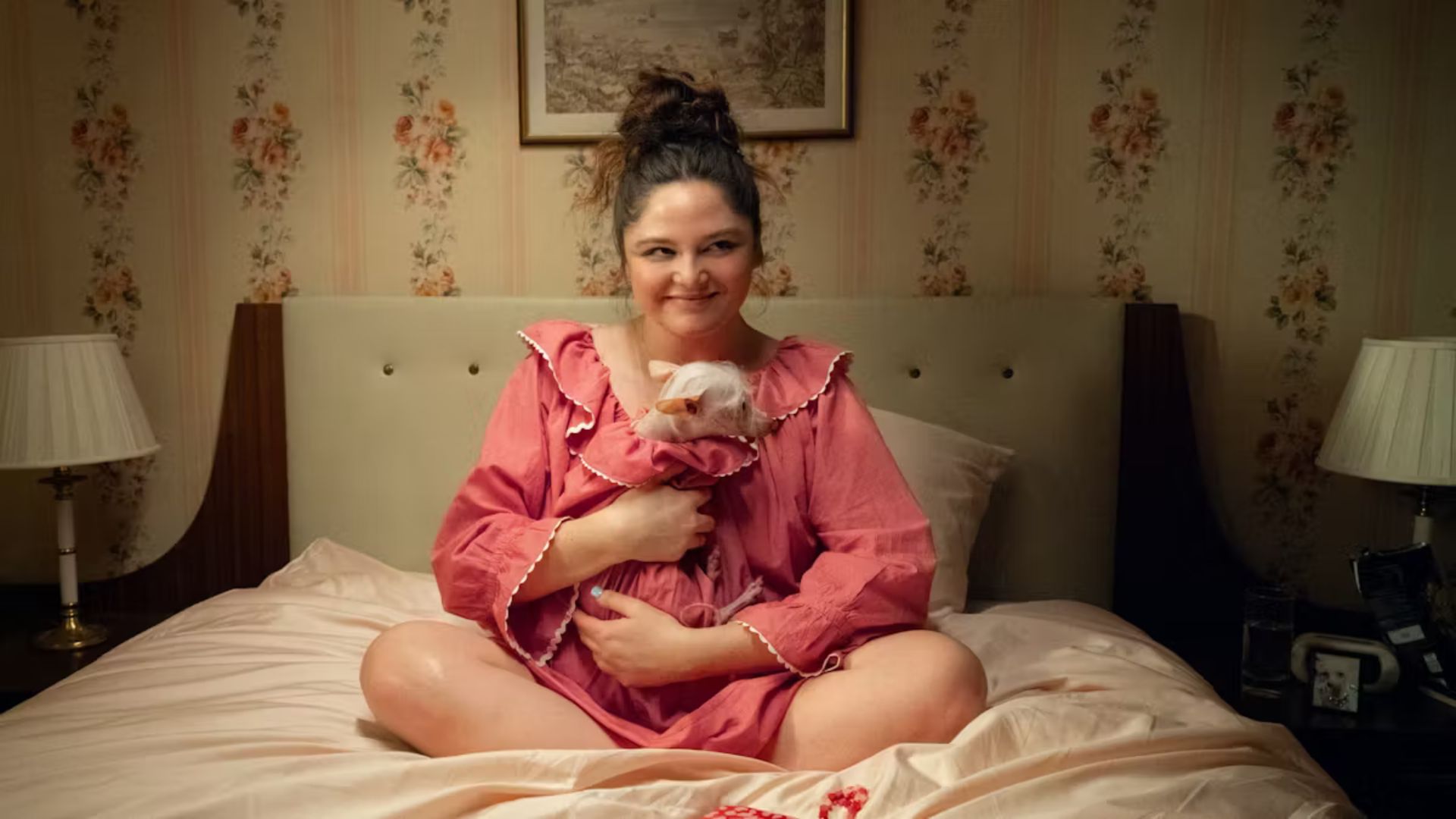
Following the decade-long success of her HBO series Girls, Lena Dunham makes her highly anticipated return to television with Netflix’s romantic comedy series Too Much. Dunham’s new project, co-created with her husband and musician Luis Farber, is semi-autobiographical.
Too Much’s protagonist, Jessica, escapes from New York City to London for work mere months after a breakup with her partner and swiftly falls in love with a British musician (a plot that mirrors Dunham’s exact journey to finding her husband). Witty and bubbling with life, Too Much is a great romantic comedy and fleetingly features great writing. However, knowing the depth Dunham is capable of, Too Much was also not enough.
Content Warning: This article contains spoilers for the first season of Too Much.
Heartbroken, In Hell
Emotionally destroyed and drained from her recent breakup with her partner Zev of nearly eight years, Jessica (Megan Stalter) finds her life at a standstill. She’s moved in with her mother (who is also housing Jessica’s sister following her recent divorce, her nephew, and her grandmother), she religiously stalks Zev’s (Michael Zegan) new knitting influencer girlfriend Wendy Jones (Emily Ratajkowski), and has plateaued in her career as a producer/ aspiring director.
As the first few minutes of episode one start with Megan breaking into Zev and Wendy’s place in the middle of the night and demanding “You, Zev Jeremiah Goldstein, need to sit down and write on a piece of paper that leaving me is the worst thing anyone’s ever done. You write that out, f**cker! You write that out in blood, bastard!”, you know at the very least whoever this main character is, she’s going to be great to watch.
When she isn’t breaking into her ex’s home, Jessica channels her grief through her private Instagram, where she makes videos addressed to real-life Austenologist Wendy Jones. These monologues make up the voiceover to the show, and the frequent references to the private nature of the videos on a very public platform are a clear Chekhov’s gun which duly goes off towards the end of the series.
When Jessica is urged to take an opportunity in London for three months by her boss/ex-brother-in-law (played by the ever-entertaining Andrew Rannells, back working with Dunham again), Jessica quickly agrees. Eager to fulfill the romantic expectations of life across the pond, spoon-fed to her from Wuthering Heights and Jane Eyre (already revealing that this girl enjoys a healthy dose of darkness with her swooning), Jessica arrives in London with rose-colored glasses. Yet, unlike the bleak realism of Girls, Jessica’s idealism is rewarded.
In Love In London
The night she arrives, she heads to the pub where she sees indie-musician Felix (Will Sharpe) perform. Later in the bathroom, they run into each other, sharing a blunt conversation about the state of the first stall and the effectiveness of soap without water. As Jessica tries to figure out her Uber outside, Felix approaches her as he smokes a cigarette.
He helps her realize she’s ignorantly called it to Heathrow (a few of these cheesy, lazy, cultural jokes make their way into the script — Uber works the same everywhere). Felix and Jessica share an instant chemistry built on their differing routes to authenticity, and it is undeniably sweet to watch. At times too quirky, but often rooted in the deeply humanist approach Dunham built her success on.
Jessica struggles between the ghosts of her past relationship (be that Zev’s social media presence, his unrelenting hold over her self-conception, or the regret that haunts those who exit nearly-decades-long partnerships) and her airy, intimidatingly real relationship with Felix. The fifth episode, Pink Valentine, finally gives us an answer for what the grip this seemingly underwhelming ex has on her: he’s a gaslighting, withholding asshole. After taking too much ketamine at a gathering of Felix’s friends, we travel back into Jessica and Zev’s relationship and see the reality of how so many emotionally abusive relationships begin: love bombing, seemingly impossible romance, and slow unravelling.
Though they start small, we see Zev’s cutting comments increase in grandeur and brazenness. First, it’s throwing out her stuff without asking because it’s not a fit for them as a couple, then it’s about her clothes and not highlighting her beauty enough, and from there it spirals into blatant cruelty and cheating. Dunham’s writing shines brightest in the intricacies of this episode, but also the intention behind her plot structure:
“It’s like her Rosebud, finally seeing what happened between Jessica and Zev. It was really important to see her in all of her dysfunction first. There might be people who are like, ‘Girl, why are you acting like that?’ And then once you see in Episode 5 how uncertainly she’s moving through the world, you can have a different appreciation. When she has her ketamine incident, it helps her realize that she does love Felix, and she has something she needs to leave behind.”
— Lena Dunham, USA Today
Too Much is Too Little
Though Pink Valentine and Terms of Resentment (episode seven), where Felix delves into his traumatic childhood and broken family, have raw and unwavering moments of introspection; if you came for the bleak and uncomfortably real vibe of Girls, you may find yourself disappointed. The dysfunction is there, and some of the humor is too, but Dunham’s Too Much has a lot of hope as well. Maybe too much.
In order to give her protagonists a happy ending, the finale was incredibly rushed and, honestly, wasn’t the best relationship example after Jessica’s brutal exit from her last toxic partnership. I wanted Jessica and Felix together, but there wasn’t a lot of working out of fundamental issues, more of a romantic skip over them. Maybe if Sharp were able to match the emotional intensity Stalter brings to the screen fully, the ending wouldn’t be as much of an issue.
Stalter’s performance is formidable; every moment she’s on screen, her energy is unmatched. But that’s also kind of the problem. Her lively presence often dulls out others in the scene or, worse, makes them look like they’re trying too hard, like Boss (Leo Reich), Jessica’s colleague, whose energetic role borders on exhausting.
One of the greatest letdowns of the show is the underbaked side characters. Though they’re all almost unbearingly singular, no one besides Jessica and Felix is ever explored beyond the surface level. The most frustrating instance of this is the evil ex himself, Zev, who is practically begging to be emotionally unpacked. However, there’s no surprise that one of the only stars capable of keeping up Dunham’s signature raw, crass, and honest humor is Dunham herself as Nora, Jessica’s older sister, but her presence in the show is far too fleeting.
Too Much was highly watchable, but, ironically, knowing what she’s capable of, it was far too little from Lena Dunham. Moments of Dunham’s gift for empathy were rich but short-lived, the cultural references — both Gen-Z and UK versus America — were tired, and though Felix and Jessica were an intoxicating pair, their ending felt more fairy-tale than real. The most important takeaway was the revelation that is Megan Stalter. As the reinvented heroine of the rom-com, while Jessica is loosely inspired by Dunham, Stalter made this role her own.
Sick of rom-coms? Check out our review of the mystery show of the summer, We Were Liars, here.
Looking for more stories like Too Much? Browse our Love is in the Air: Contemporary Romance bookshelf.