


















With the recent passing of Pope Francis, the time has arrived for the Catholic Church to elect a new pope. And if the memes are to be believed, this conclave — which starts May 7 — may be the most closely watched yet. That’s largely thanks to the Oscar-winning film Conclave, which enthralled Catholics and non-believers alike with its riveting inside look at a fictional version of the papal election process. Variety reported that the film’s viewership shot up a staggering 283% following the pope’s death on April 21.
Not up to speed on conclave lore? Don’t sweat! We’ve got all the details on this storied — and secretive — process, as well as the book and film it inspired.
Content warning: this article contains spoilers for the film and book Conclave.
Key Players
Though the pope is the head of the Catholic Church, the ones responsible for his election are the stars of this show. Cardinals are high-ranking church officials who serve as advisors to the pope, each representing a particular region of the Catholic diaspora. Together, they make up the College of Cardinals, who are the only ones allowed to participate in the conclave. The Dean of the College of Cardinals is responsible for overseeing the conclave, but otherwise has no authority over his fellow cardinals.

How the Conclave Works
The papal conclave dates back 800 years and has undergone several major procedural changes throughout. Today, to prevent outside interference, all participating cardinals and Vatican staff are required to take an oath of secrecy. They are isolated from the outside world and confined to the Vatican for the duration of the proceedings. The word “conclave” derives from a 1274 decree that papal elections take place “cum clave” — Latin for “with a key.”
The conclave takes place no sooner than 15 days after the pope’s death. During that time, cardinals may engage in preliminary discussions among themselves regarding potential candidates. Once the conclave officially starts, cardinals gather in the Sistine Chapel (where the conclave has been held since 1868) to cast their votes. In order to be elected pope, a candidate must receive a two-thirds majority of the votes. While any baptized, unmarried man can hold the position, the pope is generally selected from among the College of Cardinals. Only cardinals below the age of 80 can vote in the conclave, but older cardinals may participate in pre-conclave conversations.
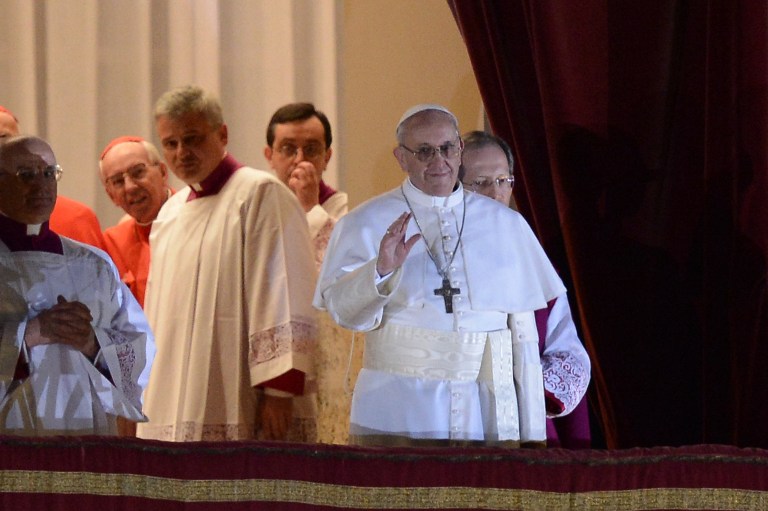
Once votes are cast, they are recorded, tallied, and then burned. At the end of each voting round, smoke is released from a chimney to relay the results to the crowd. When no candidate has been chosen, the smoke is black. When the cardinals do decide on a candidate, the smoke is white. Upon accepting his role, the new pope picks a papal name — often the name of a pope or saint he wishes to emulate. He is then announced to the crowd waiting in St. Peter’s Square before going out onto the balcony of St. Peter’s Basilica to bless them.
Conclave: The Book

The pop culture phenomenon that is Conclave began as a 2016 novel by British author Robert Harris. Conclave follows the Italian cardinal Jacopo Lomeli, Dean of the College of Cardinals. When the pope dies suddenly, Lomeli becomes entangled in a power struggle between the liberal and conservative factions of the Church.
Several contenders emerge, each vying for support. Italy’s Aldo Bellini becomes the figurehead for the liberals but has difficulty swaying enough people to his cause. His major opponent is reactionary Goffredo Tedesco, whose traditionalism and xenophobia threaten to undo the Church’s progressive trajectory. Nigeria’s Joshua Adeyemi curries a large amount of favor only for an unsavory past to prove his downfall. Meanwhile, Canada’s Joseph Tremblay, a rising favorite, seems to hold secrets of his own.
Determined to find the best possible candidate, Lomeli wades into the dirty muck of his colleagues’ private lives. Further complicating matters is the arrival of the mysterious Vincent Benitez, the former Archbishop of Baghdad. Benitez, a Filipino, was made cardinal by the pope in pectore, or in secret. As tensions rise and alliances are tested within the Vatican’s walls, additional threats lurk in the city beyond.
Conclave: The Film
Harris’s gripping Vatican drama came to theaters in Fall 2024, with a few notable changes. The most major of these was Conclave’s protagonist, reimagined as the British Cardinal Thomas Lawrence (Ralph Fiennes). Cardinals Bellini and Benitez became American and Mexican, respectively, to match the nationalities of their actors (Stanley Tucci and Carlos Diehz). Otherwise, the book’s major plot points remained largely intact.
The film earned a multitude of award nominations, winning a BAFTA for Best Film and an Oscar for Best Adapted Screenplay. It also garnered a surprising fandom online, with some likening the gossip and scandal among the cardinals to an episode of RuPaul’s Drag Race. Many have praised it for offering a fresh perspective on a rather conservative institution that has struggled to adapt to the changing times. Nuns are present throughout the film, highlighting women’s underacknowledged role in helping the Church function even as they remain barred from leadership positions. It also features an intersex character in a major role, providing mainstream representation to a largely underrepresented community and making a bold stance for inclusion in a historically exclusionary Church.
“I just think that having this queer identity visibly represented on screen [is important]. [That character] says, ‘I am what God made me’ — I think that’s a really profound message for anyone who is queer or marginalized to have in that film.”
— Pope Crave (@ClubConcrave), Conclave fan account, Them
What’s Next for the Vatican?
Despite what various media articles (and betting sites) would have you believe, there’s no clear contender for the next pope. Francis himself shocked many when he was chosen to succeed the late Pope Benedict XVI following his resignation in 2013.
Though some Catholic viewers have lamented the film’s focus on partisan politics, many wonder whether the upcoming conclave will reflect those tensions. Francis held relatively progressive views compared to his predecessors, putting him at odds with conservatives and leading some to brand him a “radical.” Some believe this could encourage the election of a more “traditionalist” successor. Others caution against viewing the conclave through a modern political lens:
“There’s no way to plot conclave politics on less than twenty different axes, several of which operate on non-physical planes and three of which are about being Italian.”
— Madoc Cairns, editor of Plough Quarterly, The Times
Whatever the case may be, we won’t know what goes on behind the closed doors of the Sistine Chapel. All we can do is wait for the white smoke to rise in the sky, and for the new pope to emerge onto the balcony of St. Peter’s.
Click here for the latest in pop culture news.
Stop by our Bookshop to find your next great read.
