

















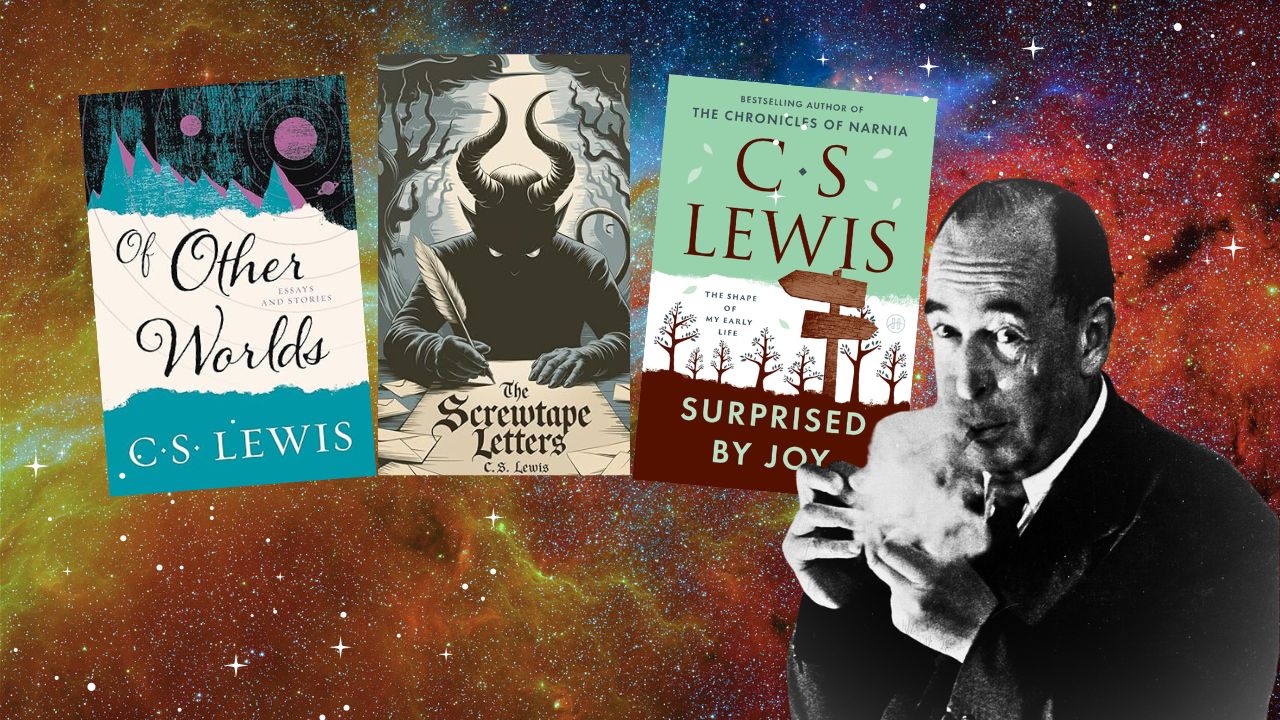
It’s been over 60 years since C. S. Lewis died (November 22, 1963 was a dark day; it saw the deaths of C. S. Lewis, Aldous Huxley, and John F. Kennedy). The Irish-born writer was a famous lover of big words, a mythology enthusiast, and a Christian convert. Although he was best known for his allegorical children’s series, The Chronicles of Narnia, Lewis also wrote satire, essays, and memoirs, all of which are distinctly colored by the philosophical dialogue that defined his inner life. Here are five of his most resonant masterpieces worth exploring, whatever your religious beliefs.
Meditation in a Toolshed
“You get one experience of a thing when you look along it and another when you look at it. Which is the ‘true’ or ‘valid’ experience? Which tells you most about the thing?”
C. S. Lewis, Meditation in a Toolshed
Have you ever stood in a dusty room and watched the dust particles dance in a single stream of sunlight? And then moved so that you were in its spotlight, and realized that the room looked entirely different when you were seeing things by its light? So has C. S. Lewis. And this moment reframed not only his perspective on the toolshed he was standing in, but his perspective on perspectives altogether.

In his essay, Meditation in a Toolshed, from the collection God in the Dock, Lewis’ moment in a sunlit shed gives rise to an epiphany. Just like the difference between the all-consuming experience of looking along a beam of sunlight and, more prosaically, looking at it, there are two ways of looking at personal experiences. Lewis gives the example of a man in love with a woman. Looking along this from the inside, the man would say he’s obsessed with her voice, a conversation with her makes his day — he’s “in love.” Looking at it from the outside, though, a physiologist could explain this purely by biological chemical reactions.
But which of these two perspectives, Lewis asks, is “true?” Only looking at things without experiencing them from the inside creates a web of infinite regress. Sure, a physiologist could explain someone’s thought processes through the neurological activity in their brain. “But then what about the cerebral physiologist’s own thought at that very moment? A second physiologist, looking at it, could pronounce it also to be only tiny physical movements in the first physiologist’s skull. Where is the rot to end?” And so it continues — unless we acknowledge the equal truth of a person’s rounded, personal, inside perspective. As Lewis concludes, “one must look both along and at everything.”
Mere Christianity
“You must make your choice. Either this man was, and is, the Son of God, or else a madman or something worse.”
C. S. Lewis, Mere Christianity
Mere Christianity is a book whose philosophy has circulated beyond its readership. In fact, Lewis’ biographer, A. N. Wilson, labeled it “a sort of Summa Theologica of the Protestant world.” Taken from a series of BBC radio talks Lewis made during the Second World War, Mere Christianity discusses his faith and his arguments for God’s existence — but one theory in particular has since provided unending fodder for theological debate.
C. S. Lewis’ “trilemma” puts forth his three-pointed hypothetical argument against the claim that Jesus was just a good teacher and nothing more. “He has not left that open to us. He did not intend to,” Lewis writes; after all, throughout the Gospels, Jesus openly accepted his reputation as the Son of God. “We are faced, then, with a frightening alternative. This man we are talking about either was (and is) just what He said, or else a lunatic, or something worse.” If Jesus claimed he was the Son of God, Lewis reasons, he must have been. Otherwise, he was either a “liar” or a “lunatic” — neither of which makes a “good teacher” in the first place. Lewis didn’t shy away from making bold claims.
The Screwtape Letters
“It is funny how mortals always picture us as putting things into their minds: in reality, our best work is done by keeping things out.”
C. S. Lewis, The Screwtape Letters
The Screwtape Letters is best described as epistolary satire. Or, in the words of Sam Leith, a “perceptive inquiry into temptation cast as a series of witty letters between a demon and his apprentice”. Through a series of letters, the “tempter” Screwtape mentors his nephew, Wormwood — a “junior tempter” — on how best to lead his human astray. As an experienced devil, Screwtape is already working his way up Hell’s “Lowerarchy” rankings (for modern-day readers, the corporate layout of the spiritual realms may well evoke Good Omens).

As heavy as Lewis’ warnings are, perhaps his most profound take is around the insidious nature of evil. It’s pretty difficult to commit murder without intention. What’s harder to detect is when we become impatient with difficult family members, snapping over chores. Or self-righteousness, thinking intellect or lifestyle make us better than those we associate with. Hypocrisy, apathy, and shallowness also make the list. Safe to say, The Screwtape Letters isn’t exactly a cozy read. It’s bold, interrogative, and forces readers to self-analyze their own standards, whatever their background or religious beliefs. But if its popularity is anything to go by (it’s currently being read by over 28,000 Goodreads users), The Screwtape Letters is as enticing a read now as it was in 1942.
Of Other Worlds: Essays and Stories
“When I was ten, I read fairy tales in secret and would have been ashamed if I had been found doing so. Now that I am fifty, I read them openly. When I became a man I put away childish things, including the fear of childishness and the desire to be very grown up.”
C. S. Lewis, Of Other Worlds: Essays and Stories
Now, for a lighter read. For Narnia fans, it’ll come as no surprise to learn that C. S. Lewis had a deep-seated love for mythology and fairytales. In his autobiography, he describes the moment he made one of his closest friends, Arthur Greeves, through noticing a copy of Myths of the Norsemen in his bedroom and discovering that he, too, had a passion for Norse mythology. Growing up, books by E. Nesbit and Beatrix Potter fuelled his own fantasy worlds, including his early “Animal-Land” sketches.
Thankfully for Narnia’s future inhabitants, Lewis’ rich inner world didn’t die with his youth. If his friendship with J.R.R. Tolkien (perhaps the king of lore himself) was anything to go by, it developed into a passion he could both discuss academically and channel creatively. “When I became a man,” Lewis writes in Of Other Worlds, “I put away childish things, including the fear of childishness.” The Lion, The Witch and The Wardrobe is a Christian allegory, relaying what Lewis and Tolkien deemed the one “true myth” through Aslan’s sacrifice, resurrection, and triumph over evil. It’s also steeped in mythology, seeing Lewis’ world of dancing fauns and bellowing minotaurs find their way into the pages of a series beloved by children and adults alike.
Surprised by Joy
“All Joy reminds. It is never a possession, always a desire for something longer ago or further away or still ‘about to be.'”
C. S. Lewis, Surprised by Joy
Published in 1955, Surprised by Joy is Lewis’ autobiography of the first half of his life — or, in his own words, his “accidental journey from Atheism to Christianity.” Lewis describes his, for the most part, dismal school days as a sport-hating bookworm. We follow him to the trenches in the First World War; after coming down with “trench fever”, the hospital bed he found himself in was “very heaven”. Lewis’ memoir ends with his time at Oxford University, a melting pot of equally philosophically-inclined minds with a variety of worldviews. It was here — thanks to his religious friends like Tolkien and, more surprisingly, his atheist friends — that he turned to faith.
Readers familiar with Lewis’ life might, at first, assume that Surprised by Joy has something to do with Joy Davidman, whom he married later in life. The “Joy” Lewis describes, however, is an elusive sensation that he spent decades of his life trying to pinpoint. It’s different from “happiness” or “pleasure”; he relates it to the German Sehnsucht and describes it as “an unsatisfied desire which is itself more desirable than any other satisfaction.” Growing up, he found “Joy” in his insatiable appetite for literature, including classical mythology, and works by George Macdonald and William Wordsworth (perhaps not so coincidentally, Wordsworth wrote a poem called Surprised by Joy).
As Lewis came to his faith, he realized that he was “approaching the source from which those arrows of Joy had been shot at me ever since childhood.” It’s a feeling that has been shared by those who don’t share his faith, too. Author Zadie Smith has recognized a similar “inexplicable feeling of gratitude” — “it comes over you sometimes. And particularly if you are unreligious, you don’t know what to do with it.” Surprised by Joy gives a name to an otherwise inexplicable sensation that perhaps many people believe they’re alone in experiencing.
Through his memoir, essays, and satire, Lewis reminds us of the importance of considering mixed perspectives, resisting unhealthy temptation, and interrogating our own worldview. He also reminds us that it’s never too late to read fairytales — especially if those fairytales happen to be The Chronicles of Narnia.
If you’re a Narnia fan, check out why The Last Battle made Lexi Dockery hate endings here.
If Mere Christianity, Surprised by Joy, or C. S. Lewis’ essays gave you pause for thought, check out Bookstr’s Nonfiction Titles for the Enlightened Mind recs here.
