

















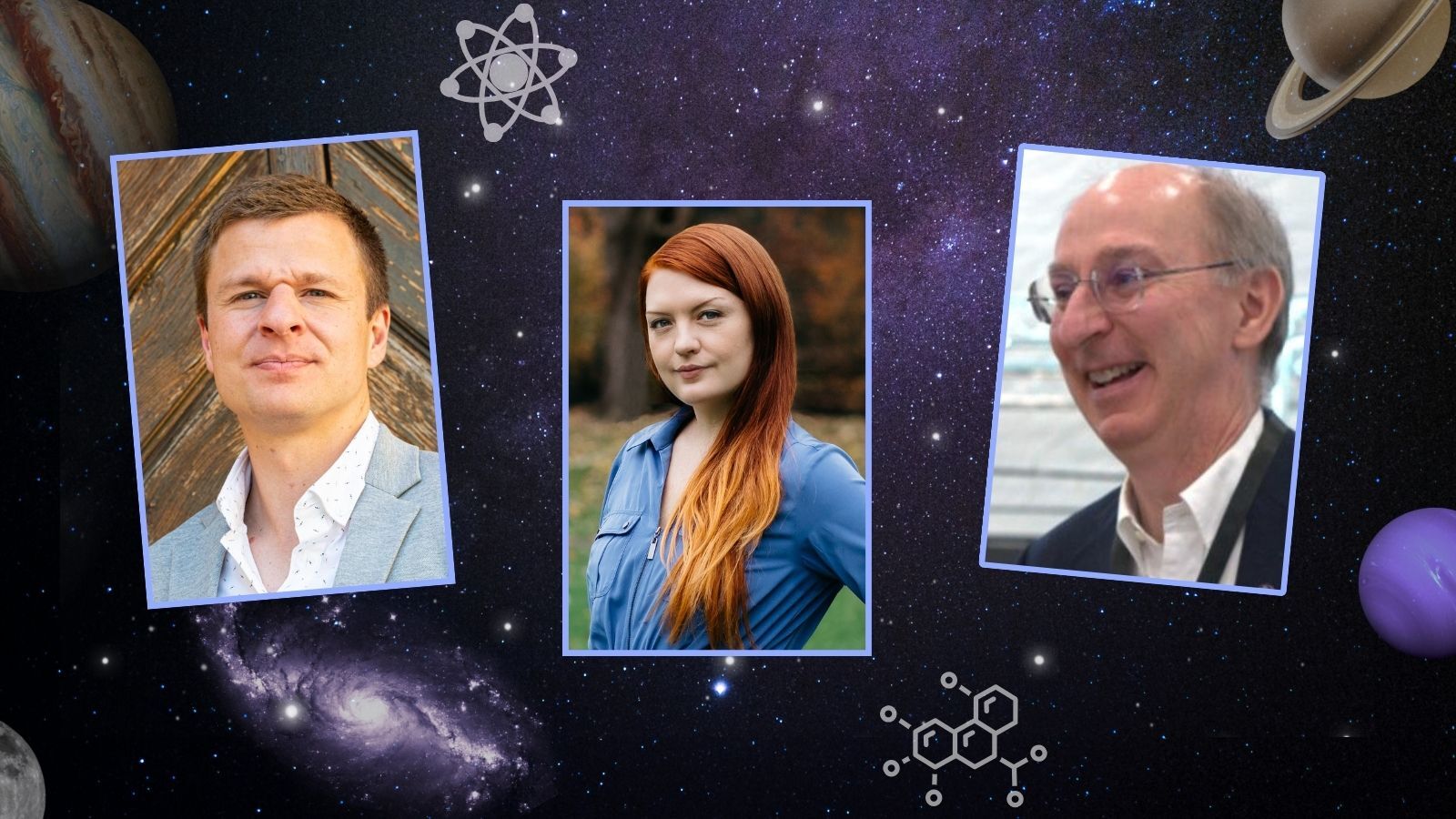
Ever wonder what actual scientists think about science fiction? We had the same question. So, for this edition of Bookstr’s In Conversation, we’re talking to experts in different fields of science about how their work influences their storytelling. Read on for an insightful dialogue where they tackle the differences between academic writing and fiction writing, as well as how sci-fi (and Star Trek) inspired them to pursue science.
The Authors
Anthony J. Melchiorri

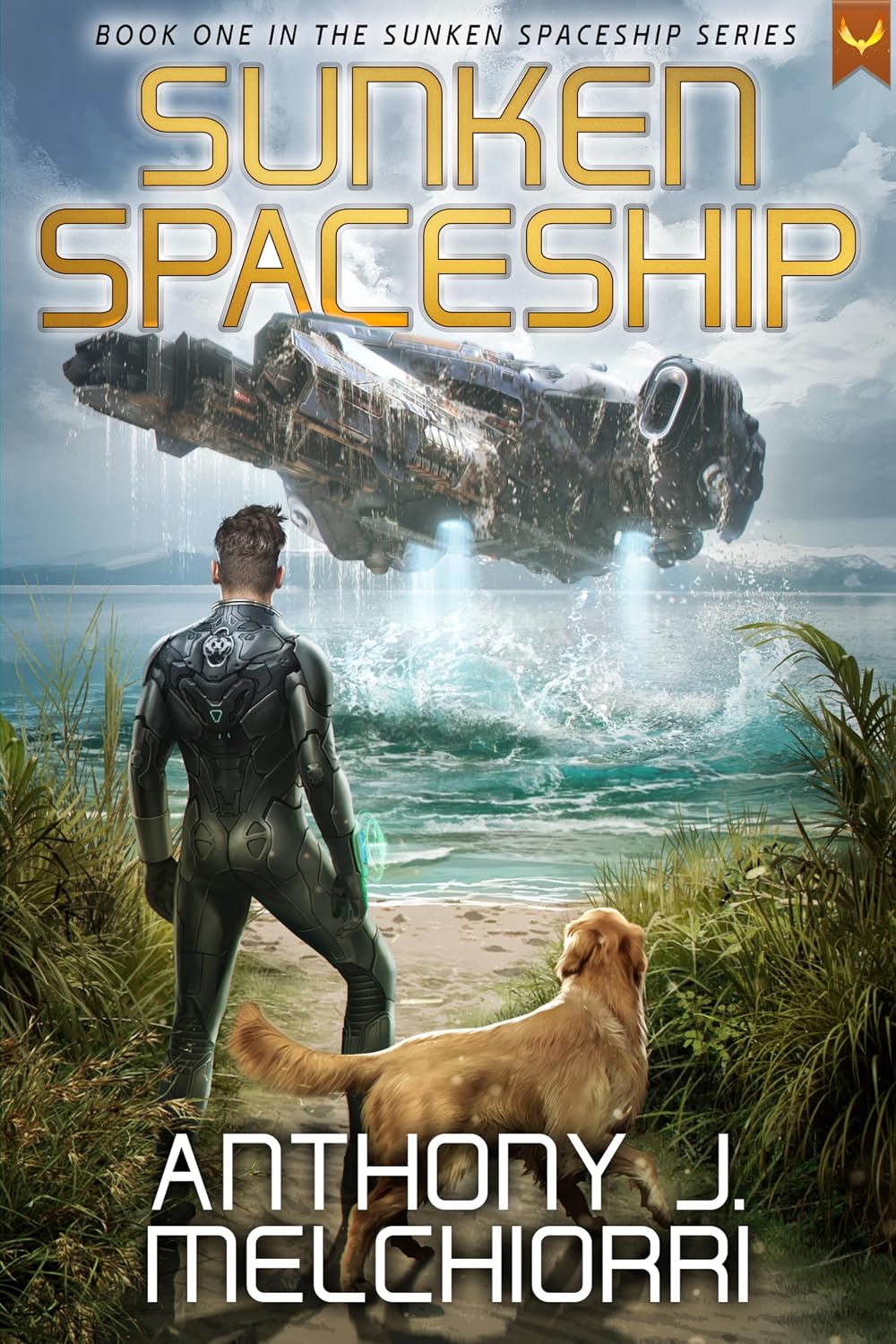
Anthony J. Melchiorri is a bioengineer, world traveler, and writer. He’s authored series like The Tide, Black Market DNA, Deadmen’s War, and the Sunken Spaceship novels. His books are inspired by both his travels and his work as a scientist. Melchiorri has a BA in English from the University of Iowa, a BSE in Biomedical Engineering, and a PhD in Bioengineering from the University of Maryland. He specializes in 3D printing artificial organs and has innovated devices to extract bone samples from patients and cellular therapies to help heal wounds.
Emily Suvada
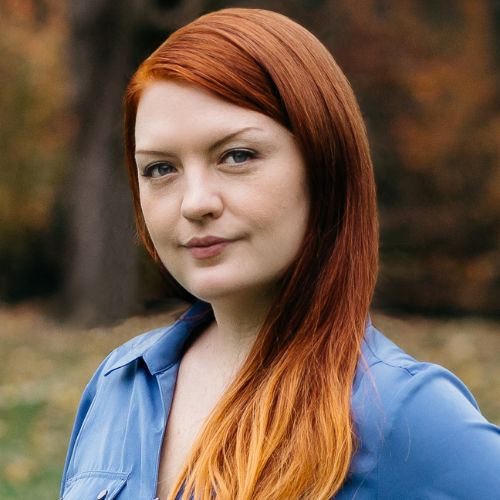
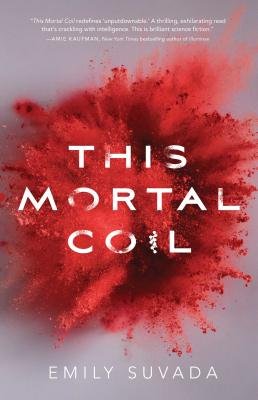
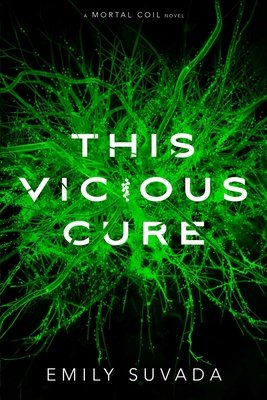
Emily Suvada is an award-winning Australian author and data scientist. The first book in her sci-fi thriller Mortal Coil series earned her an Oregon Spirit Book Award and was shortlisted for an Aurealis Award, the Waterstones Children’s Book Prize, and the Readings Young Adult Book Prize. Before becoming an author, she studied math and astrophysics and worked in finance. Suvada is also a diehard Star Trek fan and is interested in AI, nanotech, virtual worlds, space travel, and genetic engineering.
Les Johnson
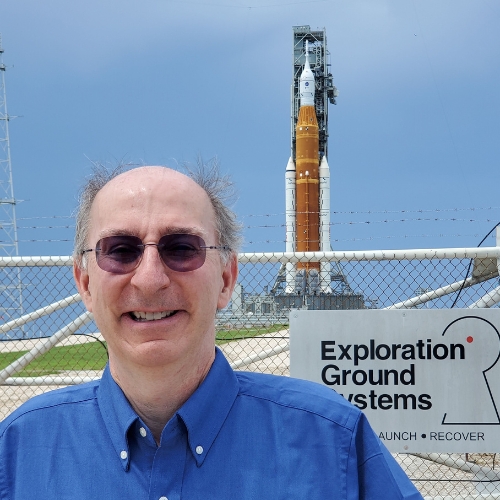
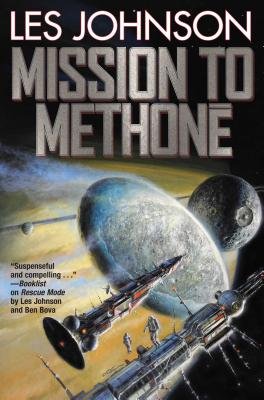
Les Johnson is a physicist, NASA technologist, and the award-winning author of several popular science and sci-fi books. Some of his fiction work includes Mission to Methonē, The Spacetime War, Saving Proxima, and its sequel, Crisis at Proxima. Aside from his writing endeavors, Johnson is the Chief Technologist for the NASA Marshall Space Flight Center in Huntsville, Alabama. He’s also the Program Chair of the Interstellar Research Group and is a member of numerous organizations, including the International Academy of Astronautics, the British Interplanetary Society, the Science Fiction and Fantasy Writers of America, and MENSA. Additionally, Johnson was a technical consultant for sci-fi projects like Europa Report, Lost in Space, and Solis.
The Questions
How does your approach to storytelling differ when crafting a rigorous academic paper versus a speculative work of science fiction?
Anthony J. Melchiorri: In both formats, the ultimate goal is to convey some tantalizing information to the reader. Maybe it’s the latest biomaterial developed to 3D print cardiovascular implants (my old PhD topic) or a hero’s journey after he discovers a sunken spaceship off the coast of South Africa (my current book series, Sunken Spaceship). Besides all the technical mumbo-jumbo and the differences between entertainment versus education, I think the biggest difference is where we begin the storytelling.
Usually, when I’m writing an academic paper, it starts with an expansive scope summarizing the field of research and its importance. You might talk about the prevalence of a disease and how it impacts society at large before delving into the nitty-gritty of a niche process of developing a unique molecule that attaches to the surface of a specific medical device to treat that disease. In science fiction, I like to start with the specifics. We begin with the nitty-gritty of the protagonist and their unique situation before expanding to and exploring a much, much wider world beyond their initial tiny worldview.
Emily Suvada: I think while academic papers and science fiction definitely both require storytelling, the approach is totally different when it comes to execution. A good academic paper will start with a “hook” that draws the reader’s interest but ideally won’t trick or push the reader into thinking a certain way about what’s being presented. Ideally, the facts and data are laid out in a coherent, logical order so that readers will glean the unbiased reality of the “story” as easily and accurately as possible.
Fiction is the opposite! Much of your time as a writer is spent on subterfuge — leading the reader’s attention down winding paths that hint at the truth while pursuing red herrings and diving into things like character backstory, world-building, and moments that generate tension.
If someone is shocked by an academic paper, generally they are shocked by the abstract and then follow the steps through the paper to relieve their disbelief and confirm that the authors have in fact depicted a shocking new facet of reality. A good story will have a strong sense of internal logic, so the reader immediately accepts that both sides of the story act in harmony, but the exciting moment of revelation is the thrill of realizing you’ve been led along a winding, detailed path and been gloriously tricked. Whereas, with a shockingly good academic paper, the “trick” is done at the beginning, and then the author explains how it worked.
Les Johnson: I write in three genres: At work, I am usually writing a very technical paper to document my work or for publication in a journal or conference proceeding. In my personal time, I write popular science nonfiction as well as science fiction. The degree of “storytelling” changes dramatically in each.
For a technical paper, I need to be clear, concise, thorough, referenceable, mathematical, and somewhat impersonal. For a popular science book, I write imagining that I am speaking with my non-technical friends, trying to explain things in terms they might understand, almost always leaving out the math. For science fiction, the science should be the setting or in the background, with the characters and the plot being primary. When something scientific is explained, it must be at the same level as the popular science book but included in the flow of the story — by one character explaining something to another or in a verbal exchange between characters as they are troubleshooting a problem looking for possible solutions.
In what ways do your real-world experiences inform the imaginative universes you construct for your science fiction?
Anthony J. Melchiorri: To start, being involved in research, it’s impossible not to dream about the future. When I wasn’t working at the lab bench, I was talking to other researchers about how we saw the shape of our field progressing over the next decades. We talked about cool new technologies and esoteric papers that documented new discoveries that hadn’t yet hit the public.
I worked for a long time in tissue engineering, which focuses on new ways to develop living organs and tissues out of cells, biomaterials, and chemical components. It’s impossible not to be inspired by such futuristic technology, so I think these constant conversations and dreams just naturally happen when you’re involved in research. Those kinds of technologies led to my Black Market DNA universe and even some of the synthetic biology aspects of my Deadmen’s War series, where bioengineering meets huge mechs.
But besides aspects of inspirational tech and scientific development, you also meet a lot of interesting characters in the field. From blunt patent lawyers to boisterous salespeople to overly confident entrepreneurial types and all types of doctors, my career in research introduced me to them all. I found ample inspiration for more than a handful of characters from my varied science-related jobs.
Emily Suvada: I think my real-world experiences often inform the smaller moments in my stories more than the larger ones. With sci-fi, it’s important to keep the story grounded with small, human moments set among the big speculative set pieces.
It’s much more engaging to have a character who is trying to outrun aliens in her little ship and keeps burning her tongue on the too-hot coffee from her food replicator than it is to have someone who doesn’t appear to live in a way that’s recognizable to us. So when your character is doing things that are impossible in today’s world or living in a society that’s unrecognizable, it’s crucial that there are ordinary, human moments they share with the reader, and the best way to find them is in your own life.
Dealing with children, with pets, with infuriating parents, with shady people and forgetful people, and with technology that breaks down at the worst moment. Little moments of kindness from unexpected places that leave you humbled. All of these are universal and will keep your story real, engaging, and true.
Les Johnson: I was at work in a “risk management” meeting at which the engineers were free to toss out ideas describing everything that could possibly go wrong with our planned deep space asteroid rendezvous mission. Our lead astrodynamicist, the person who determines the trajectory, or path, the spacecraft will fly in space, said something like, “Ya’ know, there is a small chance the asteroid we want to visit isn’t an asteroid at all.” When we asked him to explain, he said, “We will soon have new radar data to know for sure, but there is about a 5% chance this ‘asteroid’ is actually an old Saturn 5 rocket booster orbiting the sun [placed there during the NASA Apollo Program in the 1960s].”
We all then laughed, and someone said, “I can see it now. We launch this mission, fly through space for two years to the asteroid, and then see one of our rockets with ‘USA’ written on the side!” (We later learned that it was not an old rocket booster but was, in fact, an asteroid.)
At that point, my mind wandered. What if we launched this mission, flew two years to the asteroid, and then saw that it was an old spacecraft, but it wasn’t one of our own, and it looked like it had been there for thousands of years? Mission to Methonē was born that night!
Are there any cutting-edge scientific discoveries that have sparked your interest and influenced your recent creative projects? If so, how have you incorporated these elements into your work?
Anthony J. Melchiorri: Like I mentioned, tissue engineering and genetic engineering played a major role in my Black Market DNA universe. In my Tide universe, I created zombies out of nanobacteria (very questionable science, but fun for fiction) and added some more realistic genetic engineering approaches. In fact, in that series, I took bits of biocomputational modeling (using computer simulations to predict molecular interactions, specifically) and developments in biomaterials (what kind of polymers can you apply to your clothes to prevent burns from a zombie that spits acid thanks to the hyperproduction of hydrochloric acid from its GI tract?).
Pretty much every one of my books involves some recent scientific development, and many of them are related to bioengineering. I think about the problems that might be caused by the misuse of these technologies and then the scientific approach my characters might use to solve those problems when incorporating them into my work.
Emily Suvada: All my work has been inspired by cutting-edge science! Back when GPT-2 came out, I began seriously thinking about stories involving AI, though they’ve been harder to work on lately because the field is going through a period of intense acceleration. And with my Mortal Coil series, I was heavily influenced by the growth in technology surrounding genetic editing and using genetics as a tool — the kind of thing we saw with mRNA vaccines, for instance.
Lately, I’ve been watching AI developments closely, but I’ve also been really captivated by advancements in materials science, robotics, and brain-machine interface technology. I’m not sure exactly where these ideas will lead, but they’re very exciting and ripe with possibility for science fiction stories!
Les Johnson: When Andre Geim and Kostya Novoselov won the Nobel Prize in 2010 for their work characterizing graphene — a form of carbon where the atoms are bonded together in a flat plane, one atom layer thick, to become one of the strongest materials ever found (300 times stronger than steel by weight) — it changed my technical and creative worlds. This material, if it can be made in mass quantities and in the right shape or form, could be used to build extremely large, lightweight structures such as space elevators, interstellar-capable solar and laser sails, virtually indestructible body armor for soldiers, and more.
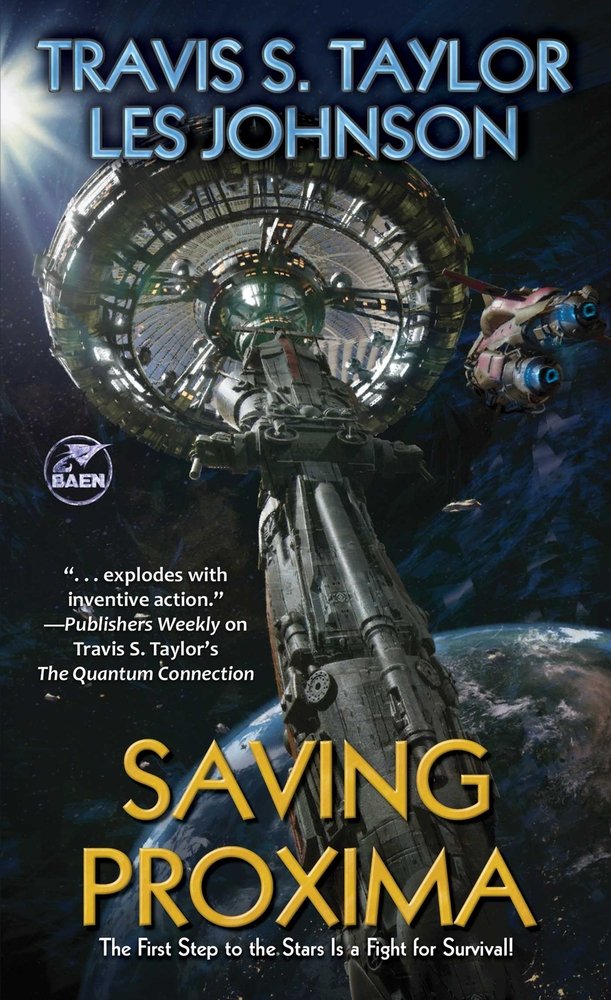
I learned so much about the material that Joe Meany and I wrote a popular nonfiction science book about it (Graphene: The Superstrong, Superthin, and Superversatile Material That Will Revolutionize the World), and I then included it in Saving Proxima, one of my science fiction novels authored with Travis Taylor.
What strategies do you employ to make complex scientific concepts accessible to a general audience without sacrificing accuracy?
Anthony J. Melchiorri: I know I’ve been throwing some jargon into these answers, but I try to sandwich any complex topics in my books with a very generic explanation and maybe a metaphor to help make it easier to understand. The thing is, while I’ve got some smart science-oriented characters, there are plenty of other characters that need to know how some scientific concept or piece of technology works to solve whatever problem they’re presented with. So, without disrupting the narrative as much as possible, I might have a scientist and an officer in the military discussing the technology:
Scientist: ‘We’re developing a targeted drug delivery system to help anyone infected with the zombie virus.’
Officer: ‘How’s that going to work?’
Scientist: ‘Basically, there are proteins on the outside of the infected cells within an infected patient. We bound antibodies to microscopic drug capsules. Those antibodies target the proteins on the infected cell. When the antibodies and proteins attach, the drug capsules are ingested by the infected cell. It should wipe out any and all infected cells.’
Officer: ‘You’re homing in on zombie cells, then? Just like a missile guidance system targeting a terrorist stronghold?’
Now, that passage is clunky and stilted, but hopefully, it hints at how this might work.

Emily Suvada: My US editor on This Mortal Coil, Sarah McCabe, gave me a piece of advice on an early draft, which totally transformed my writing. I had a line about some piece of technology that was based on real-world science, and it was a little hard to parse for people who didn’t have a firm grasp of the underlying technology. There are a lot of lines like that in “hard” science fiction books. Sometimes they’ll go into detail explaining things like motors and chemistry, and sometimes they’ll throw in these little asides to thrill the sciencey readers — and I’d thrown in some of them myself, because I’m a sciencey reader, and I found them thrilling.
But Sarah basically asked, “Do you want readers to understand this or not?” And it kind of floored me. Because, well, yikes. Of course I wanted them to understand it. That single line in an edit letter radically changed how I approach writing about technology. I now put a lot of effort into trying to make the concepts easy to understand.
I think the best advice I can give to writers is that your readers DO want to understand — most of them love learning, as all humans do, but it’s hard. So you have to find exciting, novel, fun, and important moments to explain things. Info-dumps and long spiels about how things work are unlikely to sink in. But if a character is about to die, or their world is going to turn upside-down unless they quickly figure out how to do something technical, the reader will work hard to understand it with them! “The protagonist is going to die unless they can fix the brushes on a motor” is going to engage a reader’s mind much better than “The protagonist hummed as he repaired the brushes on a motor.”
Keep it short, keep it to the essential details, and keep it exciting and fun!
Les Johnson: This is a difficult one. You must be completely accurate in a technical paper; accurate within reasonable limits, knowing that sometimes it is impossible to generalize all the details, for popular science; accurate in science, but not necessarily in engineering, for science fiction. For the latter, if something is possible according to the laws of physics, it is fair game for science fiction — even if we don’t know yet how to engineer or build it!
For aspiring writers transitioning from science to creative writing, what key advice would you offer to help them navigate this shift and harness their unique perspectives?
Anthony J. Melchiorri: Science writing in an academic setting can be stuffy and formulaic. While there are also some formulas you’ll see from time to time in creative writing, I’d say the biggest shift is learning how to write more casually. There’s no magic to it other than reading a lot of books and developing your non-academic voice.
Now, in science writing, one good thing you’ve probably learned is how to be concise. You don’t waste words with fluff in an academic paper. I think that’s a powerful skill when writing fiction, too. You’re automatically tuned to trimming the unnecessary verbiage, so your work might be punchier off the bat. Of course, all those experiences thinking about big-picture “what-if” ideas in science and technology can help inspire some creative, interesting, and unique plots.
Emily Suvada: The most important thing to do is read a lot of fiction. And bring your analytical mind to your reading. Just as you had to learn the conventions and styles of academic papers — and you probably spent time dissecting them and trying to figure out why some papers were “good” and others “bad” — do the same thing with books.
If a chapter excites you, go back through it. What was the author doing? What effect did each part of the scene have? What were they literally writing — what was the ratio of dialogue to internal narrative, to description, to action? What kind of pace and flow did the scene have? Did it rise to a peak, etc.? How many characters were in it, and what roles did they play? What role did the setting play?
And now do the same thing for a scene that bored you, and then do this thousands of times, and your analytical brain will figure out the patterns. Mindful reading with an eye to patterns is by far the most useful tool in becoming a writer.
Les Johnson: Writing fiction is difficult. I recommend you read Stephen King’s On Writing, Ben Bova’s Writing Science Fiction that Sells, and the screenplay writing book, Save the Cat. Most of all, you need to stop thinking of the scientific details and more about the societal and economic implications of whatever field of science or engineering in which you engage.
Do you believe that science fiction can inspire future generations of scientists? Did it play a role in your own decision to pursue a career in science?
Anthony J. Melchiorri: Absolutely, science fiction can inspire future generations of scientists. I think the raw power of technological advancement presented in many forward-thinking sci-fi books can be quite attractive. I also think science fiction teaches us to be better scientists. In sci-fi, you spend more time exploring moral quandaries, social issues, and that age-old question of “just because we can, should we?”. The actual process of doing science — working hours at a lab bench moving tiny droplets of liquid from one itty bitty plastic vial or dish to another, for instance — is not always that exciting. But science fiction can help us keep our eye on the prize as we dream about what could be.
Personally, science fiction helped stretch my mind when I was young. Seeing the world as what it could be instead of merely what it was helped inspire me to seek out a career where I could play some small part in molding the future. Of course, I also liked the idea that technology could be used to help people live better lives and was attracted to those kinds of stories. Biomedical engineering was a natural fit.
Emily Suvada: I absolutely believe that science fiction has the power to inspire future scientists! Sci-fi often acts as the bridge between imagination and reality — between what we can dream of and what we actually see and create in the world. Sci-fi is a great way to inspire people to ask questions about the world and the future of technology — what can we do, and how could it be done? What would the world look like with this technology in it?
Many of today’s scientific achievements first appeared in sci-fi novels or sci-fi films. Whether those ideas came directly from the minds of writers or those writers glimpsed ideas in moonshot or bleeding-edge research, I’m not sure — I’d guess it’s a complicated circle where science feeds fiction and fiction feeds science.
In my own journey, science fiction played a significant role in my interest and decision to study science. As a child, I was obsessed with sci-fi, from Star Trek to children’s books of other worlds. These stories portrayed the world as a place of wonder and possibility — of mysteries and doors waiting to be opened. That mindset lies at the heart of science and is the reason I sometimes get frustrated with the push for obviously “STEM” books for kids, which can sometimes be a bit dry and focus on teaching scientific principles. These books are important, of course, but I think the stories where a scientist is wrangling a glowing worm from another planet are equally important — they light the fire in children’s minds and teach them that the universe is an exciting place full of adventure and mystery.
Les Johnson: Yes!!! Star Trek and other science fiction inspired me. At an early age, I decided I wanted to help build an interstellar space drive like those used in Star Trek and Star Wars. If it weren’t for Captains Kirk, Cisco, Picard, and Janeway, then I would likely not have studied physics or worked for NASA.
Many thanks to Anthony J. Melchiorri, Emily Suvada, and Les Johnson for letting us pick their brains. To put a bow on this fascinating conversation, we’ll end on this note about the bridge between science and humanities.
We need more people in the sciences with an understanding of the world and culture around them, its origins, and its limitations in order to contextualize and explain their science and engineering field to those who are stakeholders.
Les Johnson
Find Anthony J. Melchiorri here.
Find Emily Suvada here.
Find Les Johnson here.
Find out what your next science fiction read should be by taking our quiz!
There’s far more riveting sci-fi to explore, so stop by our science fiction bookshelf on Bookshop.org for your next intergalactic or dystopian venture.
