
















The award-winning author, Arundhati Roy, has amazed the world since the beginning of her writing career with her books, speeches, essays, and more. Her works are usually political, and she writes with strong, unrelenting prose to expose problems she sees with the world, cultural problems, injustice, etc. She is openly critical about problems others shy away from, and she isn’t afraid to start difficult conversations. Choosing only six of her works was challenging, but I did my best!
The God of Small Things
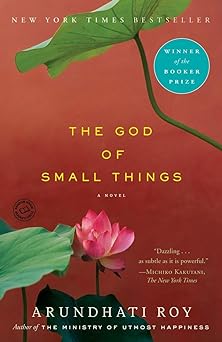
Roy’s most famous novel is a mix of a family story, forbidden love, and politics. The lives of twins Rahel and Estha are forever changed on a fateful day in India in 1969 with the arrival of their American cousin, Sophie. This starts a chain of events that leads to tragedies — both accidental and intentional — that lead to unveiling secrets in a country on the brink of unrest. Told in a disjointed narrative during the years 1969 and 1993, this novel shows how small occurrences and coincidences stack over time.
The Ministry of Utmost Happiness
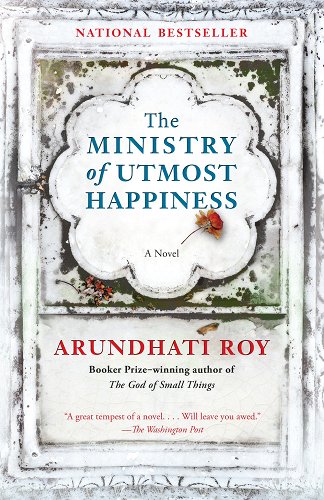
The story is told over many years, from places like the confined neighborhoods of New Delhi to large cities, from mountains to forests, where “war is peace and peace is war.” There are many characters, such as Anjum — previously Aftab — in her home of a city graveyard. We meet Tilo and the ones who have loved her, including Musa, whose fate is intertwined with hers. There is an intelligence officer in Kabul. We meet two Miss Jebeens, one who was buried in an overcrowded cemetery, the other abandoned on a sidewalk. It is a story about humanity, about people who have been broken and patched up.
My Seditious Heart: Collected Nonfiction
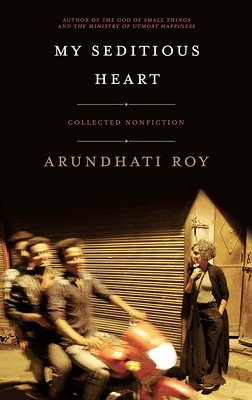
This contains two decades of Roy’s political essays, including The End of Imagination and My Seditious Heart. They are about justice, human rights, and freedom in a hostile, unequal world. Combined, they create a strong voice of compassion, clarity, courage, and spirit. The collection is radical and easy to read, and the essays defend people and their land despite the social, religious, governmental, and military elites standing in the way. The essays work with the themes of her novels and form a memoir of Roy’s personal life and her journey as a citizen of both India and the world.
Azadi: Freedom. Fascism. Fiction.
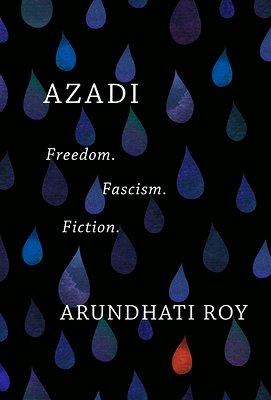
“Azadi” is the Urdu word for “freedom” and is the slogan used by Kashmiris in their freedom struggle against the Indian Occupation. It’s also — ironically — used in Indian streets against the Hindu Nationalism project. As Roy started exploring what was between these calls, if they were connected or not, coronavirus brought the world to a halt. The pandemic brought a horrible understanding of freedom as populations were arrested and international borders became messy. Roy asks us to think about freedom in a world slowly consumed by authoritarianism and how the pandemic, while devastating, gave us a chance to imagine a different world.
The Cost of Living
Roy passionately accuses big government’s disregard for the individual. Roy uses the compassionate but relentless voice from The God of Small Things, where she focuses on a single family, to write about India’s future. In her lively, strong criticism, she addresses two illusions of India’s progress: the dam projects that were intended to bring India to modernity but displaced millions and India’s first nuclear bomb. Roy combines her incredible voice with moral outrage and imagination to tear the mask of democracy down and show the consequences of what was happening, how the majority were sacrificed for the few.
An Ordinary Person’s Guide to Empire
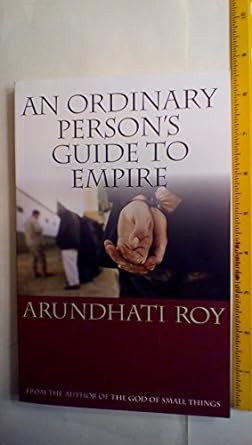
Published in 2004, Roy offers a clear briefing on what “compassionate conservatism” and “war on terror” actually meant regarding the Bush administration. In the collection, she tackles the hypocrisy of American democracy while reminding us that the power of the people is the base of democracy. She speaks out against “the apocalyptic apparatus of the American empire” and the U.S. occupation of Iraq. Roy helps us understand the New American Empire, different from Brtish imperialism, Bush’s New World Order, and how resistance movements help the people gain power. She also compares globalization in India, how African Americans are treated, and the destruction of Iraq.
For an article on Arundhati Roy and other South Asian Female authors, click here.