
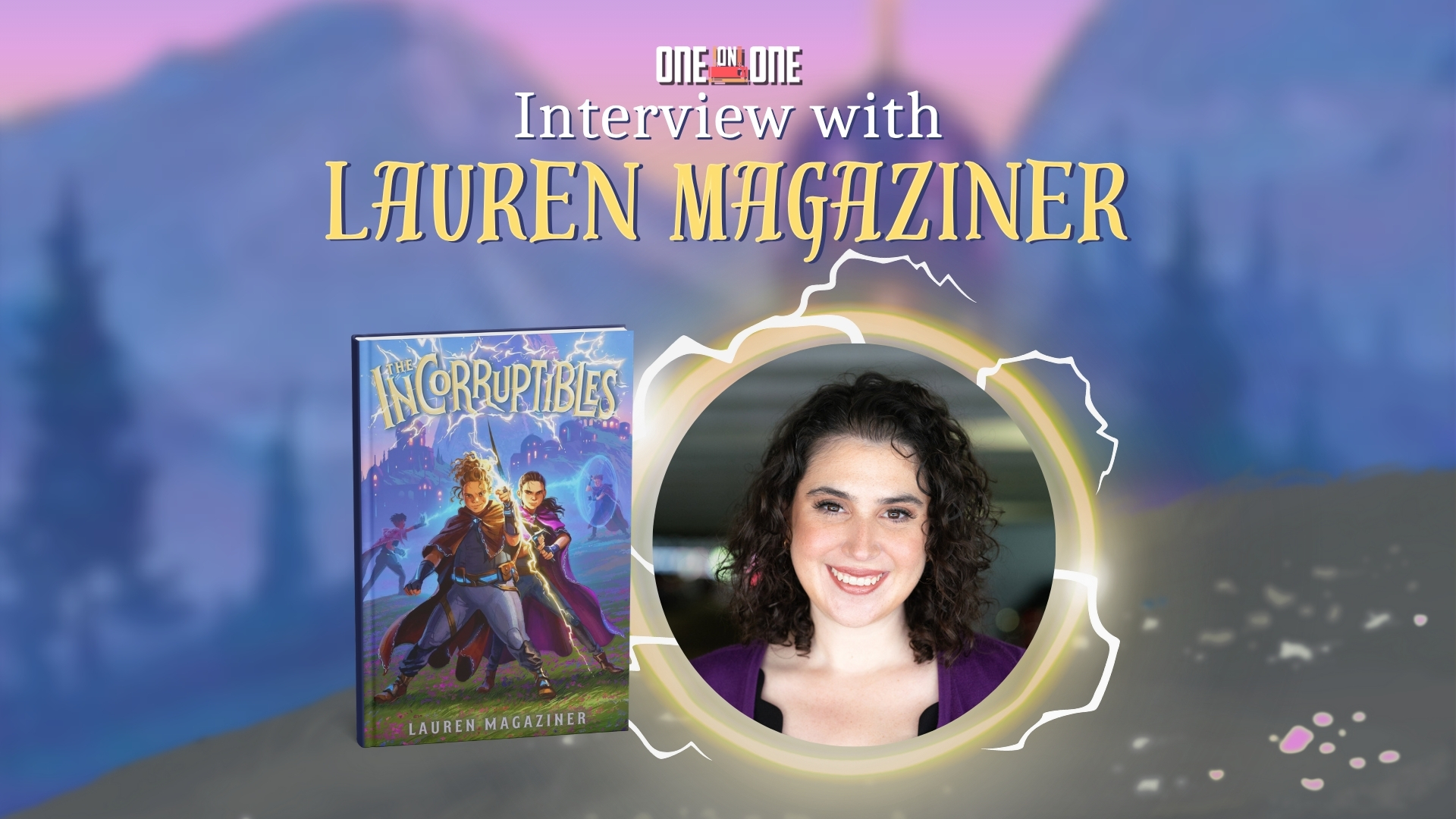
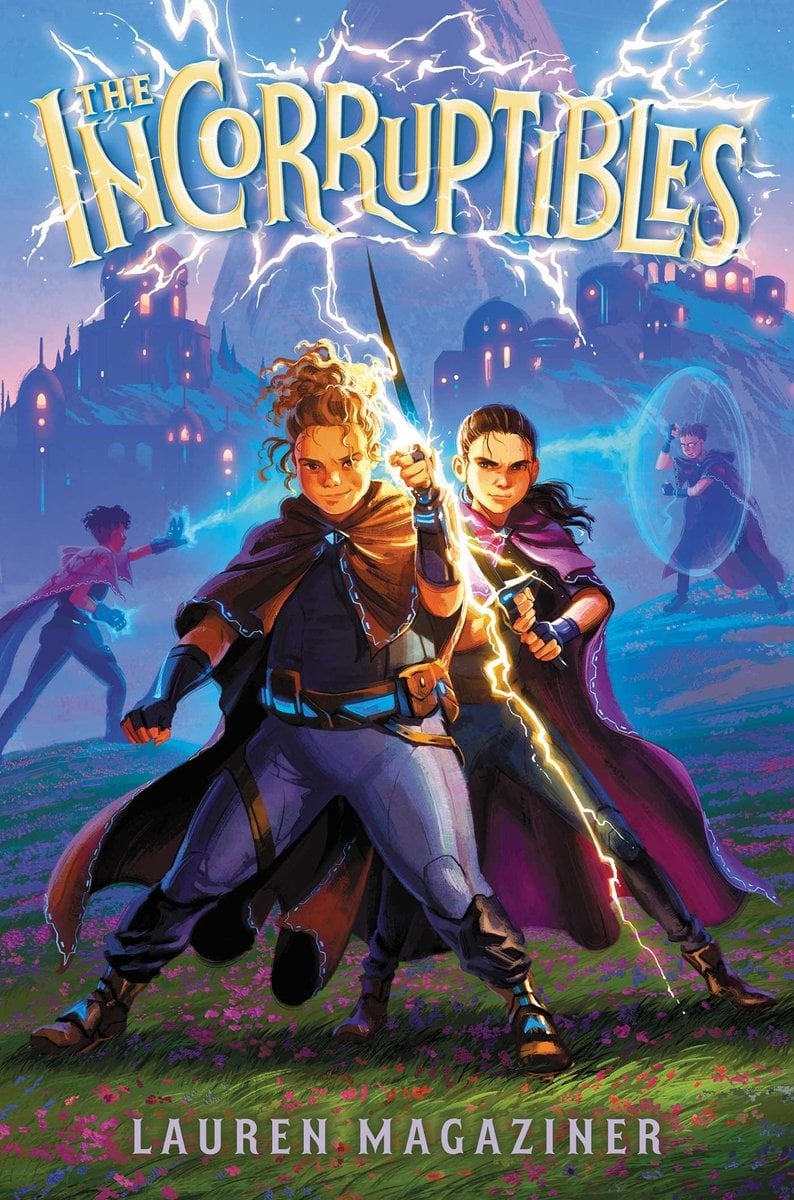
Middle grade novels are at the epicenter of cultivating a lifetime love of literature. They begin exploring a far richer, more intricately described world, relating to the woes of teens even in fantasy settings where the characters look nothing like us, yet still experience all the coming-of-age and life lessons that the teens who read them do. Author Lauren Magaziner is writing rich, world-developing fantasy novels that teens are devouring. We’re sitting down wth her to discuss all things writing and taking a look at her newest venture, The Incorruptibles.
About Lauren Magaziner
Lauren is the internationally bestselling author of the Case Closed series, The Mythics series, the upcoming series The Incorruptibles (June 10, 2025), and three other stand-alone books for middle grade readers. Her books are available in 12 languages, have been Junior Library Guild selections, have been on the Indie Next List, been an Amazon bestseller, earned starred reviews, been on state lists, and have been optioned for a TV movie with Nickelodeon. She has also contributed short stories to Storyworks magazine and a middle grade mystery anthology called Super Puzzletastic Mysteries.

Lauren grew up in New Hope, Pennsylvania. After receiving a B.A. in Creative Writing and Philosophy at Hamilton College, Lauren Magaziner worked on two delightful Scholastic magazines, where many of her coworkers didn’t believe her last name was real. She currently lives in Philadelphia, where she writes full time.
Thanks for joining us. Let’s get started, Lauren.
For readers who may not be familiar with your previous work, what should they know about your usual style or genre, and is your new book The Incorruptibles similar or different to what you’ve created in the past?
The Incorruptibles is different from my past work because it’s written for an older reader. This series is aimed at ages 10-14 (while my other series ranges from ages 6-10 and ages 8-12). Because I was appealing to a more middle school-aged audience, the narrative voice is more mature, witty, and sarcastic. The plotting, world-building, and characterizations are more complex and sophisticated. The themes are a little darker. And — for the first time ever in my career — I write romantic feelings and a character’s death. But what all twelve of my books have in common are the themes of teamwork, friendship, and trying to mold a better, more empathetic world.
Beyond your previous literary experience, what insights or novel concepts did you unearth during this writing process?
This was my first time writing such a big ensemble cast of characters. I have at least 20 characters with major roles to play in the series. But I realized I couldn’t flood readers with 20+ characters the moment Fiora arrives at Inc Academy. That’s too confusing and overwhelming. So this book ended up needing character work on a whole new level!
What I uncovered were strategies on how to make it work! First, I slowly folded different characters in — little by little — over the course of the first third of the book. My biggest revelation was that it was okay if I needed to cue the reader again (the second or even third time we meet someone) until the character is truly woven into the fabric of Fiora’s world. And what also helped was giving each character their own specific, recognizable mannerisms, personality quirks, and physical traits. Emphasizing those helps the reader come to know who they are quickly, like shorthand. Now that I have these insights, I’m ready to write a book with a hundred characters!
When you embark on the journey of world-building, what aspects ignite your excitement, and what are the most significant hurdles you encounter?
I get excited by rules, and that’s usually where I start: How does this world work? What makes the magic tick? What can (and can’t) people do with magic? I get jazzed about the history of the world, too. In The Incorruptibles, we’re not in a fantasy world — we’re in a future decimated version of the United States, like a fantasy dystopia. So I enjoyed asking myself big questions about how we could have gotten to a place where people with power had colonized existing towns and cities, took over money systems, and oppressed people without magic. To me, worldbuilding ties into allegory and philosophy. On the allegorical end, we ask ourselves, in what ways does this world mirror our own? And philosophy, what does this world say about humanity? These two questions, here, fuel my passion most of all!
I get most daunted by the scope. Our world is BIG. Even the most informed, studied person only knows a fraction of history and current events in every single country on Earth. In the first volume of The Incorruptibles, I’ve established that we’re following a resistance group in a region of what was formerly California, Nevada, and Arizona. And I’ve introduced the notion that other sorcerer-resistance groups exist, scattered across the former United States. But I haven’t touched those yet, and I haven’t even breathed a mention of the rest of the world yet. It’s an unfathomably large scale. But that’s a problem for future Lauren.
If you had to pinpoint a favorite phase within the writing process, what would it be, and what makes it so particularly rewarding for you?
I’m obsessed with revisions. My brain treats revisions like I’m tapping into the ultimate jigsaw puzzle. I live for the moment everything starts fitting together, and I can actually see the big picture instead of the individual pieces. I get tummy butterflies when I feel the story start to click. There’s nothing like realizing that (thanks to the help of my agent and editor) the story has gotten so much stronger and better than I ever could’ve imagined it at the outset.
In an era where youth literature holds such profound significance, what deeply compelled you to dedicate your storytelling to younger audiences?
I actually started writing novels for fun when I was a middle grade reader, 13 years old, in 8th grade. I never lost those memories or that part of myself. And it’s such a significant, formative time in everyone’s life: You’re trying to figure out who you are, and you’re trying to figure out your place in the world. Sometimes you feel very young, and sometimes you feel more mature—and you’re starting to understand nuance and complexity. You’re asking big questions and realizing there might not always be answers. And I really wanted to make The Incorruptibles for this middle school age, specifically because I remember so vividly what it’s like to be that age.
It also means a lot to me that I can help foster a lifelong love of literacy. Nothing gives me more purpose than when a kid tells me my book had them riveted, sparked their imagination, or made them think. The books you read as a kid tend to stick with you forever. That’s why it’s so important to help each kid find the book that speaks to them.
You’ve mentioned juggling multiple projects simultaneously. What initially led you to adopt this dynamic method of story development and writing? And what are the most notable advantages and disadvantages you’ve discovered along the way?
Juggling multiple books simultaneously allows me to have a revolving door of projects. The idea is: When I send a manuscript to my agent, I’d hopefully get revisions back from my editor. And vice versa. If I have projects in the hands of my agent, editor, and beta reader all at the same time, then I’m actively drafting a secret book or brainstorming another on deck. Sometimes the timing works out perfectly. But the biggest challenge of this method is when the timing is so not perfect, and I get all the notes back at the same time. (RIP, Lauren. Buried under a mountain of her own work, a self-created problem.)
But I really am so happy with the revolving door method. This way, I’m never just sitting around waiting. I keep my brain busy and the ideas flowing. From the time an author starts drafting to the time a book comes out takes years; for context, I first started The Incorruptibles in 2019, sold it in 2023, and publication is 2025. I’m just too impatient to see a single book all the way through the process before I work on others! I have too many story ideas that I’m excited about… and I love making space for them all.
Recalling your own “aha!” moment with writing in fourth grade, what innovative strategies do you believe are most effective in igniting a passion for both reading and creating stories in young people today?
The only reason I had an “aha!” moment about writing in fourth grade was because I had a teacher who let me break the rules of his Writing Workshops. We were supposed to write a 3-5 page short story every month. But one month, I wasn’t finished, and I wanted to keep working. When Mr. Bloom saw how invested I was in my (super depressing Holocaust) story, he said, “You’re clearly inspired. See where the story takes you!” By the time I turned in the assignment, the story was 30 pages, and I had never been prouder of anything in my life.
If my teacher had said, “Sorry, Lauren, but rules are rules, and the assignment is due, so wrap it up and hand it in,” who knows if I’d even be answering this interview question right now?! My takeaway is that when kids show passion for something, we adults have to adopt the improv method and say, “Yes, and!” Yes, and keep working on that story (even if it’s past due). Yes, and — read the book you’re excited to read (even if it’s not the genre or reading level I’d want you to read). Yes, and your ideas are smart, your artwork is great, and you can be an author or illustrator. Positive encouragement.
There’s also something to be said about keeping reading joyful. Reading logs don’t bring me happy memories. The memories that made me passionate about reading are the times I got to be creative, and the times books were made fun. For example, I smile when I think about a diorama I made for Jeremy Thatcher Dragon Hatcher and the paired diaries I wrote (with fan-fiction style entries) for the two main characters of Lily’s Crossing. I still laugh thinking about my teacher’s hilarious voices as he read aloud from Sideways Stories from Wayside School. I can still recite lines from a James and the Giant Peach play my class put on in elementary school. And I so fondly remember going to the library with my mom and brother. We’d all pick out books, and we’d get ice cream after to reinforce how fun it was to get a treat for the mind and a treat for the tastebuds, all in one perfect day.
Looking back, which books or genres captivated you most during your formative years? How do you see those early literary loves shaping the unique voice and style of your writing today?
In my formative years, I fell head-over-heels for fantasy, science fiction, mystery, and horror. Devoured them all — couldn’t get enough. I think you can see influences from all four of those genres embedded in The Incorruptibles.
Fantasy: This influence is easiest to see, since the book is about sorcerers who abuse their power. I wanted to invert the magical Chosen One trope, so the villains are the sorcerers who feel “chosen” and special, and who use their magic for evil. Also, all the fantasy I read in my life taught me so much about immersive world-building.
Science-fiction: The resistance fighters called Incorruptibles use technology to fight against magic: lightning blasters, wind swords, force-field shields, fire gauntlets, and more. There’s a magic vs. tech undercurrent running through the series. What I love most about speculative fiction is how closely it ties to philosophy. And I love exploring vast, meaningful questions with nuance and uncertainty they deserve. I write to ask questions, not answer them — and that’s something I learned from science fiction.
Mystery: I love fashioning a plot into a mystery structure… In The Incorruptibles, there is a spy at the academy; Fiora is trying to root out who it might be, and there are clues to uncover. Mystery taught me most about good twists: how they must be both surprising yet inevitable.
Horror: Horror taught me most about tension… about how to hold the reader captive and strike at the precise moment for maximum emotional impact.
I don’t think I would have been able to tackle the massively ambitious scope of a story like The Incorruptibles had I not been gobbling up these four genres since the time I was in second grade! Forever grateful that all my years of being a nerdy bookworm paid off.
As we wrap up, could you share your most exciting aspirations and visions for where The Incorruptibles series might venture next?
The last chapter of book 1 will tell you specifically where we’re headed for the next volume. Beware of imminently approaching plot twists, painful reveals, and a betrayal that will shock you. Right now, I’m sitting on several secrets, and I’m super excited to let a few of them loose in book 2.
Thank you, Lauren, for an incredible interview. If you haven’t picked up one of her novels yet, be sure to check them out at your favorite book retailer or grab them from our Bookshop.org shelf here. Be sure to keep up with what’s going on with Lauren on her website and social media platforms: Instagram, Facebook, Bluesky, and Threads.
Looking for more author interviews? Check out Author’s Corner to get the deets on everything from one-on-one to roundtable interviews with our favorite authors.
Grab Lauren’s books from our Middle Grade Fantasy bookshelf on Bookshop.org.